
An article emerged recently from Bloomberg which you can find here which talks about the rising outflows of yuan from China. As you may have heard, China is actually trying to “internationalise” its Yuan, meaning to make it comparable to the currency big boys like the USD, EURO and Yen as an international trading currency. But that is outside the point on which I want to talk about ( shall leave that for another day ).
What I want to talk about is how the current fixed exchange rate regime that China has, operates in a simplistic way. A fixed exchange rate means that the central bank of a country is committed in maintaining the exchange rate ( in this case, People’s Bank of China (“PBOC”) ) with a currency or a basket of currencies. Official stance from the PBOC is that they maintain the currency to a basket of currencies but it is common understanding that China pegs mainly to the USD currency.
In a nutshell, a central bank operates in the impossible trinity condition here with the following 3 conditions
- Fixed Exchange Rate (maintain the exchange rate to another currency)
- Independent Central Bank (can set its own interest rates)
- Free Capital Flows ( capital and money is free to flow in and out without restrictions)
It can only have 2 of the conditions. Meaning, if the central bank has a fixed exchange rate and independent central bank, then it must restrict its capital flows – which is the case for the People’s Bank of China.
How does the PBOC maintain its fixed exchange rate peg? Let’s decompose this to the basics of supply and demand for the Yuan and USD currency.
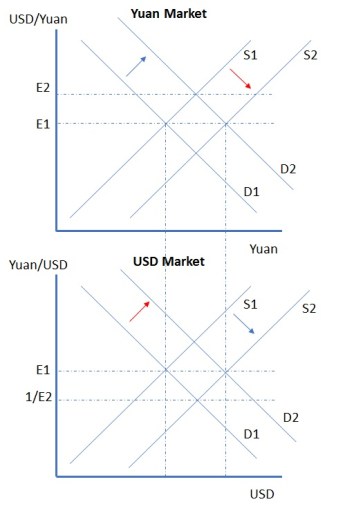
We start with 2 demand and supply curve graph for the yuan and USD. The y-axis is the exchange rate and the x-axis, the quantity of currency. Let’s say ceteris paribus, that the US demands more of China’s products:
- US demands more of China’s products => US demands more of Yuan currency to buy products
Demand of Yuan increase, shifting from D1 to D2, and exchange rate from E1 to E2. An appreciation of the Yuan to the USD. - US needs to provide USD to exchange for Yuan => Supply of USD increase
USD supply shifts from S1 to S2, and exchange rate from E1 to 1/E2. A depreciation of the USD to yuan. - China needs to maintain the Yuan peg to USD which is overvalued now => China prints more Yuan to buy the USD in the market
Supply of Yuan increases, shifting from S1 to S2, exchange rate from E2 to E1. A depreciation of the Yuan to the USD, back to the original peg. - Demand for USD has increased because of the actions of PBOC
Demand for USD increase, shifting from D1 to D2, and exchange rate from 1/E2 to E1. An appreciation of the USD to yuan, back to the original peg.
The impact of this is that the PBOC will be printing more Yuan in the Chinese economy and risk stoking inflation – more Yuan chasing a fixed amount of Chinese products in the short term. What it gets in return is that the PBOC at this point of time will be holding larger and larger amount of USD currency reserves in its balance sheet.
Let’s say now, the opposite happens in that the demand for USD products increase relative to Chinese products. The yuan will be undervalued (depreciated against USD) and the USD overvalued (appreciated against Yuan) at this point. What PBOC has to do now is to buy Yuan in the market with the USD reserves (demand increase for Yuan) to appreciate the Yuan back to the original peg. In order for PBOC to engage in this, it needs to have adequate reserves of USD to buy the necessary Yuan.
The key to maintain a fixed exchange rate is to have adequate amount of foreign reserves to intervene in the local and foreign exchange market. The interesting implication from this is that many countries who maintain some kind of quasi or full peg to the USD, maintain large amount of USD reserves. And they mainly maintain them in the form of US government securities. This has a lot of implications on how US monetary policy is determined or rather how US interest rates are actually determined by other foreign players too and not just the FED. This deserves a post on its own, so stay tune.
Image of Post from http://www.lycheetravel.com/china-travel-guide/china-money.html
 Slice of P.I.E