

Cover Image from “Global Research”
I have to admit, this is not an easy issue to research or talk about. I have been reading a book titled “Political Business in East Asia” edited by Edmund Terence Gomez, and it basically turned my understanding on economic development/growth and corruption upside down, especially true in the Asian countries cases.
Common sense – development/economic growth and corruption is negatively correlated. The less corrupted a country is, the higher the economic growth.
Reality – Most Asian countries especially Japan, China, South Korea, Taiwan, Malaysia, Thailand and Indonesia had high economic growth rates … accompanied by higher levels of corruption from the 1950s to 1990s.
Andrew Wedeman in the book, basically breaks down corruption into 2 types, degenerative and developmental corruption. Degenerative corruption is a form of rent seeking that seeks to plunder or hollow out an economy, where the state or businesses or both excessively extort the economy for their own gains. Developmental corruption however, posits that politicians accept “monetary contributions” or crudely, bribes from businesses to provide a “pro-growth environment”. It’s an arrangement that seeks to connect economic growth to political power, with a cycle of businesses providing bribes to the state, and in return, promises access to state rent while the political party can remain in power.
Gomez put forward the argument that “whereas corruption in other regions has been characterized by “degenerative corruption”, frequently in the form of plunder or non-productive rent-seeking, corruption in East Asia has been characterized “developmental corruption””. So it is not a straightforward relationship between growth and corruption. Wedeman puts it nicely by saying that it is the form of corruption that determines whether an economy grows at a high or low rate. Malaysia actually falls into the developmental corruption form as evidenced by its high rate of growth in the 80s and 90s. And even though most countries in Asia has this form of corruption, they differ quite significantly from each other in terms of the relationship between the state, business and society. I will write about them more extensively next time but let me just put this graph from the book so that my readers can understand what is the plausible relationship between growth and corruption.
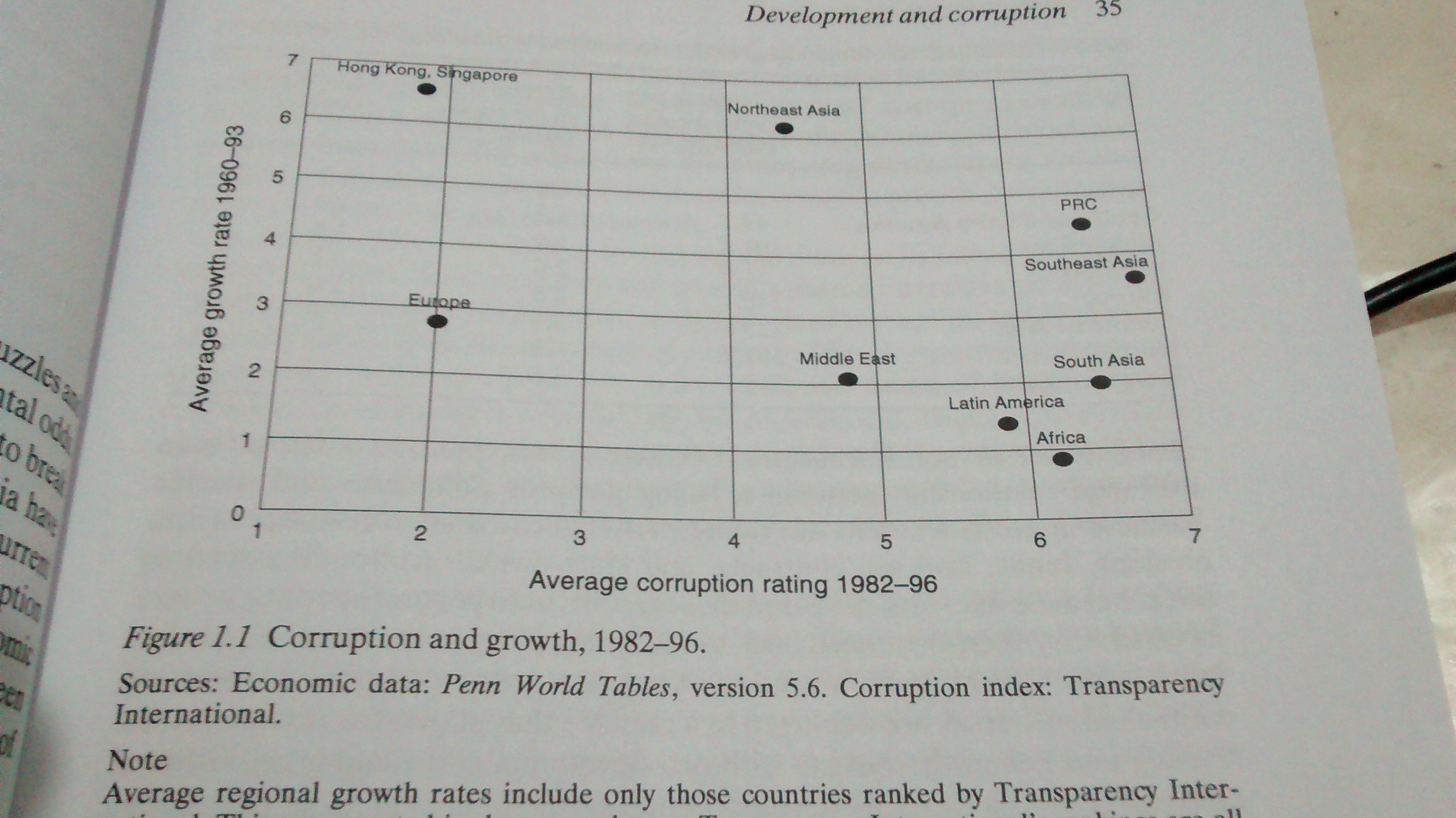
Graph from “Political Business in East Asia” pg 35, by Edmund Terence Gomez
 Slice of P.I.E