

I have recently gain some interest in the Purchasing Manager Index from reading this article here from the Star on the Nikkei Malaysian Purchasing Manager Index. I don’t really know much about this index other than just occasionally reading it on the news that an above 50 indicates an expansion and below 50 indicates contraction in industrial production. So what is the Purchasing Manager Index and how should the ordinary folk on the street look at this metric?
A brief history on PMI. There are 2 main PMIs in the world, the PMI produced by Institute for Supply Management based in the US for the US and the PMIs produced by the Markit Group (heavily based on the ISM PMI) for about 30 countries in the world. ISM started its PMI coverage way back in 1948 and are currently publishing 5 separate indexes for New Orders, Production, Employment, Supplier Delivery, Inventory, Price and Customer Inventory for a total of 18 manufacturing industry in the US ( Source here )
Investopedia defines the PMI as the “indicator of the economic health of the manufacturing sector. The PMI is based on five major indicators: new orders, inventory levels, production, supplier deliveries and the employment environment.” How these are gathered is through monthly surveys sent to purchasing executives of top producers in the manufacturing sector. Executives will then reply with answer of improvement, same, or deterioration. The percentage of respondents with improvement, no change and deterioation answers would then be fed to a diffusion index as follows ( Source: Markit from Wikipedia )
PMI = 100* ( (P1*1) + (P2*0.5) + (P3*0)), where
P1 = Percentage of Improvement
P2 = Percentage of No Change
P3 = Percentage of Deterioration
How do we make sense of this equation? If P1 = 100%, P2 = 0%, P3 = 0%, PMI will be 100. If P2 = 100%, PMI will be 50 and if P3 = 100%, PMI will be 0.
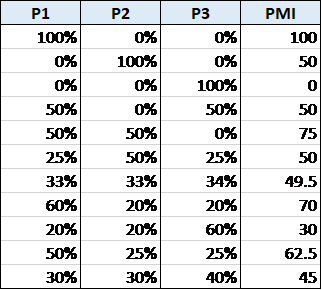
An index of 50 indicates no change according to the opinions of the executives, an index of more than 50 indicates an expansion of the manufacturing sector and an index of less than 50 indicates a contraction.
First things first, the purchasing manager index reflects the opinions of the purchasing managers on the manufacturing industry. The thinking behind this is that purchasing managers would have a better grasp and feel on the demand and supply of the manufacturing industry, but it is also inherently reliant on the “emotions” of the managers involved. How I will use this metric is to compare the index to the production volumes and inventory levels reported by manufacturing companies and its clients in their quarterly and annual reports. as PMI is a broad based metric, it will be interesting to investigate the relationship of the production and sales number reported by companies to the index to see if there is a strong correlation or not. If indeed there is one, I can use PMI numbers to project the production numbers of a specific company.
Post Picture from WWT
 Slice of P.I.E