

Disclaimer: The article represents mine and my view/opinion alone and does not represent any other companies’ or the company I am working. This is an independent project for informational/research purposes and I do not have any trading position in the company below.
Hi guys, its been a while since I did a research on any companies. One of the things I want to update about the content of my blog is that I have recently started working for the central bank so there are potential conflict of interest landmines all over. I have decided not to conduct any macro or market research of the companies (construction, manufacturing etc) as it puts me in a precarious position. I will also not publish any research on monetary policies in Malaysia but I can talk about overseas countries economic issues. I am unsure yet on how the central bank treats these type of articles on a personal level so we have to see how it goes.
Executive Summary
Suggested call of BUY with target price of RM3.52 at a P/E of 19.58. This call is bullish as compared to analysts with an average TP of RM2.52. If you are looking for a SP Setia like company but can’t afford its high valuations, IOI Properties is a good alternative.
Reasons for calls
- Huge upside potential in large projects such as IOI Putrajaya (RM19.5bn), Bandar Puteri Puchong (RM15.8bn), Bandar Putra Kulai (RM9.1bn), Cape Royale (RM5.0bn)
- Strong margins in EBITDA and Net Income (38% and 33% compared to peers at 33% and 24%)
- Decent revenue growth (CAGR of 37% compared to peers at 35%)
- Largest property development company in Malaysia by market by market cap and Net PPE
- Relatively cheap to buy at P/E of 10 to 11
- Downside in cash flow collection ( low net op cash flow to net income and EBITDA) and short term risk in debt position. Leverage has increased from 22% to 41% in one year. Short term debt accounts for close to 61% of total debt.
Background
IOI Properties Group Berhad (“IOIPG”) has 3 main businesses, chiefly Property Development, Property Investment, and Leisure and Hospitality. IOIPG is the property arm of IOI Group, which was listed on 15 Jan 2014, with IOI Group also involved in the oil palm plantation business. One of the strengths of IOIPG is that its holding company, IOIG also has oil plantation businesses with large landbanks and potential for more property development potential.
The Property Development ara m is mainly involved in the township development in areas like Klang Valley, Penang, Southern Johor, Singapore and China. Notable overseas project include Seascape, Cape Royale in Sentosa and IOI Park Bay and IOI Palm City in Xiamen, China.
IOI’s Property Investment’s portfolio consist mainly of retail and office space with key investment properties of IOI Malls in Putrajaya, Puchong, and Kulai, Johor Bahru. Its Leisure and Hospitality arm owns and manages hotels, shopping malls, golf courses and office blocks with notable assets in Putrajaya Marriott Hotel & Spa, Palm Garden Hotel and Palm Villa Golf & Country Resort.
IOIPG’s vision according to its annual report 2016 is “to be a leading corporation in our core businesses by providing products and services of superior values and by sustaining consistent long-term growth in volume and profitability” which gives an idea that IOIPG is focused on its core businesses of property development and investment with a focus on scale (volume) and margin retention. This means IOI is more focused on the conventional property type businesses and applies conservative costing for its projects to maintain margins and profitability.
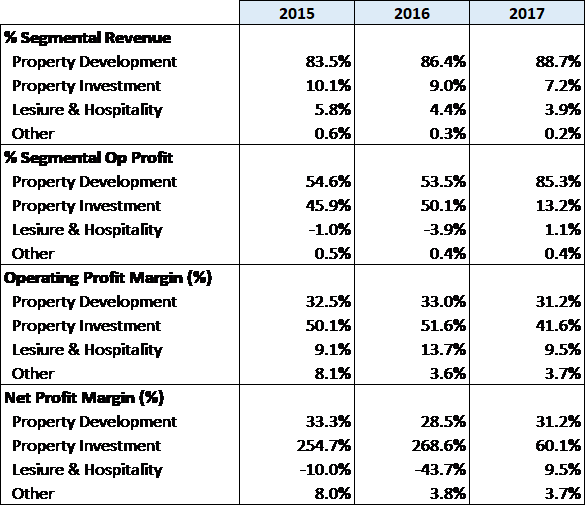
Property Development is IOI’s biggest revenue contributor at 84-88%, with Property Investment at 7-10% and Leisure & Hospitality at 4-6%. In terms of operating profit margins, Property Investment is highest at 50%, with Property Development at 33% and Leisure and Hospitality at 13%. IOI’s profit is mainly derived from its 2 arms of Property Development and Investment, at 53.5% and 50.1% contribution to profit respectively. At this point, readers would be wondering why property investment’s profit contribution is so high given that its revenue contribution is only at 9-10% for years 2015-2016. It is because it records fair value gain from disposal of its properties and share of results from its joint ventures at the bottom end of its Profit & Loss statement, and these 2 items make up a big chunk of the segment’s profit. (Please refer to tab “Segmental” for more details)
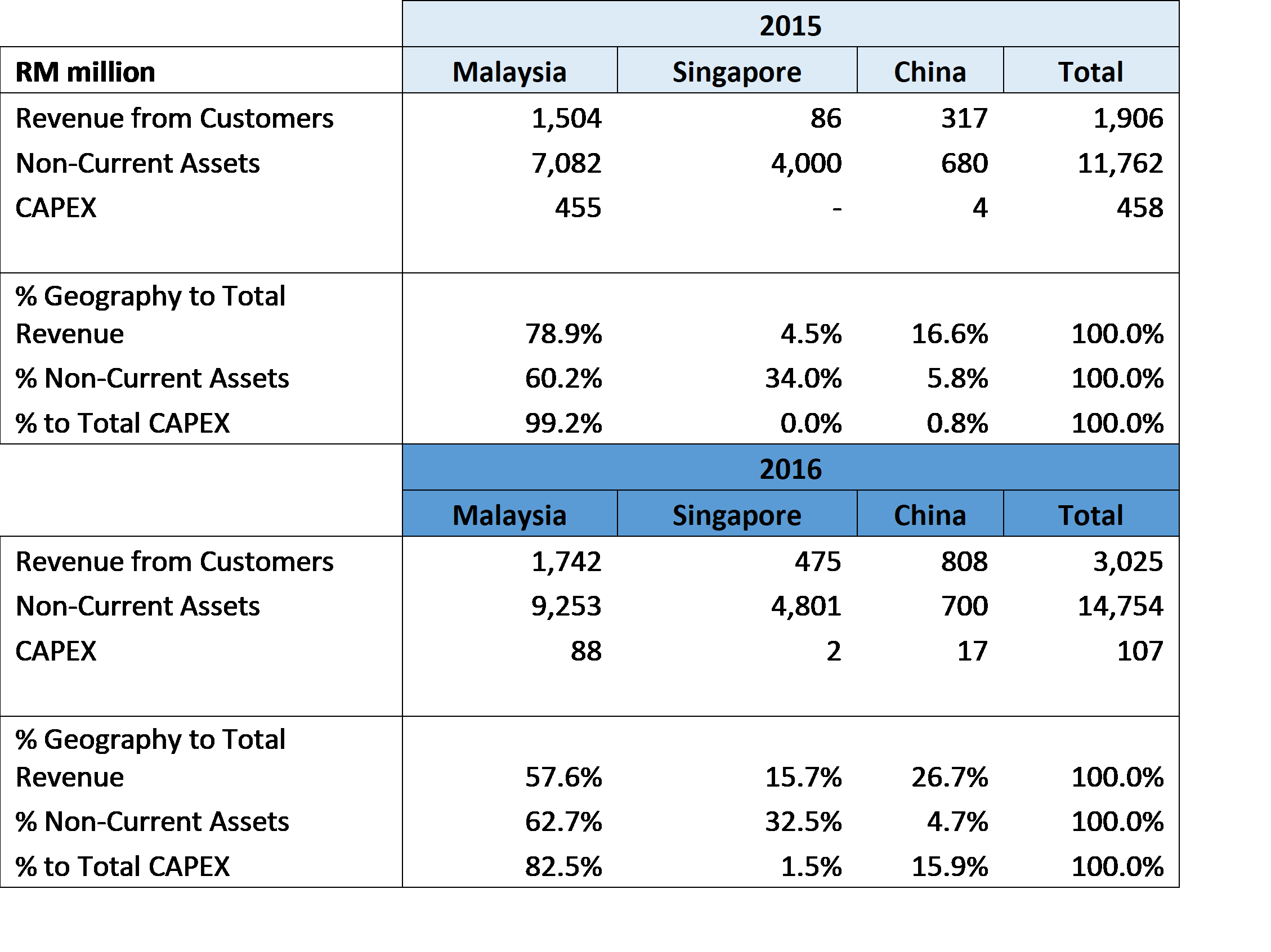
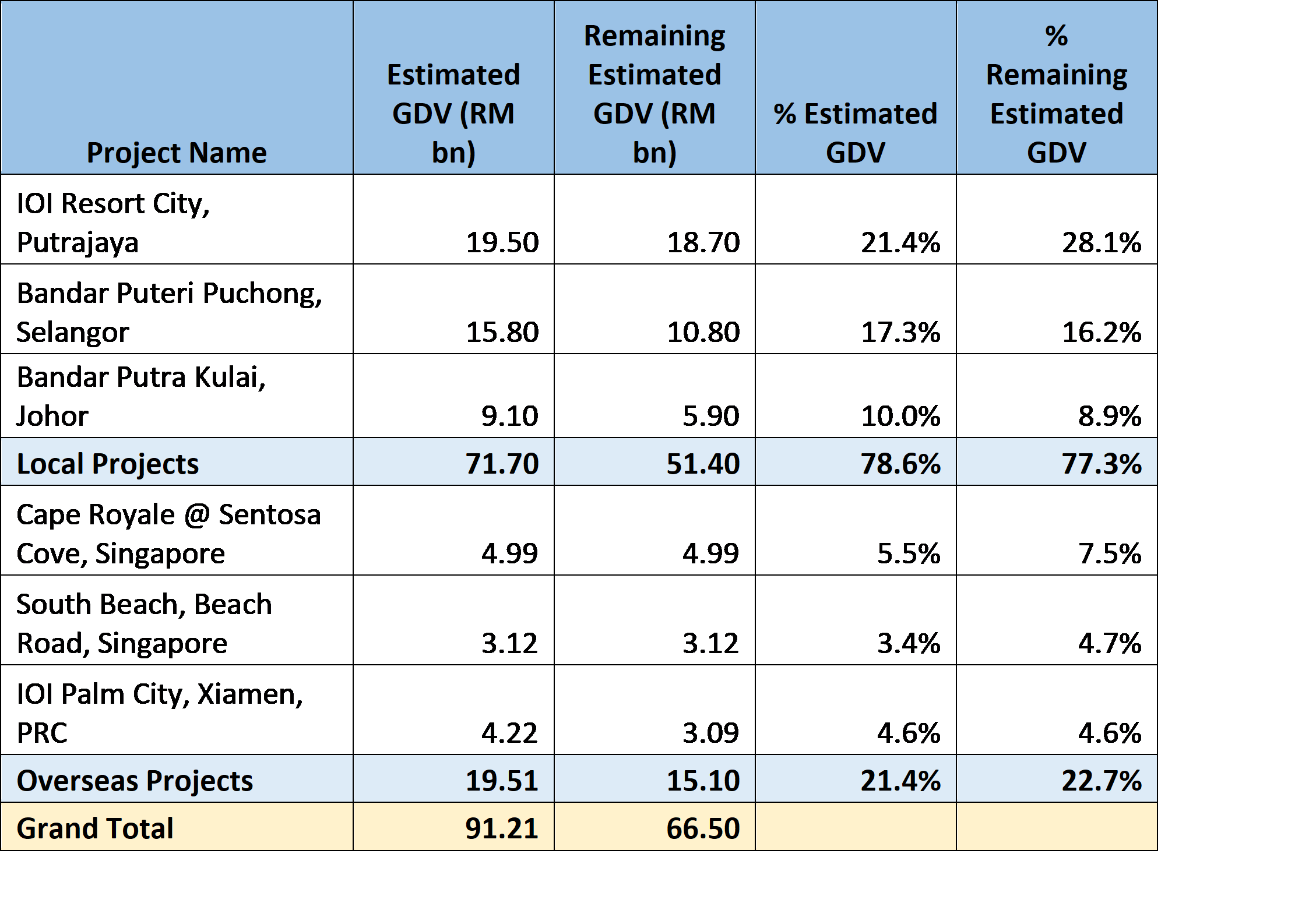
IOI’s 2016 revenue is mainly derived from Malaysia (57.6%), Singapore (15.7%) and China (26.7%) with an increased focus on its overseas operations from 2015 to 2016. According to its AR 2016, IOI’s estimated remaining project Gross Development Value (GDV) stands at RM66.5bn with 77.3% in Malaysia and 22.7% in overseas projects. Its flagship project, IOI Resort City in Putrajaya remains the highest contributor to its GDV at RM18.7bn (28.1%), followed by Bandar Puteri Puchong (RM10.8bn, 16.2%), and Bandar Puteri Kulai (RM5.9bn, 8.9%). Its biggest overseas project is Cape Royale at Sentosa, Singapore, generating a GDV of RM5.0bn (7.5% of total GDV), followed by South Beach also in Singapore at RM3.12bn (4.7%) and finally IOI Palm City in Xiamen, China at RM3.09bn (4.6%).
Market Performance
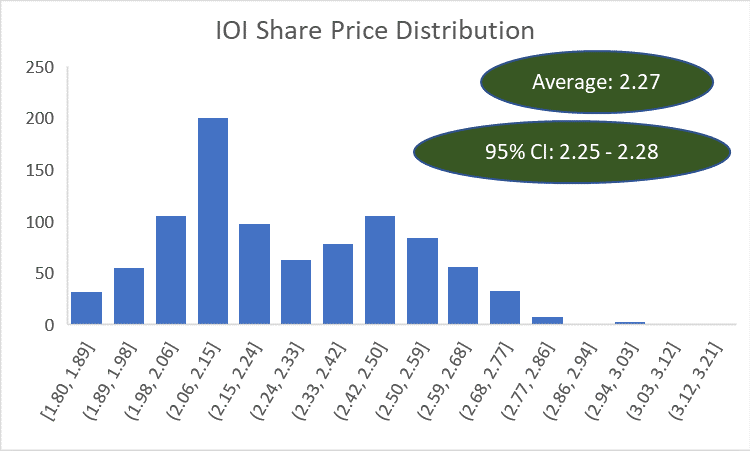
IOI Properties was listed on 15 Jan 2014, with an initial offer price of RM1.76 in its prospectus. Initial reception was positive, with share price trending at RM3.15 on the first day, but would soon drop to the lower RM2.00 range by the end of 2014. Its share price has mostly been in the region of RM2.00 – RM2.50 for the past 2 years, disappointing investors initially invested into the company at a price of RM2.50.

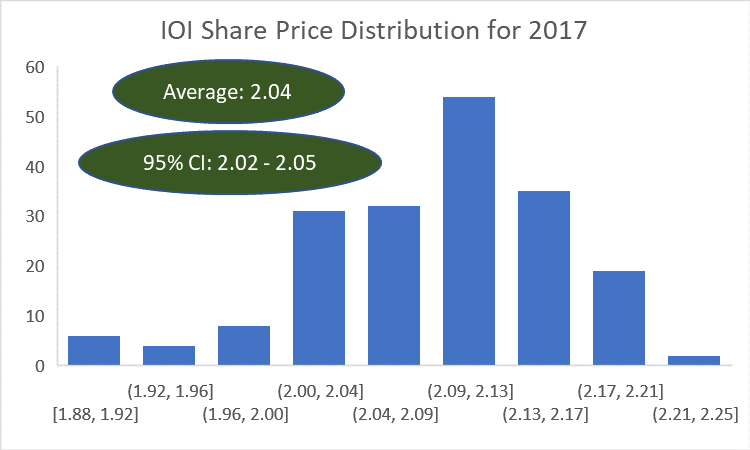
In terms of historical distribution, IOI is more skewed to the left hand side of the distribution, indicating a higher frequency of share price in the lower half of its average price of RM2.27. Investors can expect share price trading more frequently at the level of RM1.98 to RM2.25, and lower probability of share price rising above RM2.28. For 2017, its share price distribution was more normal and doesn’t indicate any particular skewness but has been lower at an average of RM2.04. Its 95% Confidence Interval stands at RM2.02 – RM2.05, indicating a very narrow trading range for IOI. It does indicate historically, that its 2017 share price is on the lower end of the distribution which presents some buying opportunity with a potential upside up to its historical average of RM2.28.
In terms of comparison against its peers, IOI would be classified as a big player in property development alongside SP Setia, UEM Sunrise and Eco World. Its market cap is one of the highest at RM10.8bn compared to SP Setia (RM10.2bn), UEM Sunrise (RM4.95bn) and Eco World (RM4.53bn). IOI’s P/E valuation at 10.8 seems fairly valued as its closest peer by market cap, SP Setia trades at a P/E of 12.1 . But overall, it remains at the low side of the P/E range with local peers averaging 13.8 with Eco World trading at the highest at 20.73. Its YTD and 1 year returns however has lacked its peers, with peers registering an average of 11.3% and 6.3% while IOI registered 1.0% and -13.7%.
Considering that it does have significant business interest in China, I thought it might be useful to compare IOI to foreign competitors too. The 4 foreign companies were obtained from WSJ, and the main weakness of this peers are that most of their business are in Hong Kong and not directly China. Overseas peers outperform local competitors by a wide margin if we look at the 1 year returns but trades at a lower P/E valuation of 8.62.

Financial Analysis
First thing off the bat, IOI’s income statement looks funky to me. It has a large portion of non-Op income which registers at the lower half of the income statement, which has fudged up the EBITDA numbers when I calculated them. The EBITDA, profit before tax and net income margins were screwy with PBT and Net Income margin higher than EBITDA, because of the Non-Op income and Unusual Expense components. Based on the annual report 2016, a big part of the Non-Op income and Unusual Expense components composed of “Fair value gain on investment properties” and “Share of results of Joint Venture”. Fair value gain on investment properties basically means the properties are revalued and any gain is registered in the P&L which to me, is padding the P&L as this is not realised investment. Please see below the margins without the Non-Op Income being included for EBITDA number.

As you can see, the margins do not make much sense in that EBITDA margins are lower than PBT and Net Income margins. I have adjusted them by adding the Non-Op Income portion to the EBITDA and Revenue number for a fairer picture of the financials. IOI does have significantly high margins with a 5 year average EBITDA, PBT and Net Income margin of 59.7%, 58.6% and 46.4%, and its (Revenue + Non-Op Income) is growing at a rapid CAGR of 34.8% from 2012 to 2016, powered by its Property Development business segment.

Let’s talk a bit on IOI’s cost and revenue structure. One of the things we have to understand about property development companies is that they go through a life-cycle development of planning ( finding consultants for its projects, securing funding), pre-launch marketing and sales, construction, and lastly handover to customers. Its annual report describes property development revenue and cost recognition as follows
“The Group recognises property development revenue and expenses in profit or loss by using the “percentage of completion” method. The percentage of completion is determined by the proportion of property development costs incurred for work performed up to the reporting period to the estimated total property development costs.” (IOI AR 2016)
One of the things to note on the “percentage of completion method” is that it is determined by the
“proportion of property development costs incurred for work performed up to the reporting period to the estimated total property development costs. Where the actual total property development cost is different from the estimated total property development costs, such difference will impact the property development profits losses recognised”
The thing we should be aware about is the use of estimation (read management “estimation”) to compute the percentage of completion in revenue and cost recognition. That means during a project lifecycle, there will be uncertainties in P&L recognition and my view from this is that a look at its operating cash flows with the P&L as context would be the right way to go about this ( later on ). For now, it will be ok to use P&L numbers for the analysis.
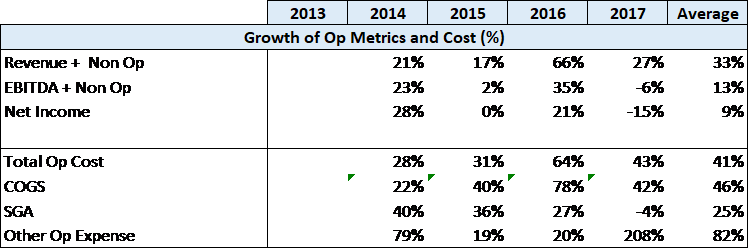
The bulk of IOI’s cost lies in its COGS ( 70-80% ) followed by SGA ( 10-20% ) and Other Op Expense (5-10% ). My way of looking at cost of goods sales relates to scalability of IOI in relation to revenue. From its revenue growth patterns and COGS margins, we can see that COGS (46% average) has been growing faster than its revenue (33% average) by about +13%, with COGS to revenue margin increasing from 37% in 2013 to 54% in 2017. EBITDA margin as a result has declined from 63% in 2013 to 34% in 2017, quite a big drop off with a yearly -10% decline. With the context of the accounting standard of revenue and cost recognition above, this might be coming into effect now with actual and estimates being divergent from each other as project completion percentage getting higher. Revenue is still growing at a healthy clip of 27% from 2016 to 2017, though it pales in comparison to its 66% growth in 2016. One of the concern I have is the consistent big drop in margins throughout the years, with revenue growth being very solid.

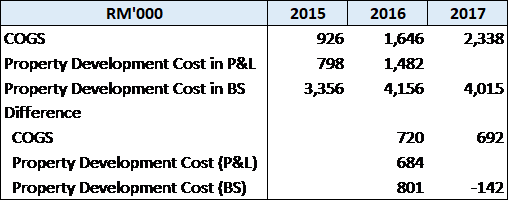
The main cause for the big increase in Cost of Goods Sale is the increase in Property Development Cost recognised in its P&L. As I only have incomplete numbers and data, I have computed the data below for PDC recognised in P&L and BS, and COGS. Much of the increase in COGS is due to the increase in Property Development Cost being recognised in the P&L ( RM720m increase) and although property development cost in the balance sheet has decreased from 2016 to 2017 (RM142m decrease), COGS has increased by RM692m which I am guessing, Property Development Cost recognised has also increased. Moving forward, we should be aware on the recognition of property development cost in the P&L as this is the big mover in determining margins for IOI.
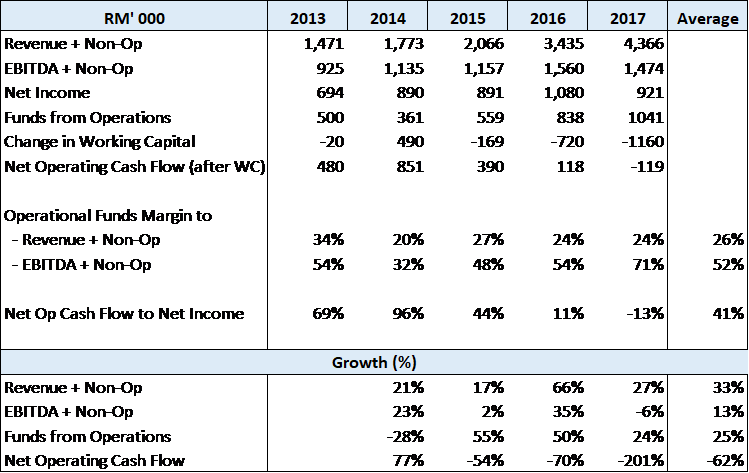
Looking at its Operational Cash Flow for some context on the P&L, IOI does not have a robust operational cash flow. Its Operational Funds to Revenue margin (my way of seeing how much funds are collected against revenue recognised) is low at an average of 26% and Operational Funds to EBITDA margin is also low at an average of 52%. Its Net Operating Cash Flow to Net Income margin are also low at an average of 41% with 2016 and 2017 registering a very low 11% and -13%.
IOI is having problems with its net working capital in terms of high receivables and low payables evident by its deteriorating NWC from 2013 to 2017. IOI is not collecting enough from its revenue streams and not having enough payables with its suppliers and contractors. (Good companies normally can negotiate good payment conditions with its suppliers)
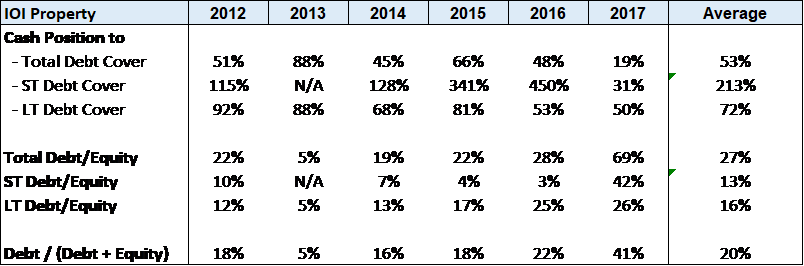
IOI has rapidly built up its debt profile in the last 3 years, from RM2.1bn in 2014 to RM12.5bn in 2017. Most of the increase is due to the short-term SGD loan (RM7.96bn) being procured to pay for a parcel of land in Central Boulevard in Singapore. IOI will be working with Hong Kong Land to develop a prime office project. Looking at its cash flow positions, its plain to see IOI doesn’t quite have the operational cash flow coverage to cover its short term. It would have to rely on its reserve cash to pay the short-term loan and even then, its cash position isn’t sufficient. A cash position of RM2.4bn isn’t adequate at this stage to service RM7.7bn of short term loans.

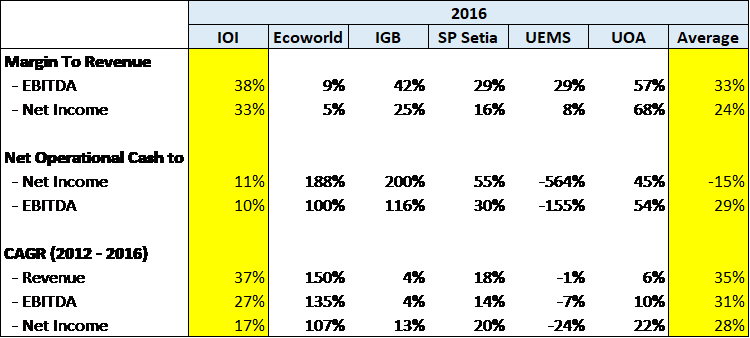
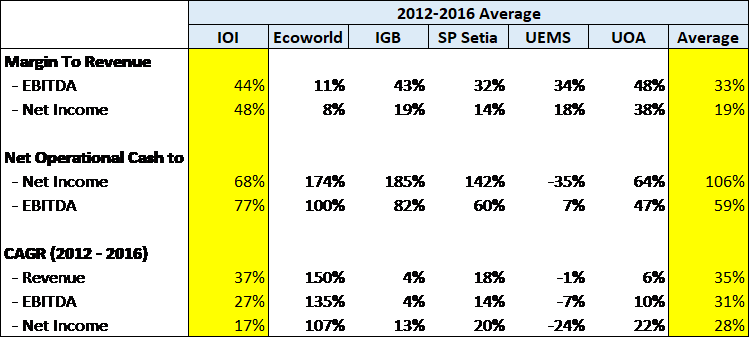
IOI’s operating margins (EBITDA and Net Income) are higher than its competitors’ average margins for 2016 and 2012-2016. IOI registered an average EBITDA margin of 44% compared to its peers average at 33%, with only UOA having a higher figure at 48%. One of the concerns I highlighted for IOI is its collection of cash from revenue recognised. When compared to its peers, IOI’s net operational cash to Net Income (68%) is lower than its peers average (106%). In 2016, Ecoworld, IGB, SP Setia, and UOA outperforms IOI in terms of operational cash flow to EBITDA and Net Income. On a good note however, IOI has one of the highest CAGR growth ( Ecoworld started from a low base) for its revenue (37%), EBITDA (27%) and Net Income (17%). The main takeaway point is that IOI has the better operating margins and growth numbers but suffers from cash revenue collection.

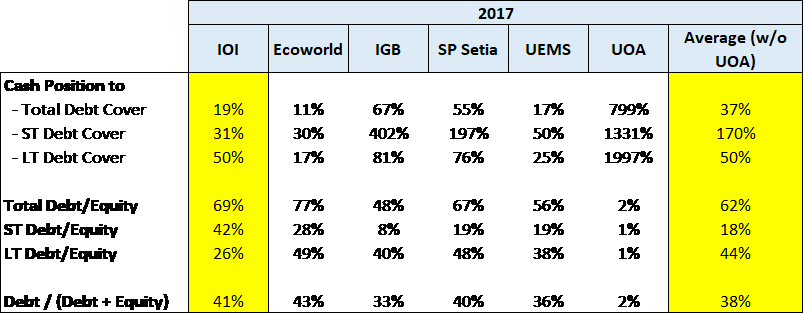
One of the main concerns that I had previously is that its current cash position doesn’t seem adequate to finance its large short term debt. I understand that this is financing for a mega project in Singapore and is in partnership with HK land, but I think it might be a good idea to compare its cash position to debt cover and gearing ratios to other competitors to get a general feeling how leveraged is IOI currently.
IOI’s cash position to total debt cover is lower at 19% compared to its peers at 37%, and its cash position to ST Debt Cover is also much lower at 31% compared to its peers at 170%. In terms of servicing its ST debt principal, IOI is much more vulnerable compared to its peers. Its ST Debt/Equity ratio is also higher than its peers at 42% against 18%, though its LT Debt/Equity ratio is much lower. Looking at its debt history, IOI significantly became more leveraged this year (2017) with Debt/(Debt + Equity) ratio increasing from 22% in 2016 to 41% in 2017. But this is not a big concern since its peers’ Debt/(Debt + Equity) ratio averaged 38%, which is about the same as IOI. The concern here then is its vulnerability in its short term cash cover position to its large ST Debt. We might see IOI rolling its ST debt position for more favourable long term tenure loan this or next year.
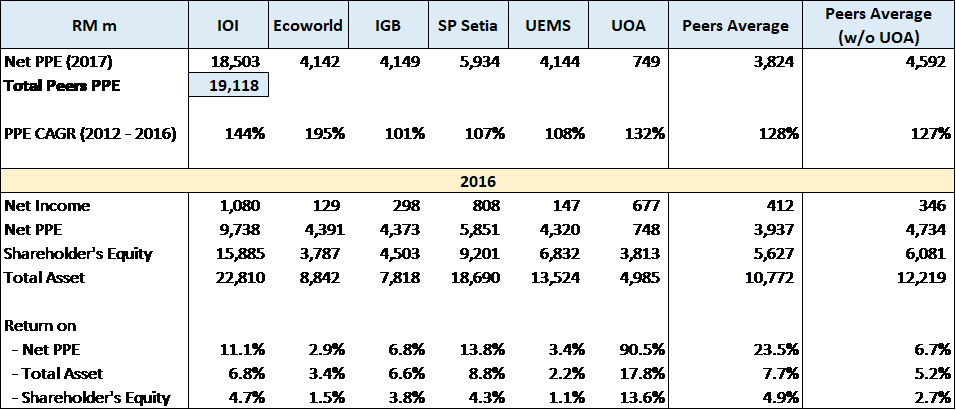
To get a sense on how big a player IOI is, I examined the Net PPE and Total Assets of IOI against its peers and the observation is that IOI has the highest total assets at RM22.8bn compared to its peers average of RM10.7bn for the year 2016. This year alone, IOI’s Net PPE of RM18.5bn is comparable to all of its peers combined at RM19.1bn. Its net income to Net PPE, Total Asset and Equity returns also outperforms most of its peers except for SP Setia and UOA Development (this is an outlier among its peers). Based on these returns alone, IOI can be an SP Setia like company and since IOI trades at a lower valuation now compared to SP Setia (Insert SP Setia and IOI P/E valuation), there are opportunities for investors interested in SP Setia but are looking for a cheaper valuation.
Valuation
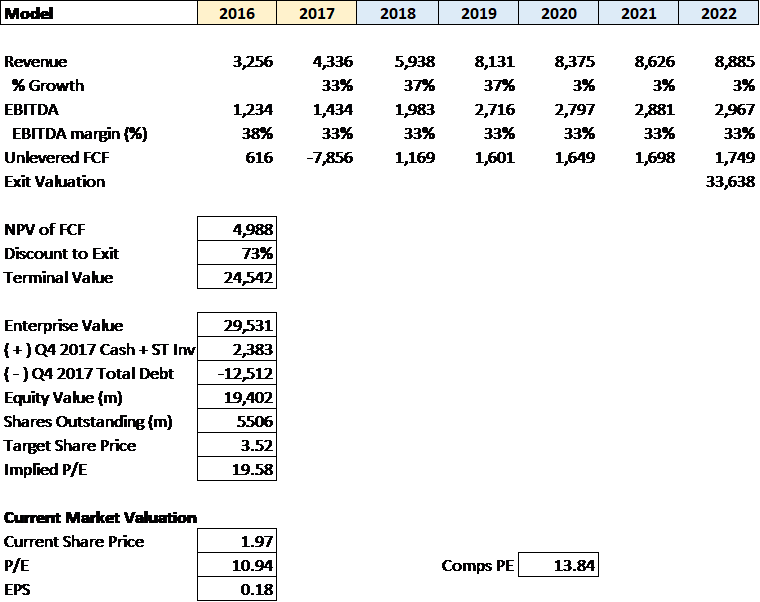
The valuation I will be using for IOI will be a normal DCF. Now, I am well aware that the method of valuation for property companies are through GDV calculations of its existing and future projects and then taking a discount on them like many analysts do. But the problem is that you need to have very good visibility on the rents and cash flows of individual projects which analysts have when they go for presentations by the company. And one more thing to note is that I will be valuing the company from 2018 onwards for one reason, 2017 was a year with very high CAPEX investment which cause my cash unlevered cash flow for 2017 to be negative. The high CAPEX investment is due to the acquisition of the land in Singapore and I think it’s not right to value from 2017 onwards when we know the CAPEX investment is unusually high.
There are a few assumptions and key points that I would like to highlight for my model
- I am very bullish on IOI’s projects going forward. IOI currently has a lot of value in its projects that have yet been completed which I think the market is not taking into account. Local projects such as IOI resort city in Putrajaya (RM18.7bn) and Bandar Puteri Puchong (RM10.8bn) will provide a lot of value to IOI. Please see below the remaining GDV breakdown for IOI.
- EBITDA margins are projected to be in the 30% range as IOI has proven that it’s proficient at cost management and margin retention.
- I did not incorporate Net Working Capital as part of the valuation as this item has always proven very volatile and tough to estimate. This is not to say it is not important, but I prefer to leave it out as the method of estimation often proves to be iffy and not reliable.
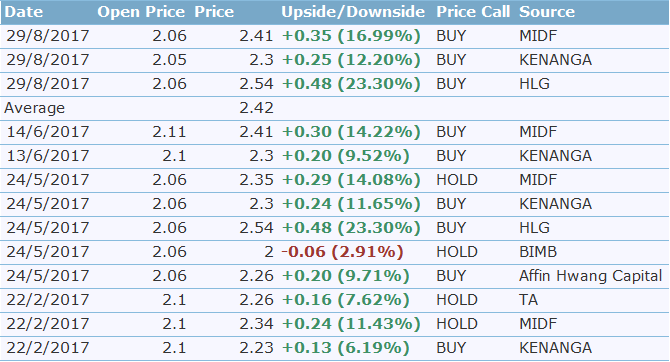
I am valuing IOI at RM19.4bn with a target share price of RM3.52 implying a P/E of 19.58. This is in comparison to current share price of RM1.97 (P/E of 10.94) and its competitor’s P/E of 13.84. I am bullish on IOI as I like its margins and prospects for growth with its ongoing projects. Looking at the 3 recent analyst (MIDF, Kenanga, HLG) target price average at RM2.42, my target price is much more bullish and optimistic.
Post Picture from Rexez
 Slice of P.I.E
