
Dear readers, it has been a while since I updated anything related to investment calls or rather anything on my blog. I have been busy with work commitments and time has not been kind to someone working in the central bank. Anyway, you can find my previous updated GMB piece here. As usual, hope you enjoy this piece and find it useful for your own personal use.
Summary
BUY call with Target Price of RM3.55
Genting Malaysia Berhad shares has been oversold recently primarily because of “bad results” which took an impairment of RM1.8bn fully on account of uncertainties in its joint development with Mashpee Wampanoag Tribal on an integrated gaming resort in Massachusetts, United States. On a purely operational basis, margins have actually improved in 2018 compared to 2017.
However, its business prospects have significantly declined with the introduction of higher casino duties at 35%, the pulling out of 21st Century Fox as the IP for its theme park and lacklustre tourist arrivals over the past couple of years.
Background
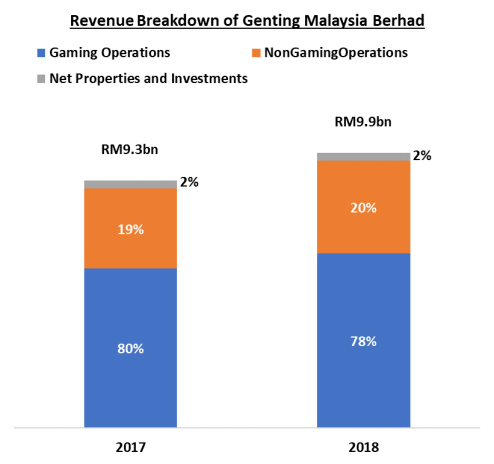
Genting Malaysia Berhad (GMB) is mainly involved in the business of gaming operations where about 78 – 80% of its revenues are derived from, while the remaining 20% is from non-gaming operations like hotel, food and beverages, tenancy, transportation, properties and investment. Note: GMB has changed how they slice and dice their business segments. They are separating gaming and non-gaming operations now as compared to lumping them together as leisure and hospitality previously.
Source: WSJ
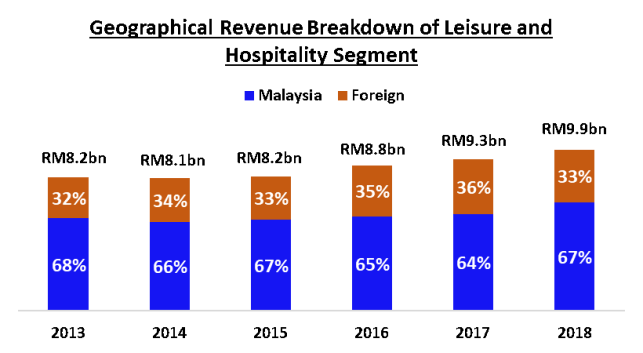
GMB is mainly involve in the gaming business in Malaysia, with an exposure of 65% – 68%. 30% – 35% of its revenues are from overseas operations mainly in the United States, Bahamas, and the United Kingdom.
Source: WSJ
Note: Foreign segment includes United States, United Kingdom, Egypt and Bahamas.
Share Price Performance
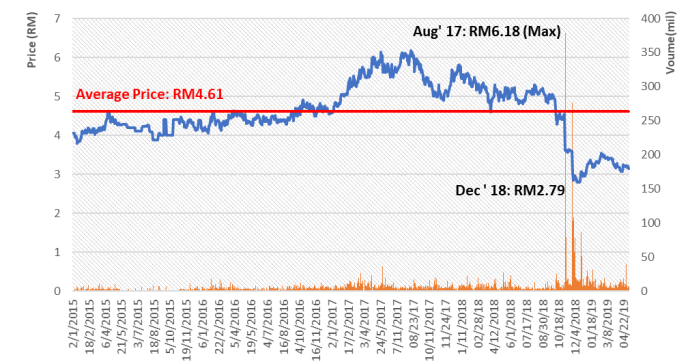
Share price drastically declined from about RM4.60 in the month of October 2018, to about RM3.46 in the month of November 2018. The Budget 2019 announced that gaming tax of up to 35% will be applied to the gaming industry (25% previously).
In another news in December 2018 that effectively buried Genting Malaysia’s prospects, 21st Century Fox pulled out of an IP agreement with Genting Malaysia for its theme park. Share price tanked further to RM2.90 in December 2018.
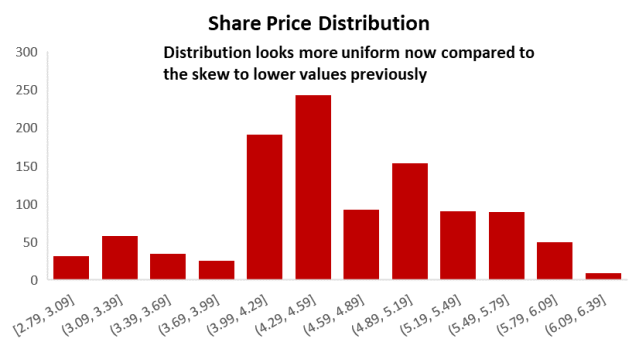
As a result, share price since then has traded well below its historical average, presenting either 1) a beginning of the deterioration of Genting Malaysia’s prospects or 2) a buying opportunity for investors interested in entering.
Source: WSJ
The share price distribution is now more evenly distributed considering the recent underperformance of the share price below the average of RM4.61. I will recommend investors especially ones who trade technically to be neutral on account of this, and to reexamine the fundamentals of the company in their trading strategy. Previously, I have recommended that technical investors holding Genting Malaysia’s stocks (during the RM5.00 to RM6.00 period) start selling them as historical evidence suggest that prices tend to be at the lower range.
Source: WSJ
Financial Analysis
I think in my 2 years analysing GMB, the thing I found a bit misleading sometimes in its financial statement is how much its non-operations drastically change how we look at GMB. I have highlighted in the past that I took out its Other Income line item because it was inflating its topline numbers. It seems that for this round however, I would have to take out its Unusual Expenses line item too as it has deflated its topline numbers.
In the U.S, GMB has partnered Mashpee Wampanoag Tribal (WMT) in Massachusetts to develop an integrated gaming resort. GMB subscribed to RM1.8bn worth of notes issued by WMT, carrying about 12-18% interest rates. However, in September 2018, the government concluded that WMT did not satisfy the conditions under the Indian Reorganisation Act that allow WMT to have the land in trust to develop the integrated gaming resort. Considering this, GMB has decided to fully impair the RM1.8bn notes until further notice and clarification. A legislation being introduced in Congress, which if passed, will reaffirm the land in trust for the benefit of WMT. On 15 May 2019, the US Congress finally passed the legislation Bill 312 by 276 – 146 which reaffirms the land in trust for WMT. While it is not clear yet whether the plan for the integrated gaming resort will resume, it is nonetheless good news and provide further evidence for the reversal of the RM1.8bn impairment.
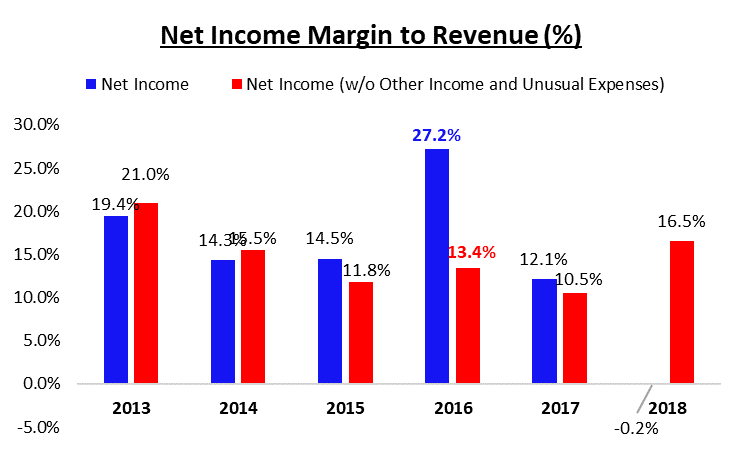
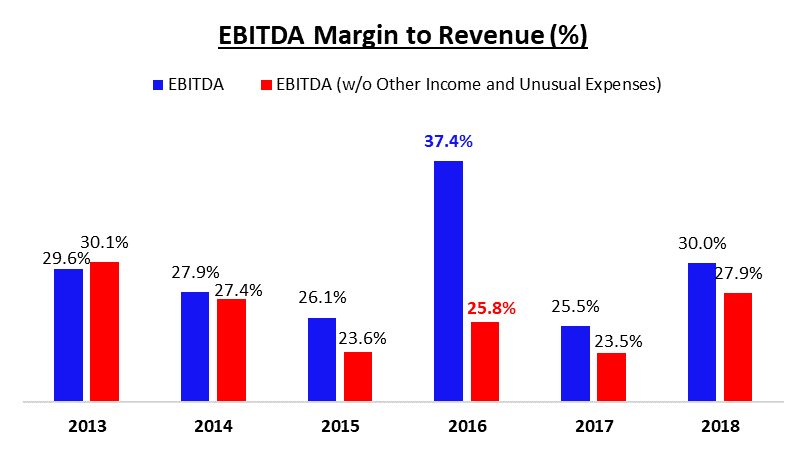
However, to be very clear on this, my aim is to examine GMB’s operational performances. I am of the view that removing the non-operational items like Other Income and Unusual Expenses, would provide more clarification to GMB’s operations. The analysis is starkly different as removing non-operational items indicate that GMB’s performances has improved. While there weren’t any changes in the EBITDA story (Unusual Expenses come in after EBITDA), net income margin improved to 16.5% in 2018 (2017: 10.5%) as opposed to -0.2% (2017: 12.1%) including Other Income and Unusual Expenses.
Source: WSJ
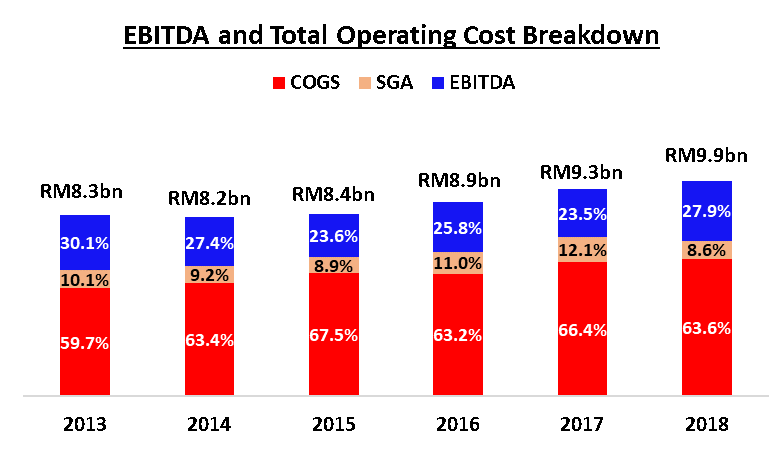
The improvements in profitability was driven mainly by lower Selling, General and Administrative Expenses (SGA) possibly reflecting GMB’s ability to realise cost efficiencies after the completion of projects in its GITP program ( I highlighted in last year’s analysis that GMB will require some time to realise cost efficiencies for some of its new projects). SGA to Revenue decreased to 8.6% in 2018 (2017: 12.1%), while COGS to Revenue also declined to 63.6% (2017: 66.4 %).
Source: WSJ
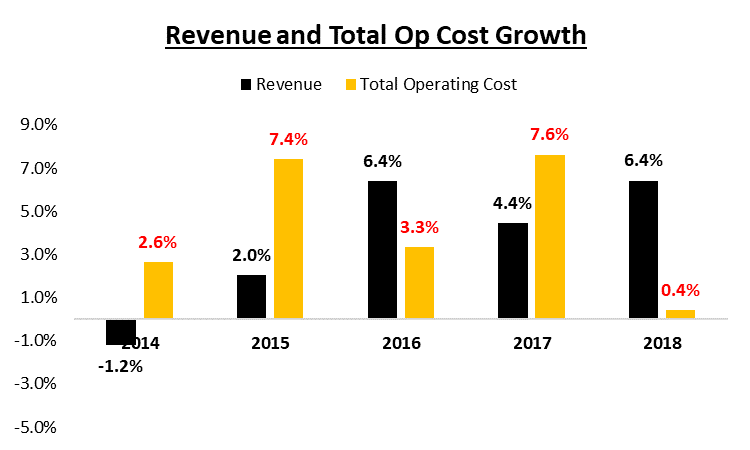
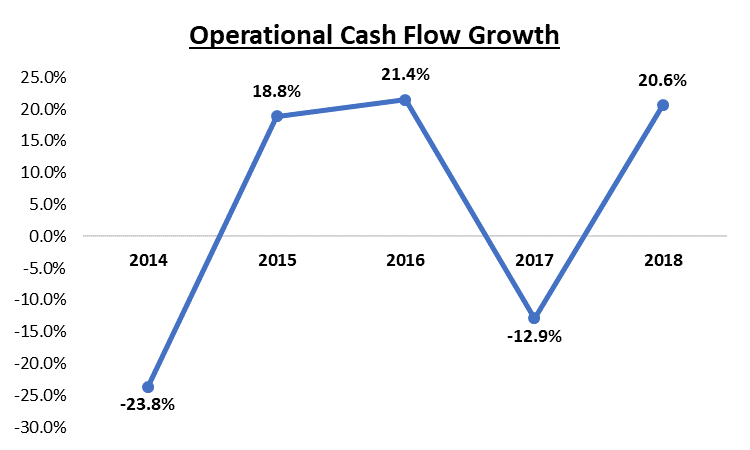
While the previous narrative was that operating cost growth has been outpacing revenue growth, it has reversed in 2018. Revenue grew at a pace of 6.4%, much higher than operating cost growth at 0.4%. As a result, net operational cash flow has rebounded in 2018 with a growth of 20.6% (2017: -12.9%).
Source: WSJ
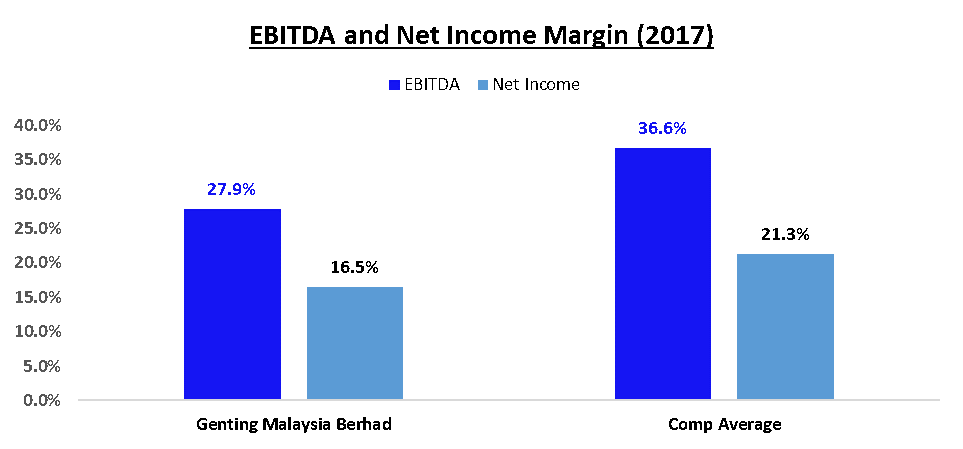
As a guide towards whether Genting Malaysia Berhad’s operational margins are high or low, Genting’s operational margin in 2018 is lower than its competitors leaving room for potential improvements. However, it should be noted that Genting’s GITP is still underway, and this could be the reason behind the low margins as some time is needed to realise cost efficiencies from its new revenue sources.
Source: WSJ
Note: The competitors I used are Las Vegas Sand Corp, Kangwon Land Inc, Bloomberry Resorts Corp, MGM Resorts International, and Galaxy Entertainment Group.
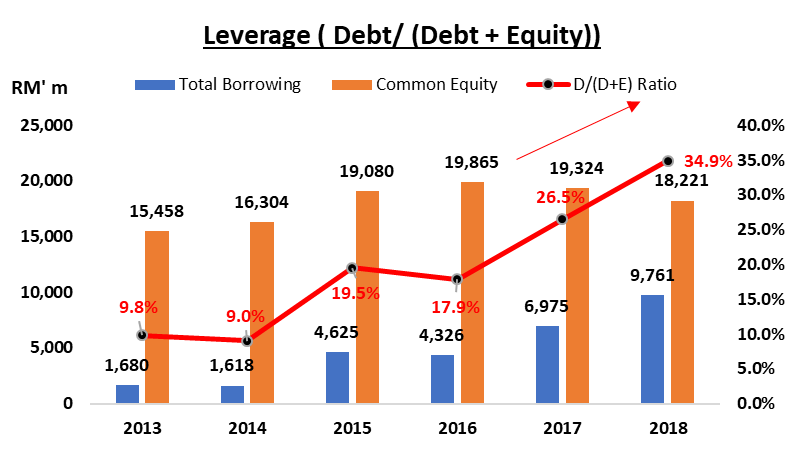
GMB’s leverage increased sharply to 34.9% in 2018 (2017: 26.5%) while its peers were relatively sustained at 48%. GMB issued about RM2.7bn of Medium-Term Notes in July 2018 for operating expenses, capital expenditures and working capital to finance its GITP program.
Source: WSJ
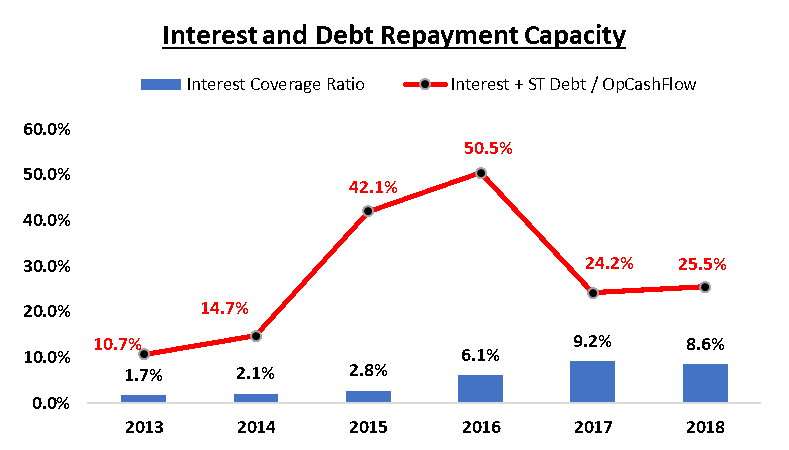
While the increase in the leverage of GMB is concerning, its ability to repay its interest and debt obligations have remained sustained. Interest coverage ratio declined slightly to 8.6% in 2018 (2017: 9.2%) while its ability to repay Short Term obligations (Interest + ST Debt/ Operational Cash Flow) has increased slightly to 25.5% (2017: 24.2%). So far, there are no alarm bells yet from this front, but caution has to be exercised to these metrics as the sharp increase in leverage could push them even higher.
Source: WSJ
Business Prospects and Outlook
While GMB’s operational performance has improved in 2018, I think its prospects and outlook have deteriorated significantly by the end of 2018. The biggest downside factor is the imposition of up to 35% of casino duties in the budget which will compress its profit margins even further. The second will be the pulling out of 21st Century Fox as the IP for the Genting Theme Park, which was supposed to be a new major source of revenue. The third will be the declining prospects of tourism in the country, with tourist arrivals and receipts being lacklustre in the past couple of years.
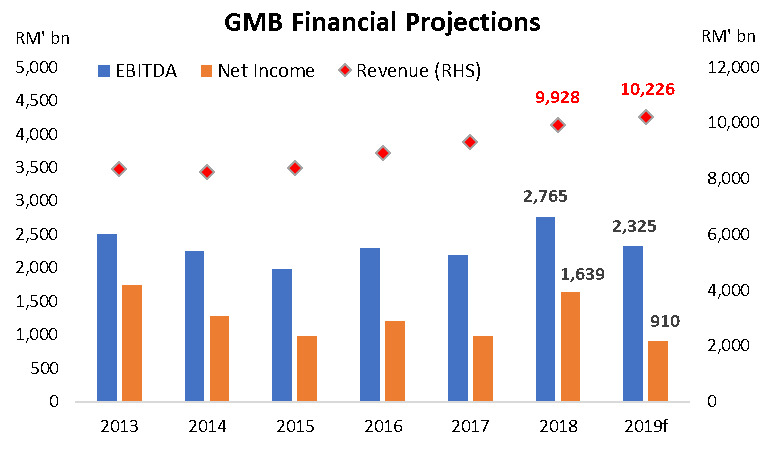
First, I estimate that in 2019, GMB will incur an additional RM688m in casino duties, bringing total casino duty to RM2.4bn. My estimate is about the same as what Fitch estimated at about RM700m. Secondly, I project that revenue will only grow by 3% in 2019 as there are no new source of revenue from the Genting Theme Park or WMT’s integrated gaming resort in Massachusetts, and tourism arrivals have consistently missed Tourism Malaysia targets.
Considering the factors above, I forecast that in 2019, its EBITDA will decline to RM2.3bn (2018: RM2.8bn) while its net income will decline to RM1.2bn (2018: RM1.7bn). This yields much lower EBITDA margin of 22.7% (2018: 27.9%) and Net Income margin of 8.9% (2018: 16.5%). I do not expect GMB to be able to achieve much higher cost efficiencies in such a short amount of time of 1-2 years. However, in the medium term, the highest upside for GMB will be achieving similar EBITDA and Net Income margins to its competitors in the market at 36.6% and 21.1% respectively.
Source: WSJ
Financial Valuation
Please find my excel file Genting Malaysia Berhad Model v16 in the tab called “Valuation”)
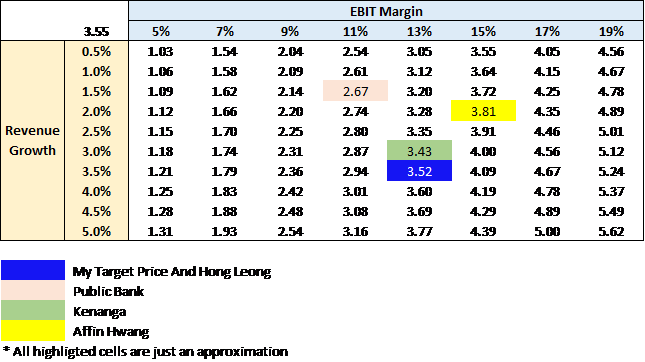
I am forecasting a target price of RM3.55 for GMB, with a Price Earnings Ratio of 12.3x (Note: I utilised net income without other income and unusual expenses to obtain the Earnings Per Share). I do feel the share has been oversold recently (currently trading at RM3.09) because of the “bad results” from its impairment of bonds from WMT. However, make no mistake, I do not think GMB will trade back to its RM5.00 levels during the 2017 and 2018 years in the short term. This is premised on fundamental issues such as higher casino duties, and the uncertainty surrounding its theme park. While there are good news coming out of the WMT situation in the US, GMB will still be mainly driven by its Malaysian operations. In comparison to other research houses, my target price is more on the bullish side (Average Research house TP: 3.36) but is by no means the most bullish.
Source: i3 Investor
 Slice of P.I.E