

Dear readers, please find my latest analysis on Kuala Lumpur Kepong. I have tweaked things here and there to enable the content to be more reader friendly. Hope you find this useful.
Executive Summary (Call: SELL, TP: RM21.07)
A SELL call for Kuala Lumpur Kepong with a Target Price of RM21.07.
- I am less bullish on KLK’s prospects in the current macroeconomic environment with low CPO prices and lack of demand factors.
- KLK is overvalued at price earnings ratio of 39.6 compared to its peers at 33.3. I do think most palm oil companies are overvalued at this juncture also.
- Operational efficiencies should be achieved in 2018 with its high CAPEX investments in the past. That did not materialise.
- However, KLK’s diversified businesses into its downstream segment (manufacturing) is positive in this environment of low CPO prices.
Background
Kuala Lumpur Kepong is a palm oil company involved in the trading and manufacturing of palm oil and oleochemicals (please see below for a brief description of oleochemicals). KLK primarily produces palm oil, palm kernel and oleochemical materials in the forms and uses described below.
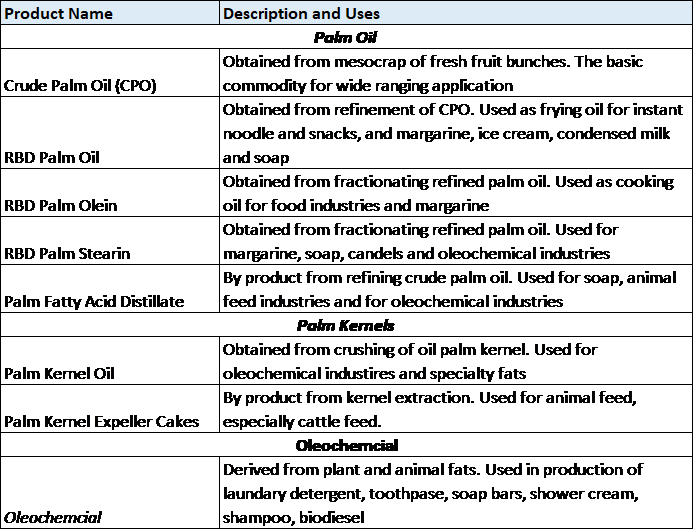
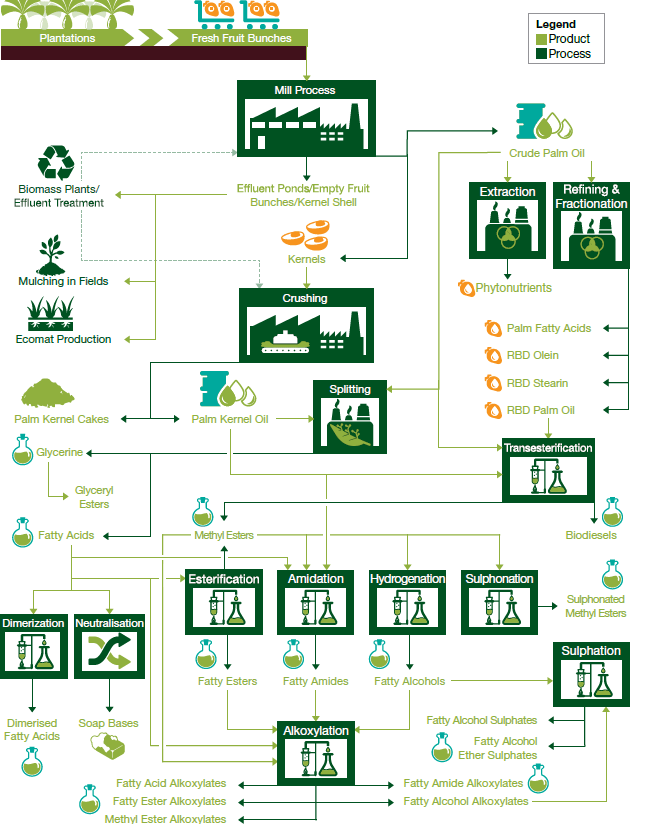
KLK operates mainly in the upstream and midstream portion of the palm oil value chain, involved in producing, refining and selling palm oil produces and products to customers. Many of its products are intermediary inputs for its customers to produce final goods and bring them to the end market (consumers). KLK is not heavily involved in the selling and distribution (downstream business) of its palm oil products. Please refer to this dissertation here by Siti Rahyla Rahmat page 58-59 for a flow chart of the Malaysian Palm Oil value chain.
Market Valuation and Share Price Performance
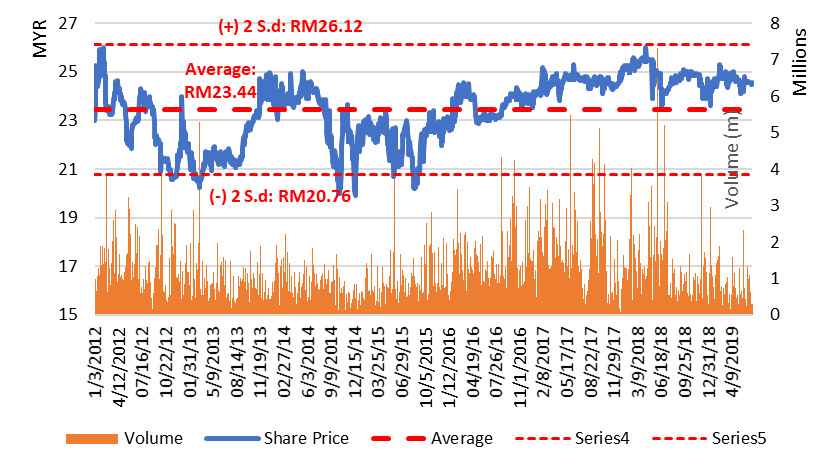
First thing to notice, share price traded above its average of RM23.29 for the past 2 years. However, it is important to note that share price has increasingly converged to its average especially in the 2Q and 3Q of 2018 before rebounding after that. We could attribute that to pre-election weakness and post-election uncertainties for that period, and the gradual moderation in CPO price since 1Q 2018. However, what is interesting is that, CPO prices did moderate further past 3Q 2018, but KLK’s share price rebounded despite this. My hunch is that KLK was still doing alright because of its involvement even in the midstream and downstream CPO value chain. I will be trying to explore in the later parts of this research piece on what are KLK’s qualitative strengths with its diversified business.
Source: WSJ
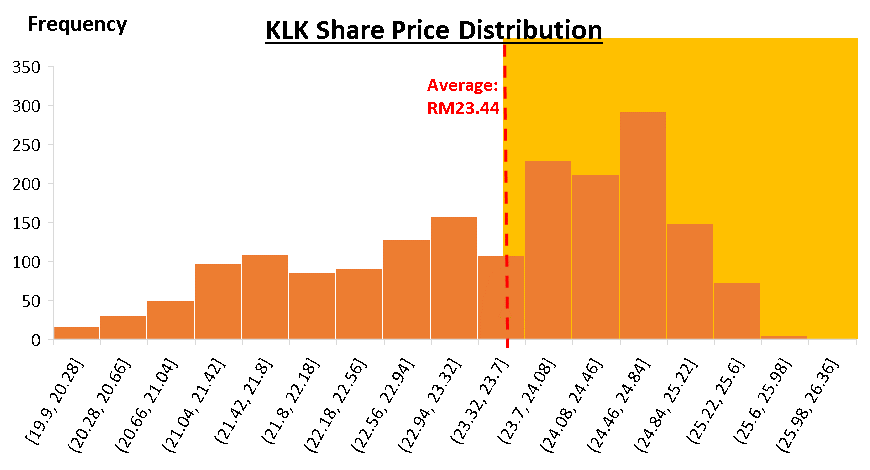
KLK’s share price distribution indicates that share price is skewed towards the right, into the higher range of prices, which presents an interesting investment opportunity. For investors aiming to enter KLK at the right time, it is advisable to enter when share price dips below RM23.44 as share prices are mostly above average. However, I believe KLK is overvalued at this point and investors might have given too much credit to its prospects. We shall also explore how this is so in the later parts.
Source: WSJ
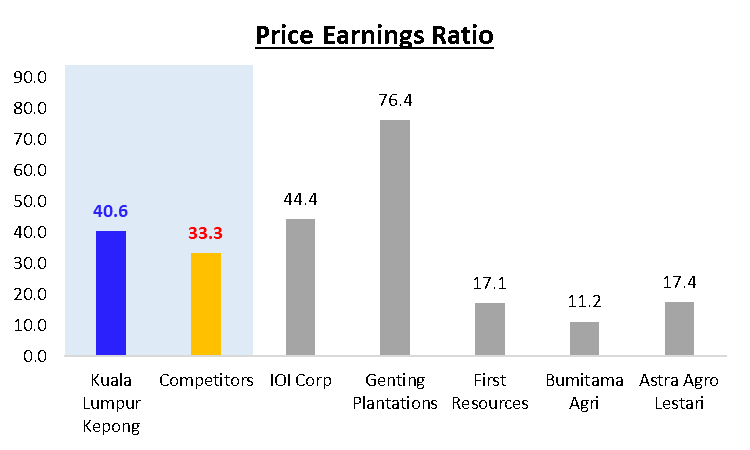
In comparing KLK to its competitors, its price earnings ratio ranks one of the highest at 40.6 times, exceeding its competitors who averaged 33.3 times. Its dividend yield (1.9%) is not that spectacular when compared to its competitors (2.9%) but the yield is low because of its high share price (Dividend/ Current Share Price). Hence, I believe KLK is overvalued at this juncture, but so are the other companies like IOI (44.4 times) and Genting Plantations (76.4 times).
Source: Bloomberg
Financials and Operations
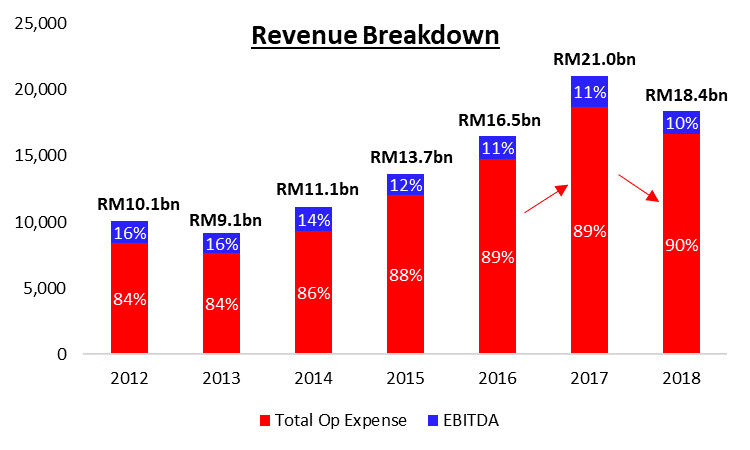
Revenue growth has been strong in the past, but prospects for CPO production and prices were bad in 2018. CPO prices moderated to $535 by the end of 2018 (2017: $672). Hence, revenue actually declined by 12.4% in 2018 to RM18.4bn. What is concerning also, total operating expense grew even stronger in 2018 compared to 2017. This might be a one-off until CPO prices recovered but it might mean that we need to investigate deeper into what is driving KLK from its business unit analysis and prospects.
Source: WSJ
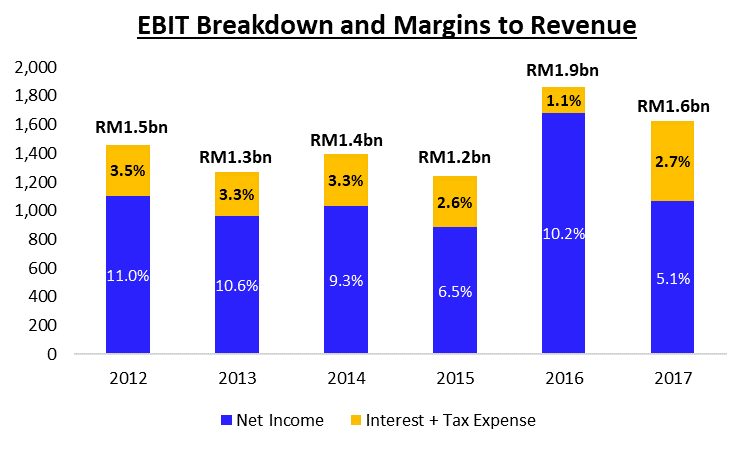
As a result, net income margin has been particularly low in 2018 (3.3%) compared to other years (Avg 2012 – 2017: 8.8%). This comes from the back of contraction of revenue (-12.4%) and net income growth (-43.6%). However, there is an interesting dynamic to these trends. Both revenue and operating cost growth were volatile at standard deviations of 16.1% and 16.5%, but net income growth was even more volatile at 44.3%. Thus, it means that the high volatility of net income comes from further down the income statement, namely its interest and tax expense components. Standard deviation of income and tax expense is a whopping 84%, so we need to be cautious of this component in swinging the net income margins moving forward.
Source: WSJ
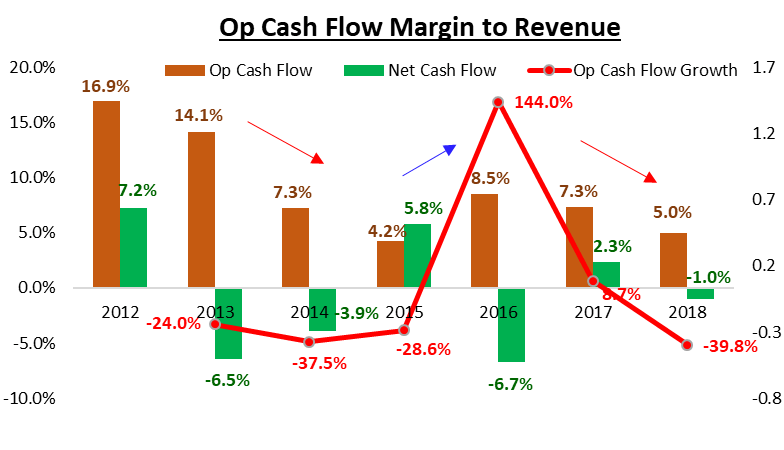
To come to the meat of any financial analysis, what matters most is the cashflow of the company. In my last analysis, I highlighted that the current trend of growth in operational cash flow (2016 and 2017) was encouraging but must be sustained moving forward. Unfortunately, that hasn’t been the case in 2018. Operating cash flow growth contracted by -11.1% in 2018 (2017: 10.4%), bringing operational cash margin to only 5.0% (Avg 2012- 2017: 9.7%). Much of the contraction was driven by the worsening of working capital (-RM457m; 2017: -RM20m) and a broad-based contraction in its revenue.
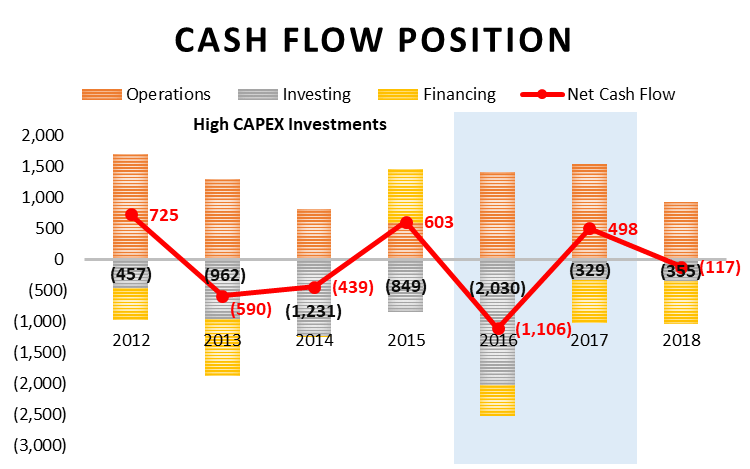
Source: WSJ
It is become increasingly so, that KLK’s operations are unable to fulfil its short term debt obligations. Its interest coverage ratio (Interest/ EBIT) increased sharply in 2018 to 16.0%, due mainly to a contraction in EBIT to RM1.1bn (2017: RM1.6bn). Its ability to repay its interest and debt obligations (Interest + ST Debt / Operational Cash Flow) has also deteriorated to 151.6% (2017: 101.0%). Although KLK is by no means insolvent, I would like to see better management of cashflows
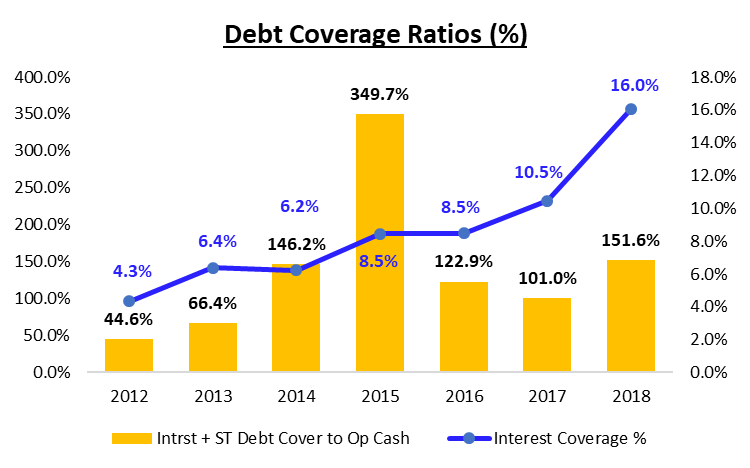
Source: WSJ
Although there are some concerns over KLK’s ability to cover its short-term obligations, its leverage structure seems to be in order. Its leverage ratio (Debt / (Debt + Equity)) increased from 23.7% to 32.2% in 2015 but has seen decreased to 27.3% in 2018. There are no alarm signs yet in this regard as the Equity portion is growing healthily while borrowing has settled at the level of RM4.3bn recently. So how do we square this with the insights we obtained from its increasing inability to repay its short-term obligations? Total debt has remained steady around RM4.5bn in these past 4 years and declined slightly in 2018 (RM4.3bn; 2017: RM4.4bn). While KLK have not been incurring additional debt, it has begun to meet more of its short term obligations (that were converted from long term debt) and its operational income has not been sufficient to cover them.
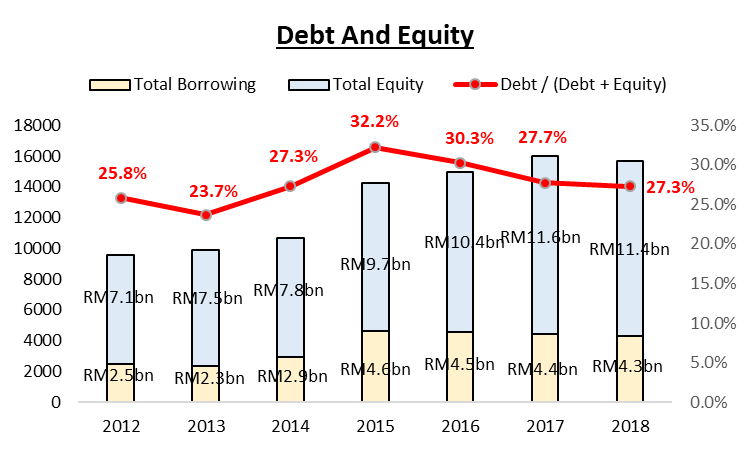
Source: WSJ
In terms of asset efficiency, ROA has been steadily declining since 2012 (9.8%) to 2018 (3.2%). In my last analysis, I highlighted that its heavy CAPEX investments needed time to bear fruition and that the year 2018 will be the litmus test to see whether asset investments will lead to an improvement. While it may be premature to conclusively write KLK off as not being able to realise operational efficiencies, it certainly doesn’t look good with net income declining. What we can take away from this is that investors really need to scrutinise the Returns on Investment of their PPE investment in the last 4 years.
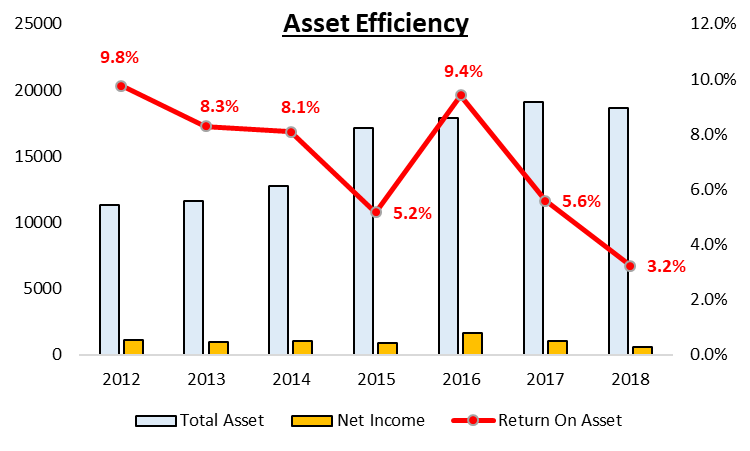
Source: WSJ
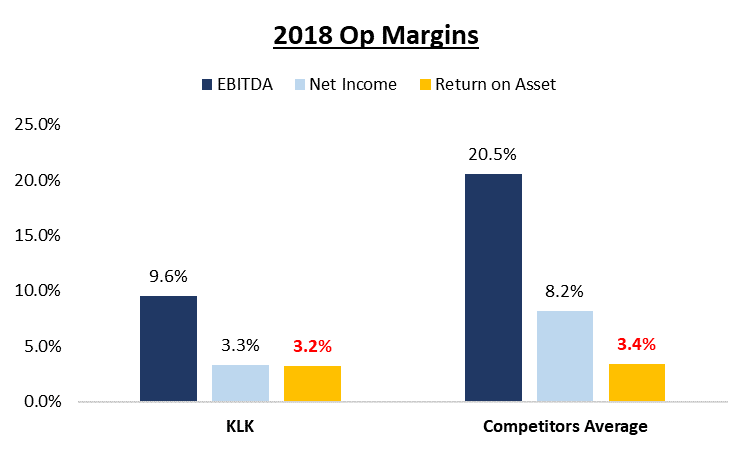
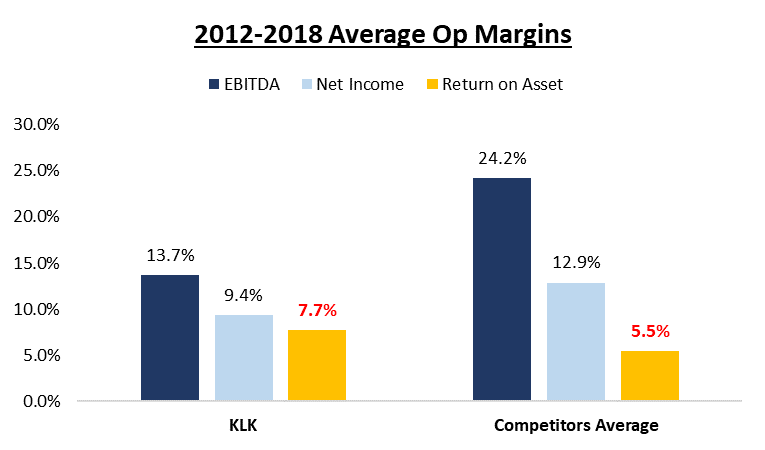
In comparison to its peers, KLK’s margins in 2018 have not been impressive and are on the low side. EBITDA, Net Income margins and returns on asset are lower than its competitors. In my last analysis, I highlighted that one of the bright points for KLK was that its returns on asset outperformed its peers. This is still true from a historical perspective (Average 2012 – 2018). That’s why 2018 might just be the case of a bad year for KLK.
Source: WSJ
Business Unit Analysis and Prospects
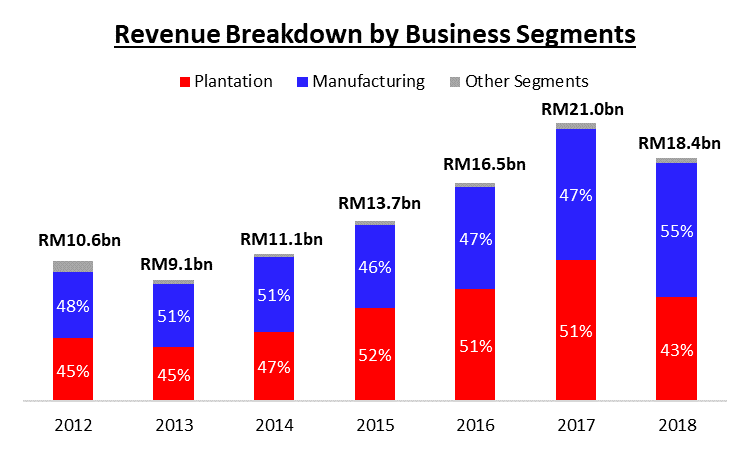
KLK’s manufacturing business played a prominent role in offsetting the loss of revenue from the plantation business. While the planation business revenue declined by -26% to RM7.9bn (2017: RM10.6bn), its manufacturing business growth was sustained at 2%, increasing to RM10.1bn (2017: RM9.9bn) giving a much-needed buffer and diversification advantage to KLK.
Source: Annual Report 2018
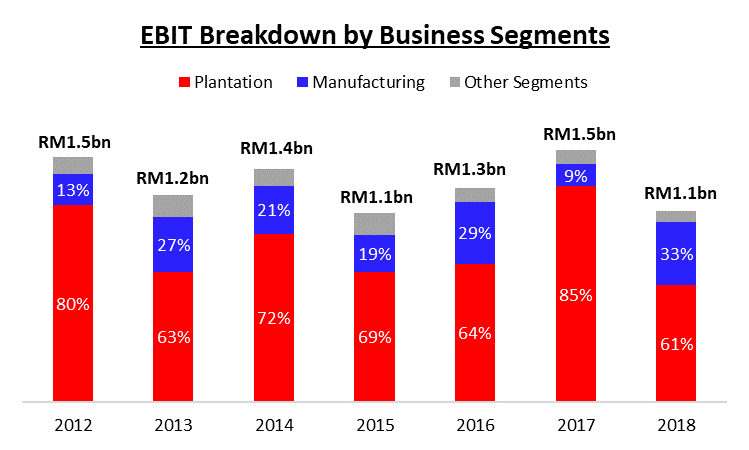
Even though the plantations business still contributes the majority of earnings to KLK at 61%, its manufacturing business contribution has increased from 9% in 2017 to 33% in 2018. I do think this is where KLK shines the most. It has both up and downstream businesses to support their company even when CPO prices are weak, or demand is lacking. It has the capacity to weather the upstream business downturn by turning to its downstream business, similar to how companies like Petronas operates. I am positive on what I am seeing in terms of revenue and profit contribution from its manufacturing (downstream) business segment.
Source: Annual Report 2018
Macro Environment and Trends
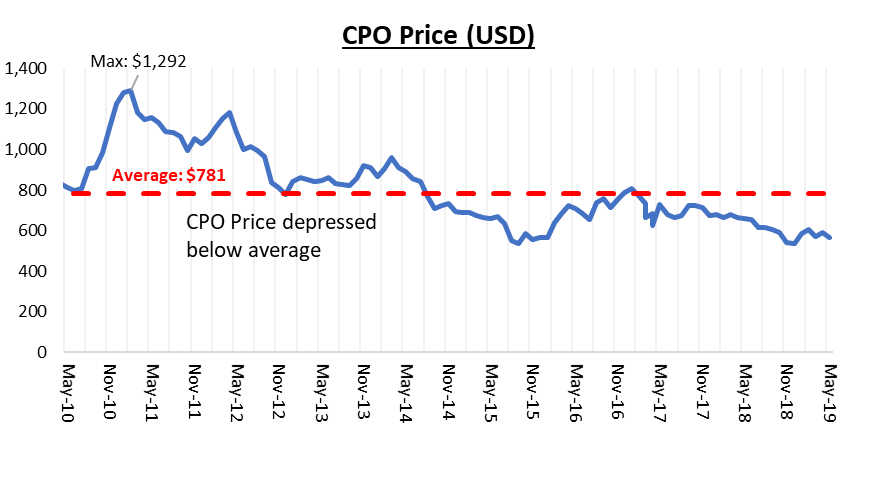
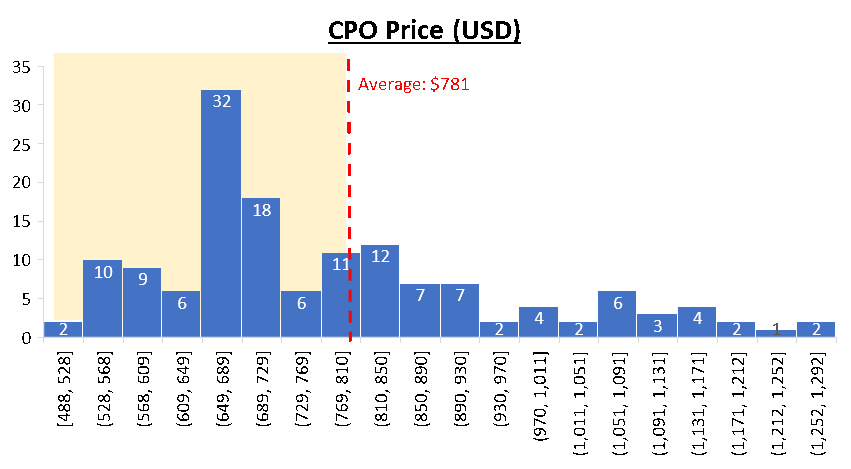
CPO prices have been depressed the last 3 years (below the average of $798) due to the El Nino effect. The boom period of 2009-2013 saw high demand for palm oil by big players like China, US, India and Europe, while the bear period after that saw concerns of low GDP growth from China and India and the increasing competitiveness of soybean and rapeseeds. CPO prices continued its decline in 2018 and into 2019, below its historical average of $781. Prospects are not expected to be bullish moving forward as there are no demand impetus to drive CPO prices higher.
Financial Valuation
Key Assumptions for DCF:
| Revenue Growth | 6.1% |
| EBITDA Margin | 9.6% |
| Cost of Equity | 11.10% |
| MGS 10-year | 4.03% |
| ERP (Damodaran) | 7.07% |
| Cost of Debt | 4.14% |
| Tax Rate | 24% |
| D/D+E | 28% |
| WACC | 8.9% |
| Terminal Growth | 3.0% |
My DCF valuation yielded Equity Valuation of RM22.4bn (RM21.07 per share) with an implied P/E of 35.12. This is lower than KLK’s current Market Cap of RM25.2bn (RM23.70 per share) and P/E of 39.63. Investors seem to be pricing in a more aggressive upside for KLK while I was more conservative in projecting its revenue growth. I am leaning more towards an overvaluation in this case as I don’t see a case for an abrupt increase in its operational margins or a bull case for the overall macroeconomic environment. The P/E comparison earlier also indicate KLK is more likely to be overvalued at a P/E of 39.6 compared to its peers’ average of 33.3.
 Slice of P.I.E