

Hi all, please find the latest investment call for IOI Property Group. Hope you all can find this useful. Post Picture from Rexez
Executive Summary
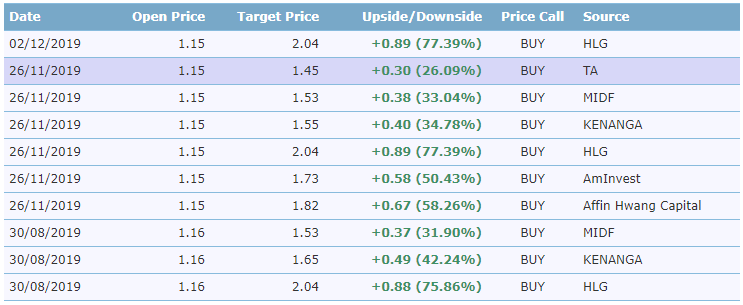
Suggested call of BUY with target price of RM1.43 at a P/E of 11.9. If you are looking for a SP Setia like company but can’t afford its high valuations, IOI Properties is a good alternative. This call is slightly less bullish as compared to analysts with an average TP of RM1.69.
Reasons for calls
- Huge upside potential in large projects such as IOI Putrajaya (RM19.5bn), Bandar Puteri Puchong (RM15.8bn), Bandar Putra Kulai (RM9.1bn), Cape Royale (RM5.0bn)
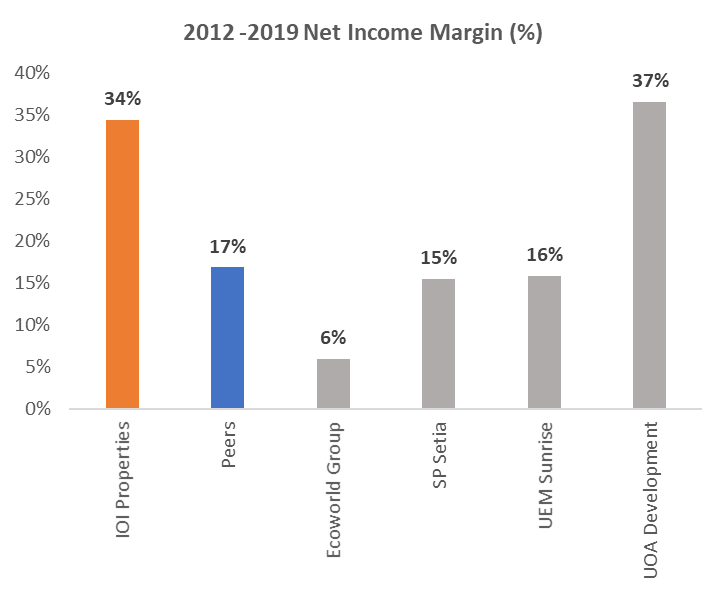
- Strong net income margin at 34% when compared to its peers at 17%.
- Stock is underappreciated and undervalued currently at P/E of 9.5.
- However, IOIPG will need to address its cash flow problems as it has large debt obligations in the next 3-4 years.
Background
IOI Properties Group Berhad (“IOIPG”) is the property arm of IOI Group which is also involved in the oil palm plantation business. It is mainly focused on the property development business in the residential sector with some exposure in the Leisure and Hospitality segment.
The Property Development arm is mainly involved in the township development in areas like Klang Valley, Penang, Southern Johor, Singapore and China. Notable overseas project includes IOI Palm City (RM5.0bn) and Xiang An (RM2.0bn) in Xiamen, China.
IOI’s Property Investment’s portfolio consist mainly of retail and office space with key investment properties of IOI Malls in Putrajaya, Puchong, and Kulai, Johor Bahru. Its Leisure and Hospitality arm owns and manages hotels, shopping malls, golf courses and office blocks with notable assets in Putrajaya Marriott Hotel & Spa, Palm Garden Hotel and Palm Villa Golf & Country Resort.
Property Development is IOI’s biggest revenue contributor at 84-88%, with Property Investment at 7-12% and Leisure & Hospitality at 4-7%. In terms of operating profit margins, Property Investment is highest at 50%, with Property Development at 31% and Leisure and Hospitality at 12%. IOI’s profit is mainly derived from its 2 arms of Property Development and Investment, at 73.8% and 22.0% contribution to profit respectively. At this point, readers would be wondering why property investment’s profit contribution is so high given that its revenue contribution is only at 9-10% for years 2015-2016. It is because it records fair value gain from disposal of its properties and share of results from its joint ventures at the bottom end of its Profit & Loss statement, and these 2 items make up a big chunk of the segment’s profit.
Market Performance
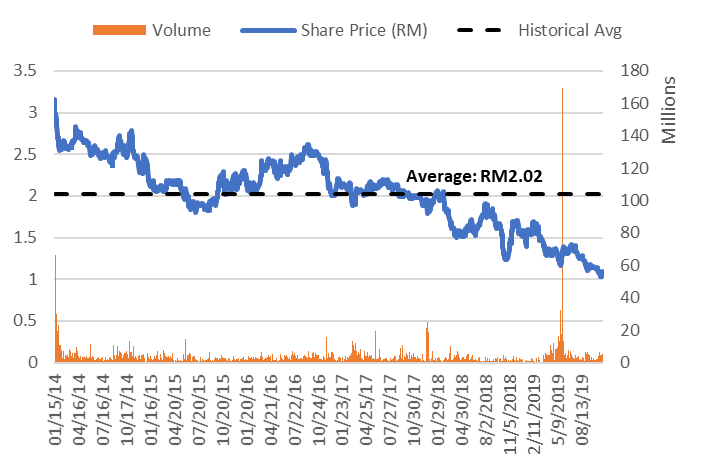
IOI Properties was listed on 15 Jan 2014, with an initial offer price of RM1.76 in its prospectus. Initial reception was positive, with share price trending at RM3.15 on the first day, but would soon drop to the lower RM2.00 range by the end of 2014. Share price in 2018 and 2019 trended lower than its average of RM2.02, signalling continued weakness in share price performance. Share price in 2019 especially has been particularly weak at an average of RM1.33 compare to 2018 average of RM1.68, which is in line with the soft property market that we are seeing now.
Source: WSJ
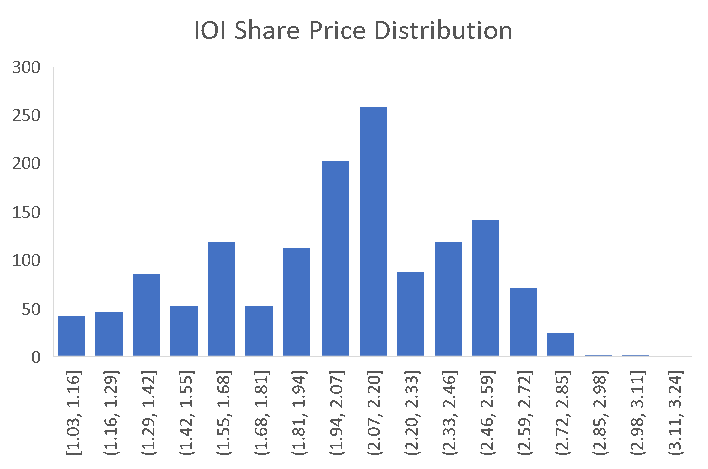
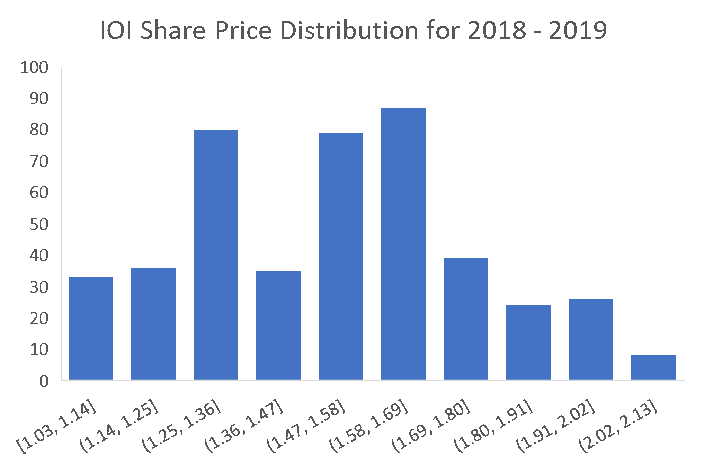
In terms of historical distribution, IOI is more balanced now, same as the last research report. However, I do see an opportunity now as its distribution in 2018 and 2019 is slightly tilted to the left. This means share price in the past 2 years have been slightly undervalued currently in my opinion.
Source: WSJ
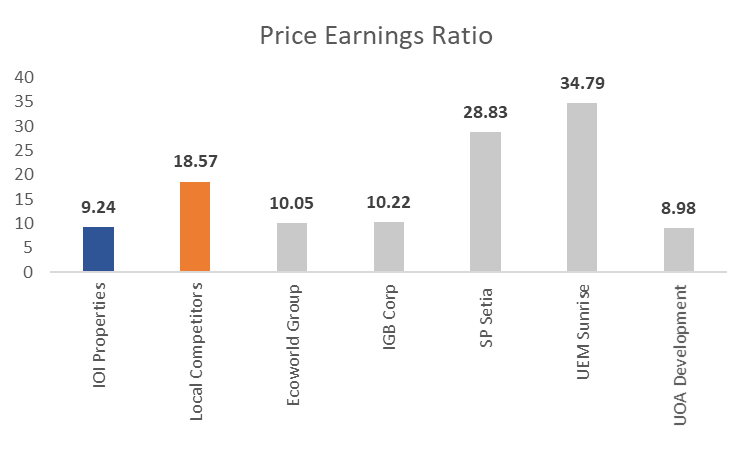
In terms of comparison against its peers, IOI would be classified as a big player in property development alongside SP Setia, UEM Sunrise and Eco World. Its market cap is one of the highest at RM6.22bn compared to SP Setia (RM5.78bn), UEM Sunrise (RM3.40bn) and Eco World (RM1.91bn). IOI’s P/E valuation at 9.24 seems fairly valued as it trades about the same as Ecoworld Group (10.05x), IGB Corp (10.22x) and UOA Development (8.98x). But overall, it remains at the low side of the P/E range with local peers averaging 18.57x with UEM Sunrise trading at the highest at 34.79x. The low P/E does jive well with the share price performance in 2018 and 2019, and presents a good opportunity to buy the stock at the moment.
Source: WSJ
Financial Analysis
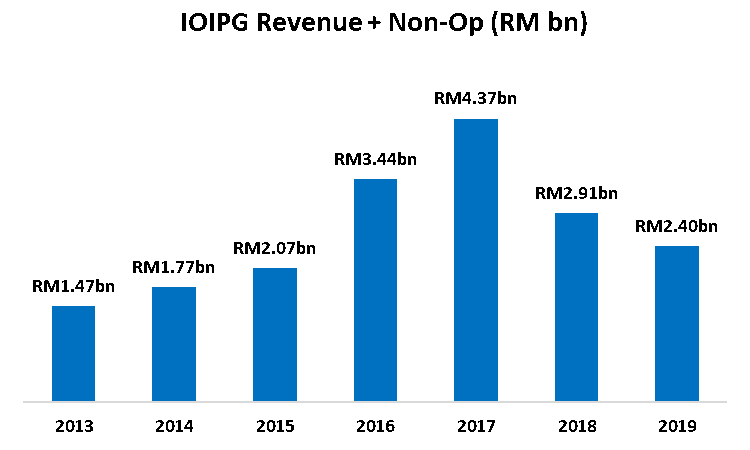
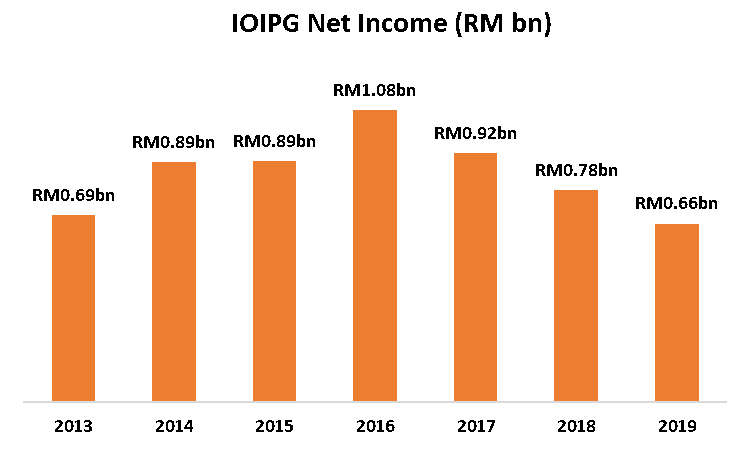
Firstly, let’s restate the profit and loss statement first. You can read about why I am doing this in my last research piece here. In 2018 and 2019, IOIPG’s revenue numbers declined significantly with the ongoing weakness in the broad property market. Revenue contracted by 18% from RM2.91bn to RM2.40bn in 2019, compared to its peak of RM4.37bn in 2017. IOIPG’s net income have also been contracting, but started its contraction from its peak in 2017 of RM1.08bn in 2016 to RM0.66bn in 2019.
Source: WSJ
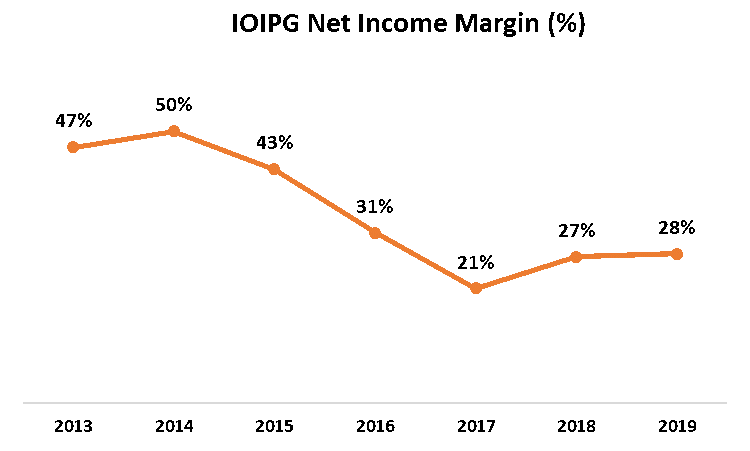
The bulk of IOI’s cost lies in its Cost of Goods Sold where it encompasses 70-80% of total operating cost, followed by SGA ( 10-20% ) and Other Op Expense (5-10% ). Its cost structure has improved in 2019, with total operating cost encompassing 59% of revenue (2018: 69%). As a result, net income margin improved slightly to 28% in 2019 (2018: 27%), but unfortunately has been contracting for 3 years straight from 2016 to 2019.
Source: WSJ
There is an interesting dynamic in 2016 and 2017. Firstly, revenue grew to RM4.37bn in 2017 (2016: RM3.44bn), but net income contracted to RM0.92bn (2016: RM1.08bn). This does have something to do on why I restated the profit and loss statement. There are unusual line items called non-operating income and unusual expenses (no pun intended) which have done something wonky to the final net income. A big part of the Non-Op income and Unusual Expense components composed of “Fair value gain on investment properties” and “Share of results of Joint Venture”. Fair value gain on investment properties basically means the properties are revalued and any gain is registered in the P&L which to me, is padding the P&L as this is not realised investment. Hence, looking at its cash flows actually make more sense in getting a clearer picture of IOI Properties.
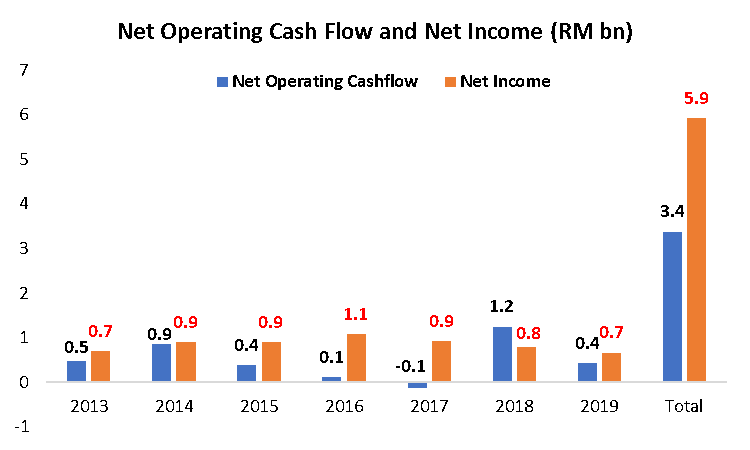
Looking at its Operational Cash Flow, IOI does not have a robust operational cash flow. Its Operational Funds to Revenue margin (my way of seeing how much funds are collected against revenue recognised) is low at 20% and Operational Funds to EBITDA margin is also low at an average of 43%. Its Net Operating Cash Flow to Net Income margin are also low at 57% with 2016 and 2017 registering a very low 11% and -14%. While there was a big jump in net operating cash flow in 2018 at RM1.2bn (2017: -RM132m), its operating cash flow declined to RM425m in 2019. From 2013 to 2018, IOIPG generated RM3.4bn in operating cash flow against registered net income of RM5.9bn. There is a significant gap of RM2.5bn that has not translated into cash for IOIPG and I am concerned about the ability of IOIPG to manage its net working capital position. However, I do think that if IOIPG makes some progress in addressing its net working capital problems, investors could potentially value it higher.
 Source: WSJ
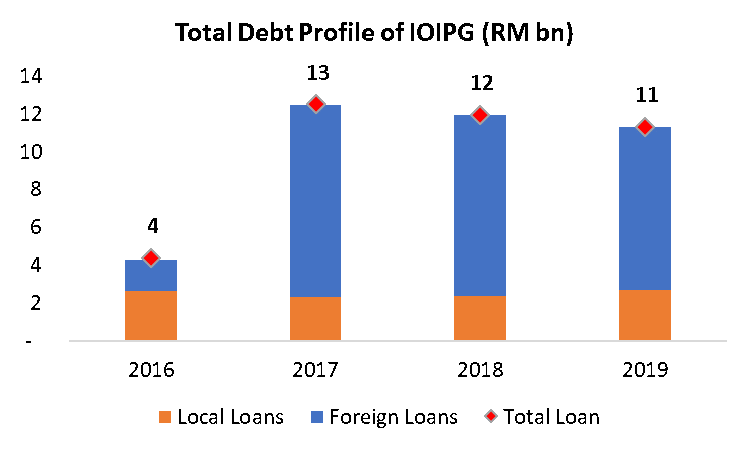
IOI has rapidly built up its debt profile in the last 3 years, from RM2.1bn in 2014 to its peak of RM12.5bn in 2017. Total borrowings has somewhat declined to RM11.3bn in 2019. Its short-term loan of RM6.9bn in 2017 to pay for a parcel of land in Central Boulevard, Singapore was converted to a long-term loan. A large portion of IOIPG’s total debt is denominated in foreign currency at 76% in 2019, but has declined from its peak of 81% in 2017. There is actually a considerable amount of risk in this regard as most of the loans have floating interest rates which will mature in 3-4 years time. This is concerning because its current cash position of RM1.6bn is inadequate to service its total loan obligations. Its cash pile would have to grow 63% every year for the next 4 years to service its total debt obligations. This implies that its current net income of RM661m would have to grow to an average of RM2.4bn for the next 4 years. However for context, this is the worse case scenario in that IOIPG isn’t able to obtain refinancing on its current debt obligations but it is still concerning with its high debt load.
 Source: WSJ
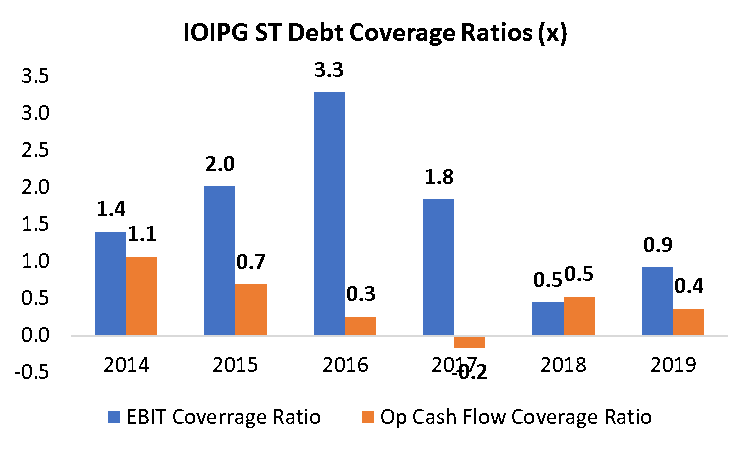
We established that there is a concern on IOIPG’s ability to repay its total loan obligations, and the same story is true for its short term obligations. Its ST obligations ratio (EBIT / (Interest + ST Debt)) has declined from its peak of 3.3x in 2016 to 0.9x in 2019, while its net operational cash flow cover has declined even further to 0.4x in 2019. As its investment in Singapore and China is still under construction, I do foresee that IOIPG will have some cashflow problems in the short to medium term and they might tap the capital markets for working capital requirements
 Source: WSJ
When compared to its peers, IOIPG does outperform most of them at an average net income margin of 34% compared to its peers at 19% from 2012 to 2019. One can argue that, if anything, it is performing better than the likes of Ecoworld Group and SP Setia whom have become darlings of the investor’s community.
 Source: WSJ
Valuation
I do think there is an underappreciation of IOIPG as a stable property stock and it does have ongoing large projects both domestically and internationally. Currently, IOIPG has about RM84bn worth of projects ongoing (including overseas projects in Singapore and China). If we take its net income margin of 28% currently, this implies a value of RM23.5bn. Current market capitalisation is at RM6.3bn which implies a discount of 74%, which is a very steep discount.
I am valuing IOI at RM7.9bn with a target share price of RM1.43 implying a P/E of 19.58. This is in comparison to current share price of RM1.14 (P/E of 9.5) and its competitor’s P/E of 18.6. In comparison to other analyst target prices, my target price is slightly less bullish when compared to their average of RM1.69 as I do think IOIPG needs to exhibit better cashflow management.
Source: i3investor
 Slice of P.I.E
