
Getting on a train in Maluri station with my friends after Friday school, was the first memory I can think of. I was about13 years old, getting into the groove of hanging out with friends and we were just so hungry to go on our way, exploring this city of Kuala Lumpur.
Back then, we would usually go to Times Square, taking the train at Maluri station and dropping off at Hang Tuah station. It was about 4 to 5 stations away along the Ampang – Sri Petaling LRT line. If my memory serves me right, it was about RM1.40 per way there. It might not seem like much but it was quite a fair bit considering that my daily allowance was RM5 and Nasi Lemak was about RM0.80 still (yes, I know, I am old).
Transportation in Malaysia had always been a matter of intense debate. Is it affordable? Is it accessible? Is it easy to use? Most importantly, does it actually help Malaysians?
Why Malaysians Take Trains versus Driving?
I think the main consideration for many Malaysians is the trade-off between money and time. Driving of course, takes less time, but it requires you to have a car or motorbike in the first place. That requires a big investment upfront and not everyone can afford that. Other than that, you would need to spend money on petrol and yearly maintenance for your vehicle. Traffic jams, oh they are the worst during rush hours.
Horn, horn! Here comes the train roaring into the platform. You strap up your bagpack, walk into the train, take a seat and enjoy a cup of coffee that you have just purchased from the shop in front of the station. It’s going to take 20 minutes to get to the station you need to get off. There are no jams, and you are assured the train will get there in time because why won’t they? You pop your earphones in and scroll through Tik Tok or Instagram, not concerned with the happenings around you. Now, that’s a less stressful way to get to your destination. In 2019, about 671,885 passengers board the trains in Klang Valley every day.
At least, that’s the ideal scenario in most Malaysian’s head when they consider the decision to take the train. But not all Malaysians do it and we got to dig a little bit deeper into the decisions that we all take regarding transportation.
Most Malaysians Travel to Get to the Train Stations … Not Exactly Convenient for Most
If you take only 5 to 10 minutes to walk to a train station, consider yourself lucky. Most, if not a majority of Malaysians need to take either the bus or drive instead to reach the train stations. Let’s admit it, if you need to take a bus to a train station, what’s the point? You might as well take the bus all the way to the stop that you need to get to. If you are driving, you would for sure need to park your car at the station and that involves some money too.
Let’s face it, getting a place near a train station is just so much more expensive. The B40 household income group can’t afford to live that near to train stations as many of the M40 and T20 will be “crowding out” the areas around train stations. Many developers are also aware of this and normally sell properties that are more expensive to higher-end clienteles. Economics make sense here. Higher demand for train services inevitably leads to higher prices of land around train stations. Developers will need to fork out more money to buy land from the city councils or other landowners, and charge higher prices for their properties to make up for the expensive land.
There are feeder buses that transport people to the train stations, and they are important to the communities and people who need them. However, if you are relying so much on feeder buses to transport people to train stations, then you have a bigger more fundamental problem at hand. Either, one, you don’t have enough train stations or it’s just so hard to get to one. I would argue that the problem is much more deep-seated.
It’s Not Like We Don’t Have Enough Trains or Train Stations.
Hear me out here. I know what you are thinking. Of course the Klang Valley doesn’t have enough trains. There’s none near my house or Taman. These thoughts will be along the line of a Malaysians when discussing about public transportation. I get it. But let me just state some numbers for context here.
In 2019, according to data from the Ministry of Transport, there were around 745,811 average traffic on a given day in Klang Valley (Kuala Lumpur + Selangor). I am not sure whether is there actually that little traffic for Klang Valley, but I don’t compile the data for MOT, From the same dataset also, there are about 671,885 passengers boarding the trains every single day also in 2019. To me, this looks like about an equal situation between driving and taking the train. Of course, you can argue that cars and buses carry much more passengers, and that the 745,811 is understating how many people actually travel around in Klang Valley. Quite a number of people in Klang Valley actually used trains then. What is the problem then?
Malaysia Just Encourages Malaysians … to Drive?
Let’s think about this. Driving is expensive. Don’t get me wrong here. From needing to buy a car that is expensive to paying for fuel and maintenance, driving is just plain expensive for most of us. Malaysian urbanites spend on average about RM669 per month on transport in 2019, which comes to about 13.6% of total spending according to data from Department of Statistics Malaysia.
However, we are incentivised to drive. We are so used to having fuel subsidies that cuts the cost of fuel by about 20% to 50% depending on how high global crude oil prices are. Malaysia actually ranks in the top 10 for the cheapest petrol prices in 2022, registering about US$0.47 cents per liter compared to the world average of US$1.36 per liter. The government is literally telling Malaysians to drive with the fuel subsidy. I am not here to argue whether we should maintain or remove the fuel subsidy, but rather I feel like for public transportation to be successful in Malaysia, we can’t have conflicting policies that also encourage people to drive.
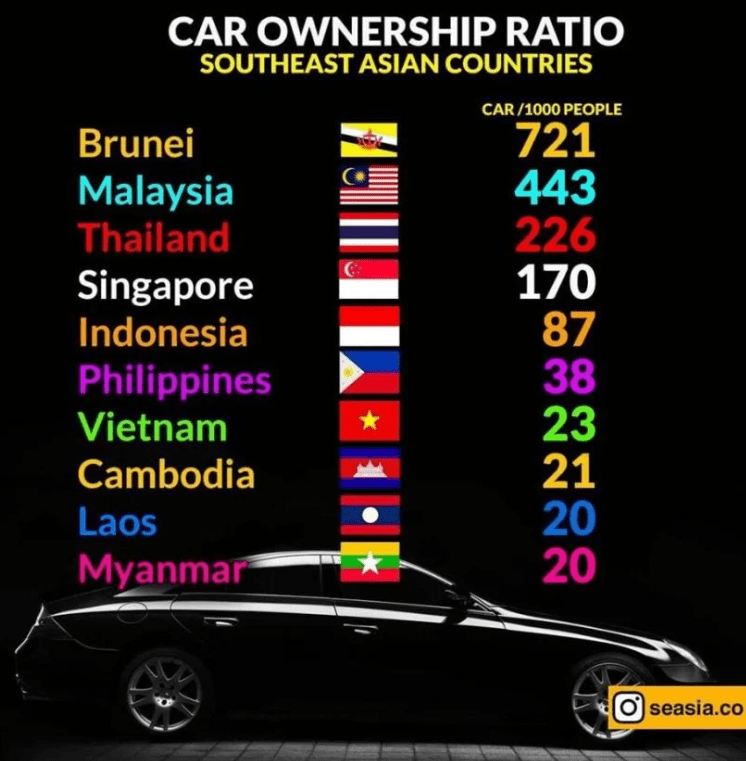
On another note, Malaysia also has explicit policies to encourage people to own cars. Malaysia actually ranks second for the highest cars per person in Southeast Asia, second to only Brunei. We have the national car maker of Proton, making cars to sell. Perodua’s Myvi is actually the most successful model to be rolled out in Malaysia. Car importers such as Toyota, Honda, Nissan, BMW, Mercedes, and Peugeot are also big players in Malaysia’s market.
Emphasis is Shifting Towards Public Transportation, But Is the Implementation Going to be Good?
The economics surrounding train transportation is sound in Malaysia’s context … at least in theory. Giving Malaysians the option to travel by train have opened up opportunities for them, as they can now look for jobs in areas that were deemed too far or inaccessible. For a breadwinner who can’t afford a car or motorbike, they now have the option to travel by train to another area to look for a higher-paying job that could improve the family’s livelihood. Kids who can’t get to a good school, now have the option of enrolling themselves in a better school somewhere else. Public transportation opens up choices for people who can’t afford it.
The key now would be implementation for the shift towards public transportation. We have started this process with the introduction of large train projects in the early 2010s, and in which it continued until today. However, multiple criticisms on the location of train stations and routes are valid. Having to pay for parking at train stations is just another burden on Malaysians. They can just drive to office and pay for the parking there instead. Waking up 6am in the morning to take a bus that leads to the train station, is just not sustainable for many Malaysians. They would just be spending more time travelling.
The next part (Part 2) on this topic, looks at the nitty gritties on the economics of investing in train projects in Malaysia and whether they are being done in a sound manner. Look out for it!
 Slice of P.I.E