
You can find part 1 here. Part 2 of this series will explore the intricacies of the automotive industry in Malaysia and why we need to keep producing cars.
It is actually interesting to see that all things in Malaysia point towards owning a car versus public transportation even from the production side.
For all the talks about taking public transportation, we are still stuck in this cycle of buying cars.
Malaysia Government Regularly Provides Incentives for Malaysians to Buy and Make Cars
It is an open secret that the Malaysian government encourages car ownership for Malaysians. In 2020, as part of its efforts to support Malaysians during the pandemic, the government introduced another round of sales tax exemption on passenger cars. This lasted until June 2022.
From 2010 to 2014, the government also introduced sales tax exemptions on hybrid cars to stimulate the drive towards green energy. Even before that, Malaysia heavily subsidized the manufacturing and production of cars in the 1980s and 1990s.
The Industry is a Big Part of the Malaysian Economy and Provides a Lot of Jobs for Malaysians
The automotive industry contributes around 4% to Malaysia’s gross domestic product, and is a big part of the Malaysian economy. Important players in the industry include Proton, Perodua, Toyota, Honda, Nissan, Mercedes, and BMW.
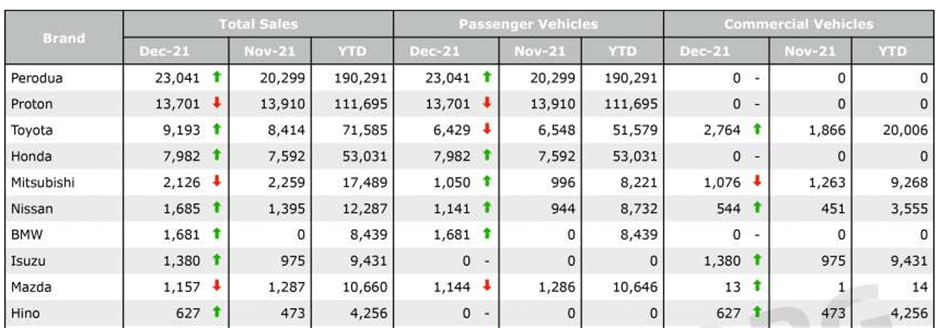
Passenger car sales have risen by 41.8% to 641,773 in 2022 – a record high. Average passenger car sales from 2010 to 2019 only amounted to around 550,000. In 2021, Perodua is the market leader followed by Proton, Toyota, Honda, and Nissan.
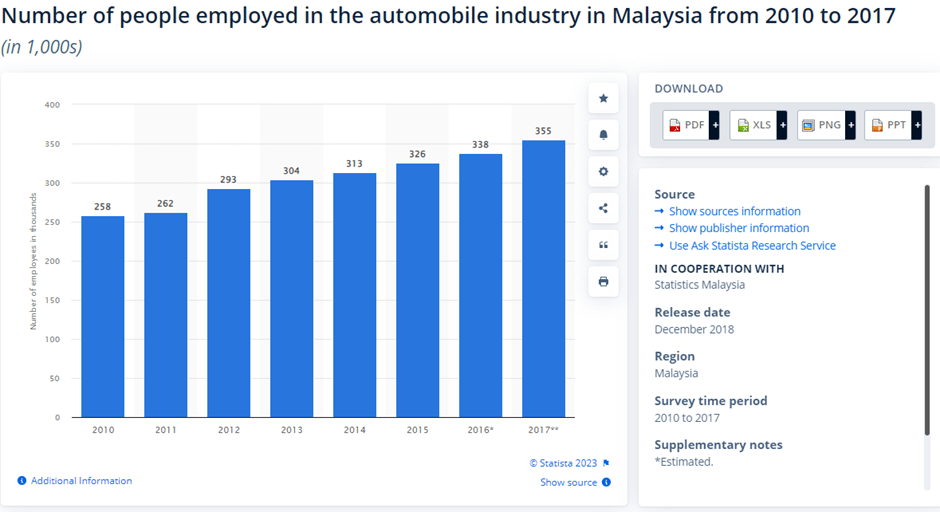
Hence, the automotive industry became an important source of employment for many Malaysians. Based on latest data in 2017, the automotive industry employed around 355,000 people, which is equivalent to 2.3% of Malaysia’s total labour force.
The Automotive Industry is Seen as the Industry that Will Drive Growth in Other Industries Also
Not only is the automotive industry good for itself, it also drives growth in other industries also. According to the Input-Output Table 2019, the automotive industry contributes mainly to the wholesale & retail sales and repair & maintenance of vehicles industries in Malaysia.
Other than that, it also purchases a lot of raw materials from the rubber, metal, and electrical and electronics industries to assemble its automotive vehicles. The table below shows how much input the automotive industry requires and produces for other industries in Malaysia.
Moving forward, Malaysia’s National Automotive Policy 2020 is Focused on Increasing the Development of Electric Vehicles
Electric vehicles seems to be the rage these days. Elon Musk and Tesla popularized the idea of electric vehicles and is now one of the biggest electric vehicles company in the world. Not far away, Chinese electric vehicles makers such as BYD have also became a prominent player in the market. Every car makers from Ford, Nissan, Volvo and many other are also getting into the electric vehicle market.
It seems like Malaysia is going on the same path too, with Proton and Geely spearheading the RM32 billion Automotive High-Tech Valley in Tanjung Malim in line with the National Automotive Policy 2020. The project will focus on attracting investments in electric vehicles over the next 10 years from various players to do the following things:
- High-tech global R&D centre
- Manufacturing hub
- Support services for the automotive industry
- Research-oriented university
Yeap, we will still be making cars, and buying them in the next 10 years.
Conclusion
I think we will still keep making cars, and selling them. Malaysians will keep buying them. From part 1, we could see that the fuel subsidy is the main reason why people drive. And in part 2, we could see that the Malaysian industry is geared towards making cars and the government actually encourages Malaysians to buy them too.
 Slice of P.I.E