

Written by Jake Lim Chia Hoong
Alright, listen. I love rice. Always have, probably always will, and I’m willing to bet a lot of Malaysians are the same way.
But the thing is, there’s a shortage of that starchy goodness in the country right now, which naturally raises a couple of questions, the first and most obvious being ’How’d that happen?’.
While many factors are at play…
Weather & diseases are the two major factors contributing to the rice shortage
According to the deputy director of development of the Farmers Organisation Authority, Amir Mat Amin, one of the factors that caused a hiccup in the supply of local white rice was the uncertain weather throughout the last harvest season between April and August.
A bevy of floods, said Amir Mat Amin, played a part in reducing the usual padi yield per harvest of roughly 7 metric tonnes per hectare to just four metric tonnes per hectare.
On top of that, some of the local rice crops were plagued by diseases such as bacterial leaf streak disease (BLS), bacterial leaf blight (BLB) and bacterial panicle blight (BPB). Mohd Asri Badron, a Sekinchan padi farmer, lamented that seeds given to farmers by our government are ‘of poor quality’, and the hybrid seeds used by farmers in most other regional rice-producing nations are ‘sturdier and can fight infection better’.
The situation’s gotten so bad that supermarkets and grocery stores in multiple states including Melaka, Selangor, Pahang, Negeri Sembilan, Perlis, Johor, Kedah, Terengganu and Kelantan are either lacking in or totally void of local white rice.
Of course, this also means that…
Prices of imported white rice have skyrocketed & food prices might go up
With the local white rice going the way of my dad – absent, that is – consumers have had to resort to buying the more expensive white stuff: imported rice. It’s a tough pill to swallow especially for folks in the B40 category, because a 10kg bag of imported white rice apparently costs RM39 at the time of writing, compared to its previous price tag of RM33.
“…So, I have no choice but to get the imported rice although it is expensive… and prices have gone up several times too,” – .Housewife and mother of four, Kamaria Ismail, 38
And according to Datuk Azman Mahmood, director-general of the Ministry of Agriculture and Food Security’s (KPKM), we’ll only see the comeback of local white rice toward the end of this year. In the meantime, one of the steps the government is taking to cushion the impact of the issue is giving hypermarkets as well as traders discounts to buy imported rice for business purposes.
During a meeting held between restaurant operators, small vendors and related parties at Putrajaya last Friday, the government decided to give out 103 licenses to small wholesale sellers. Through this, entrepreneurs in the food business association can buy imported white rice for RM160 per 50kg, which is the warehouse door price.
This is no guarantee that food prices won’t increase, though, because the Asian Development Bank estimated that a 30% hike in international food prices in 2011 translated to a 10% rise in food prices for developing Asia despite the region’s reportedly stable rice stockpile.
As if that weren’t worrying enough…
We’re eating rice faster than farmers can grow it
Even though the production of rice in Malaysia has been fairly steady in the past ten years, ‘steady’ just won’t cut it in the long term. We’re just eating more rice than the local farmers can harvest, and the gap between consumption and production is likely to widen going forward.
This is illustrated pretty well in a 2015 study:
Written by Jake Lim Chia Hoong
Alright, listen. I love rice. Always have, probably always will, and I’m willing to bet a lot of Malaysians are the same way.
But the thing is, there’s a shortage of that starchy goodness in the country right now, which naturally raises a couple of questions, the first and most obvious being ’How’d that happen?’.
While many factors are at play…
Weather & diseases are the two major factors contributing to the rice shortage
According to the deputy director of development of the Farmers Organisation Authority, Amir Mat Amin, one of the factors that caused a hiccup in the supply of local white rice was the uncertain weather throughout the last harvest season between April and August.
A bevy of floods, said Amir Mat Amin, played a part in reducing the usual padi yield per harvest of roughly 7 metric tonnes per hectare to just four metric tonnes per hectare.
On top of that, some of the local rice crops were plagued by diseases such as bacterial leaf streak disease (BLS), bacterial leaf blight (BLB) and bacterial panicle blight (BPB). Mohd Asri Badron, a Sekinchan padi farmer, lamented that seeds given to farmers by our government are ‘of poor quality’, and the hybrid seeds used by farmers in most other regional rice-producing nations are ‘sturdier and can fight infection better’.
The situation’s gotten so bad that supermarkets and grocery stores in multiple states including Melaka, Selangor, Pahang, Negeri Sembilan, Perlis, Johor, Kedah, Terengganu and Kelantan are either lacking in or totally void of local white rice.
Of course, this also means that…
Prices of imported white rice have skyrocketed & food prices might go up
With the local white rice going the way of my dad – absent, that is – consumers have had to resort to buying the more expensive white stuff: imported rice. It’s a tough pill to swallow especially for folks in the B40 category, because a 10kg bag of imported white rice apparently costs RM39 at the time of writing, compared to its previous price tag of RM33.
“…So, I have no choice but to get the imported rice although it is expensive… and prices have gone up several times too,” – .Housewife and mother of four, Kamaria Ismail, 38
And according to Datuk Azman Mahmood, director-general of the Ministry of Agriculture and Food Security’s (KPKM), we’ll only see the comeback of local white rice toward the end of this year. In the meantime, one of the steps the government is taking to cushion the impact of the issue is giving hypermarkets as well as traders discounts to buy imported rice for business purposes.
During a meeting held between restaurant operators, small vendors and related parties at Putrajaya last Friday, the government decided to give out 103 licenses to small wholesale sellers. Through this, entrepreneurs in the food business association can buy imported white rice for RM160 per 50kg, which is the warehouse door price.
This is no guarantee that food prices won’t increase, though, because the Asian Development Bank estimated that a 30% hike in international food prices in 2011 translated to a 10% rise in food prices for developing Asia despite the region’s reportedly stable rice stockpile.
As if that weren’t worrying enough…
We’re eating rice faster than farmers can grow it
Even though the production of rice in Malaysia has been fairly steady in the past ten years, ‘steady’ just won’t cut it in the long term. We’re just eating more rice than the local farmers can harvest, and the gap between consumption and production is likely to widen going forward.
This is illustrated pretty well in a 2015 study:
Written by Jake Lim Chia Hoong
Alright, listen. I love rice. Always have, probably always will, and I’m willing to bet a lot of Malaysians are the same way.
But the thing is, there’s a shortage of that starchy goodness in the country right now, which naturally raises a couple of questions, the first and most obvious being ’How’d that happen?’.
While many factors are at play…
Weather & diseases are the two major factors contributing to the rice shortage
According to the deputy director of development of the Farmers Organisation Authority, Amir Mat Amin, one of the factors that caused a hiccup in the supply of local white rice was the uncertain weather throughout the last harvest season between April and August.
A bevy of floods, said Amir Mat Amin, played a part in reducing the usual padi yield per harvest of roughly 7 metric tonnes per hectare to just four metric tonnes per hectare.
On top of that, some of the local rice crops were plagued by diseases such as bacterial leaf streak disease (BLS), bacterial leaf blight (BLB) and bacterial panicle blight (BPB). Mohd Asri Badron, a Sekinchan padi farmer, lamented that seeds given to farmers by our government are ‘of poor quality’, and the hybrid seeds used by farmers in most other regional rice-producing nations are ‘sturdier and can fight infection better’.
The situation’s gotten so bad that supermarkets and grocery stores in multiple states including Melaka, Selangor, Pahang, Negeri Sembilan, Perlis, Johor, Kedah, Terengganu and Kelantan are either lacking in or totally void of local white rice.
Of course, this also means that…
Prices of imported white rice have skyrocketed & food prices might go up
With the local white rice going the way of my dad – absent, that is – consumers have had to resort to buying the more expensive white stuff: imported rice. It’s a tough pill to swallow especially for folks in the B40 category, because a 10kg bag of imported white rice apparently costs RM39 at the time of writing, compared to its previous price tag of RM33.
“…So, I have no choice but to get the imported rice although it is expensive… and prices have gone up several times too,” – .Housewife and mother of four, Kamaria Ismail, 38
And according to Datuk Azman Mahmood, director-general of the Ministry of Agriculture and Food Security’s (KPKM), we’ll only see the comeback of local white rice toward the end of this year. In the meantime, one of the steps the government is taking to cushion the impact of the issue is giving hypermarkets as well as traders discounts to buy imported rice for business purposes.
During a meeting held between restaurant operators, small vendors and related parties at Putrajaya last Friday, the government decided to give out 103 licenses to small wholesale sellers. Through this, entrepreneurs in the food business association can buy imported white rice for RM160 per 50kg, which is the warehouse door price.
This is no guarantee that food prices won’t increase, though, because the Asian Development Bank estimated that a 30% hike in international food prices in 2011 translated to a 10% rise in food prices for developing Asia despite the region’s reportedly stable rice stockpile.
As if that weren’t worrying enough…
We’re eating rice faster than farmers can grow it
Even though the production of rice in Malaysia has been fairly steady in the past ten years, ‘steady’ just won’t cut it in the long term. We’re just eating more rice than the local farmers can harvest, and the gap between consumption and production is likely to widen going forward.
This is illustrated pretty well in a 2015 study by Rajamoorthy, Rahim, Munusamy (2015):
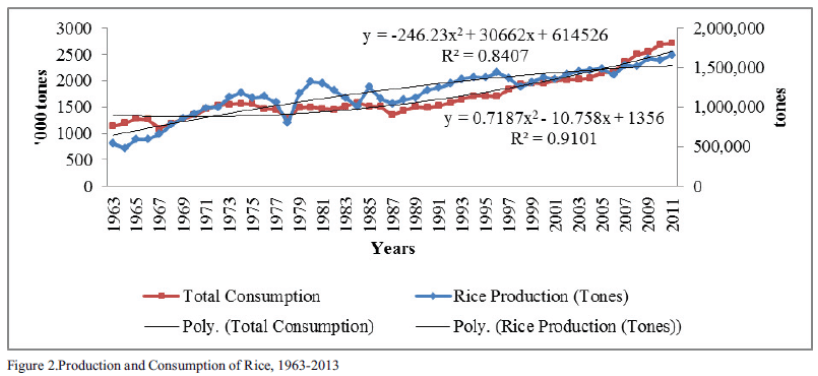
Notice how the estimated rice production stays more or less the same, but the consumption numbers keep going up? Yeah, that’s a problem. A paper published by the Khazanah Research Institute in 2019 supports that notion:
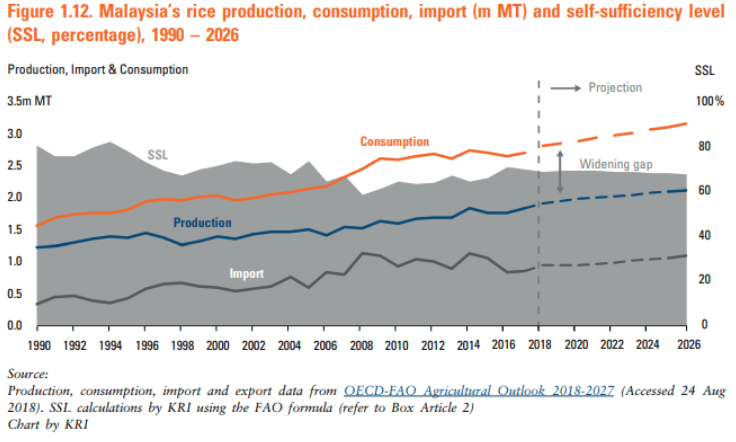
To keep up with the demand, our country has imported more and more rice every year. And even though that’ll probably be fine for Malaysians who are more financially well-off, most of our wallets will feel it if we have to start buying imported rice instead of local rice.
So, what’s the takeaway from this entire thing? Do I have a solution for y’all? Uh… start getting used to eating less rice, I guess.
Notice how the estimated rice production stays more or less the same, but the consumption numbers keep going up? Yeah, that’s a problem. A paper published by the Khazanah Research Institute in 2019 supports that notion:
To keep up with the demand, our country has imported more and more rice every year. And even though that’ll probably be fine for Malaysians who are more financially well-off, most of our wallets will feel it if we have to start buying imported rice instead of local rice.
So, what’s the takeaway from this entire thing? Do I have a solution for y’all? Uh… start getting used to eating less rice, I guess.
Notice how the estimated rice production stays more or less the same, but the consumption numbers keep going up? Yeah, that’s a problem. A paper published by the Khazanah Research Institute in 2019 supports that notion:
To keep up with the demand, our country has imported more and more rice every year. And even though that’ll probably be fine for Malaysians who are more financially well-off, most of our wallets will feel it if we have to start buying imported rice instead of local rice.
So, what’s the takeaway from this entire thing? Do I have a solution for y’all? Uh… start getting used to eating less rice, I guess.
 Slice of P.I.E