
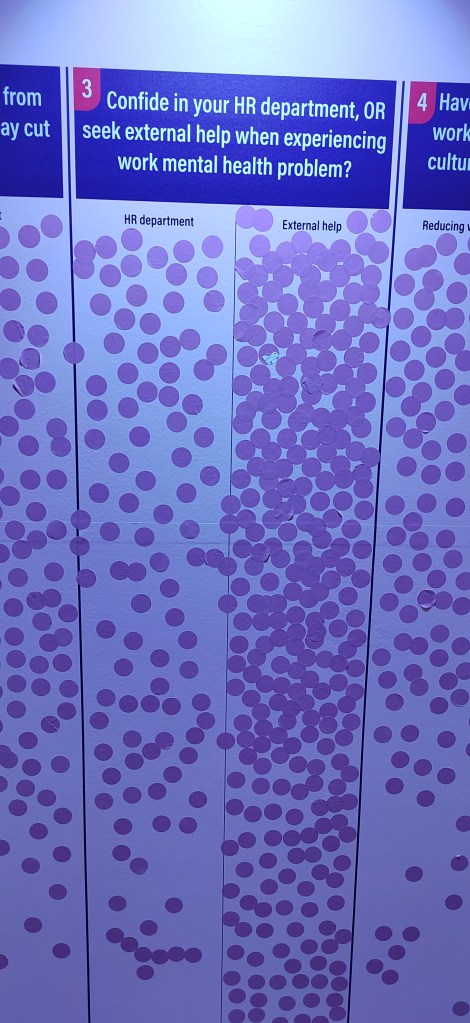
This picture was taken in KLCC for their Mental Health event happening now until 15 October 2023, and my thoughts resonated heavily with it. Like many of the respondents, I put my sticker on the external help section, where the result wasn’t anything surprising.
Overwhelmingly, most Malaysians prefer to seek external help on their mental health problems, rather than talk to their company’s human resources (HR). As someone who has faced this dilemma before, I can empathize with how the majority of people feel about this issue.
Here are my thoughts on this as I believe this isn’t exactly black and white.
HR is not on your side … most of the time
I am sad to say this, but I do think HR in many cases are not on the employees’ side. They are there to protect the company. Based on my experience working for multiple companies already in my 8 years career, HRs were rarely on my side.
It sounds cliché, but it’s true. I remembered telling one unnamed HR personnel that I would like to take some time off to recuperate mentally and the email reply was simply, “Why? Do you have mental illness? You didn’t disclose this in your health disclosure form.” I didn’t reply to that email ever again and proceeded to work continuously.
There was a single time when I went to the doctor for anxiety problems, and the doctor literally told me, “I am going to put your ailment as headache and change the name of your anxiety meds. Your company’s HR and management have a track record and history of prying into its employee’s mental health issues and asking us to disclose it. We have fended them off multiple times but for your career’s sake, I am putting it as such. Hope you understand”.
To be honest, I can prove conclusively whether the company knowing my mental health problems, had discriminated. But I do know this, my career trajectory fell off when one time I applied for no-pay leave, citing mental health difficulties. It could be due to me setting boundaries, but I never got promoted for anything after that.
I secretly went and seek help on my leave days and weekends
It’s true, I applied for leave and went for therapy. This was at the peak of my panic attacks, where I cited false reasons why I was taking leave. Vacation was the most common reason.
Looking back, I remembered being afraid and scared that anyone outside of my family and friends know that I have panic attacks. And that fear compounded even more when I was trying to hide them. I have seen many of my colleagues have about the same symptoms that I had but all of them denied anything was wrong with them in front of managers and management.
The stigma is still strong, even until today. But I believe it’s because very rarely someone confesses to having mental health problems officially. Everyone I have talked to worry about the blowback to their careers if other people know about it. Hence, most of them have gone ‘underground’ to meet therapists and counsellors and put on a façade that everything is ok in front of their companies.
Some companies do have a compassionate culture towards mental health
I haven’t met one but I have heard of companies which have big focuses on employees’ well=being. I am a little bit skeptical to be honest but that’s my bias. I shouldn’t let my bias cloud the fact that many companies view mental health as more important these days.
Some companies have policies that mandate that employees take ‘mental health’ break days every quarter if they need them. Company management actively embody these policies by sending out emails that they are doing so in hope that employees will follow suit.
Some managers, who have gone through mental health problems, also create a culture where their subordinates can raise their concerns on mental health well-being anytime and ensure that no repercussions will come their way.
Maybe what’s even more important is the prioritization of employee’s well-being as a key performance indicator for the company. Some companies and management have done this in that management and managers’ performance are tied to subordinates well-being.
Conclusion
My advice is seek external help if you have doubts about your company’s HR and even if you are confident, still don’t tell them … in the initial stages. I have biases but I think that we should all prioritize ourselves rather than trust the company.
 Slice of P.I.E