

Yes, I went and read Tesla’s 2022 ESG report which was 224 pages. Well, it wasn’t exactly 224 full pages. There were a lot of pictures and just enough wording to deliver the messages. Link here if you want to read it (probably get bored after 10 pages).
If you are interested in investing in Tesla, this will be useful as many investors are now looking at the ESG aspect of EV companies worldwide. And some funds even set the criteria that they will only invest in companies included in ESG indexes. Hence, as an investor, knowing about the ESG aspects of a company becomes key to understanding what are the factors driving investors’ interest in it.
Here are 7 things that you absolutely should know about Tesla’s ESG.
Tesla’s ESG aim is to accelerate the world’s transition to sustainable energy
I know, I know. This sounds like any other EV company’s objective. But if we dig deeper into it, there is some commercial sense here to be made.
Tesla is trying to solve one main problem. The world heavily relies on fossil fuels (about 80% of power generation), and this is leading to climate change problems.
Tesla makes electric vehicles where the electricity used to power them is generated from renewable energy (hopefully but at least it incentivizes a shift to renewable energy.
From the commercial side, Tesla aims to build and deliver 20 million EVs a year by 2030 and reduce the cost of one by 50%.
It is the biggest EV in the world, but competitors are catching up
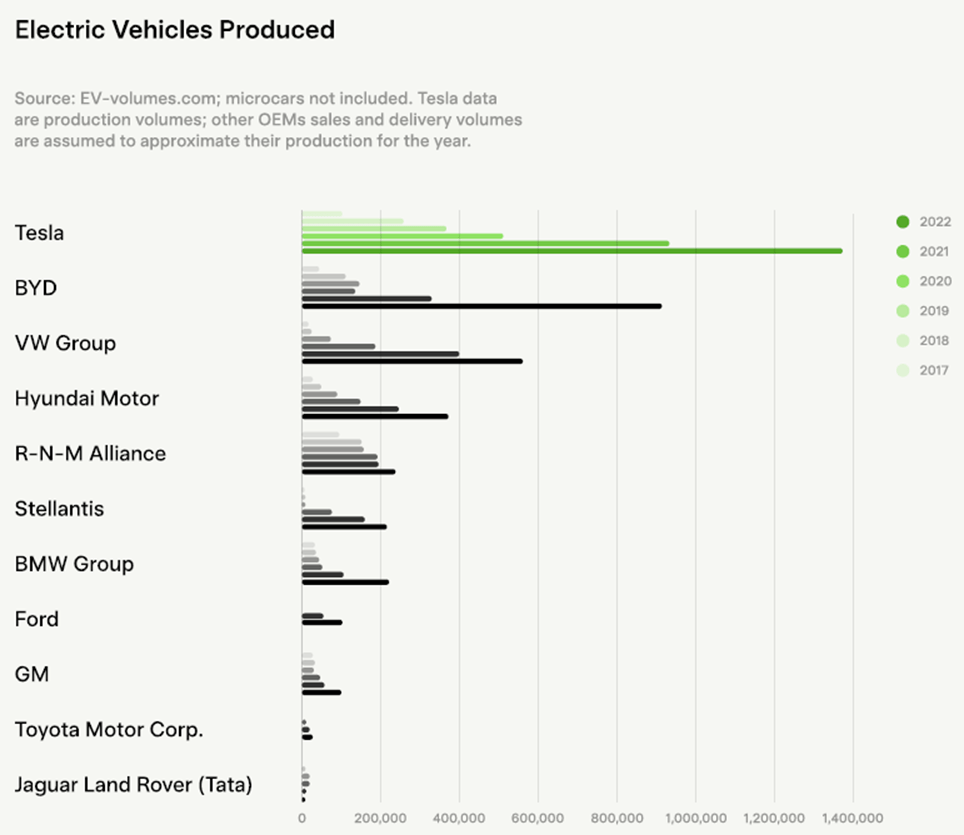
Production-wise, Tesla is far ahead of its second biggest EV player, BYD. In 2022, it produced about 1.3 million EVs. Interestingly enough, it made US$1.8 billion in revenue from selling carbon credits to other equipment manufacturers. Huh?
However, some of the other EV players such as BYD, VW Group, Hyundai, and R-N-M Alliance are catching up. BYD’s production has ramped up significantly in recent years and is now only about 30% to 40% lower than Tesla’s. VW Group is also not far behind.
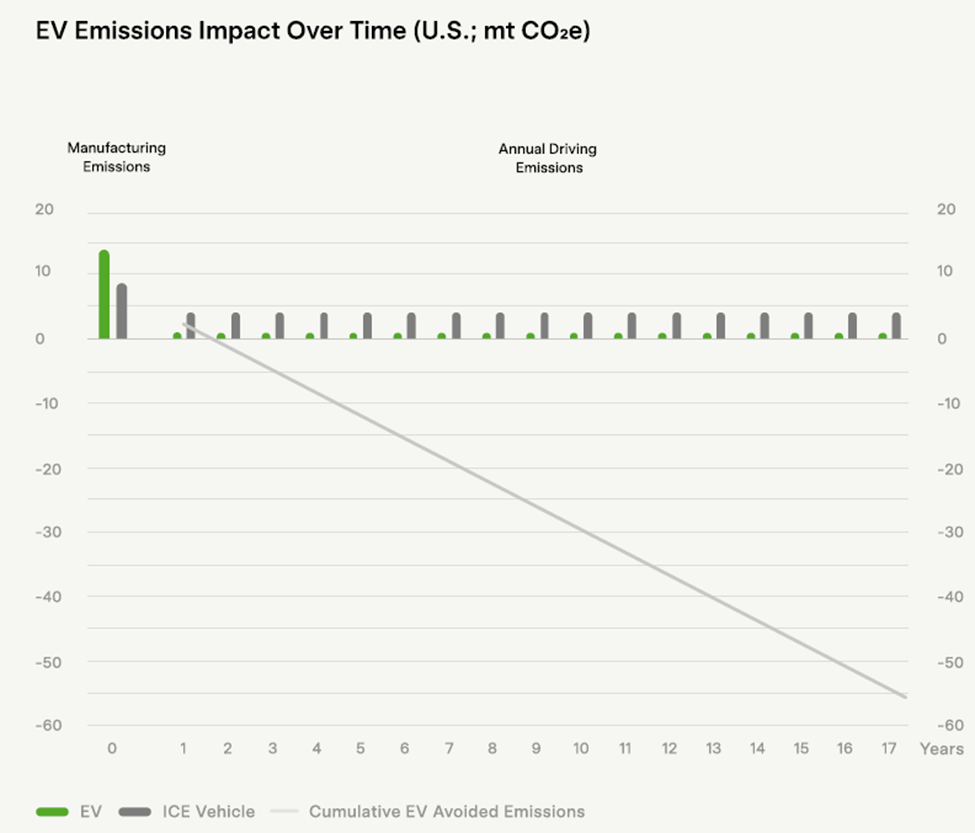
One Tesla will avoid about 55 tons of carbon emissions in its lifetime
This is the crux of Tesla’s ESG. One Tesla will help avoid 55 tons of carbon emissions (compared to a normal car) over the lifetime of the car. In 2022, all of Tesla’s customers avoided 13.4 million tons of carbon emissions. But there’s a catch here.
The production of a Tesla emits more carbon emissions than a normal car. But because of the electricity usage (assuming that it comes from renewable energy), throughout its lifetime, the total carbon emission by a Tesla is less in totality than a normal car guzzling on fossil fuel.
To elaborate more on this, most of Tesla’s carbon emissions are coming from its upstream supply chain which is its factory energy consumption direct emissions, and use-phase emissions. If these big words are scaring you, they did to me too.
But it essentially just means that when companies extract key minerals such as lithium, aluminium, cobalt, and nickel which are important for the production of batteries in EVs, they produce a lot of carbon emissions. Other than that, the electricity used to produce the components for the cars also does so. Here’s the comparison of a Tesla (green) to a normal vehicle (grey).
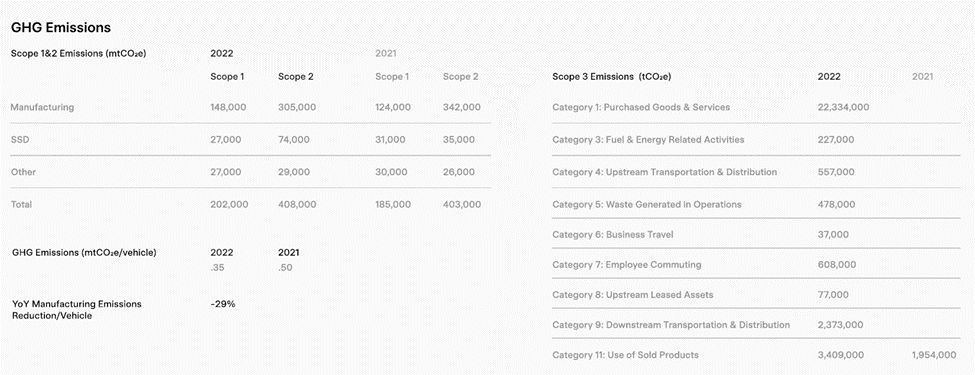
Tesla’s car emissions have gone down significantly in the past year, but there’s a catch
If we look at its scope 1 and 2 emissions which essentially measure whatever direct emissions Tesla is emitting from its production process and the lifetime of the cars, that has come down by 29% to 0.35 mtCO2/vehicle in 2022 from 0.50 mtCO2/vehicle in 2021. Here are the quick explanations of scope 1 and scope 2 emissions.
- Scope 1: Stationary and mobile combustion (the vehicle when driven), process emissions (production process)
- Scope 2: Purchase of electricity and heat
But if you have read the last point, it is not enough to just measure scope 1 and 2 emissions only. Tesla causes more emissions in the upstream supply chains from the mining of rare earth minerals that are used in battery production, which is called Scope 3 emissions. Scope 3 emissions will almost double in 2022.
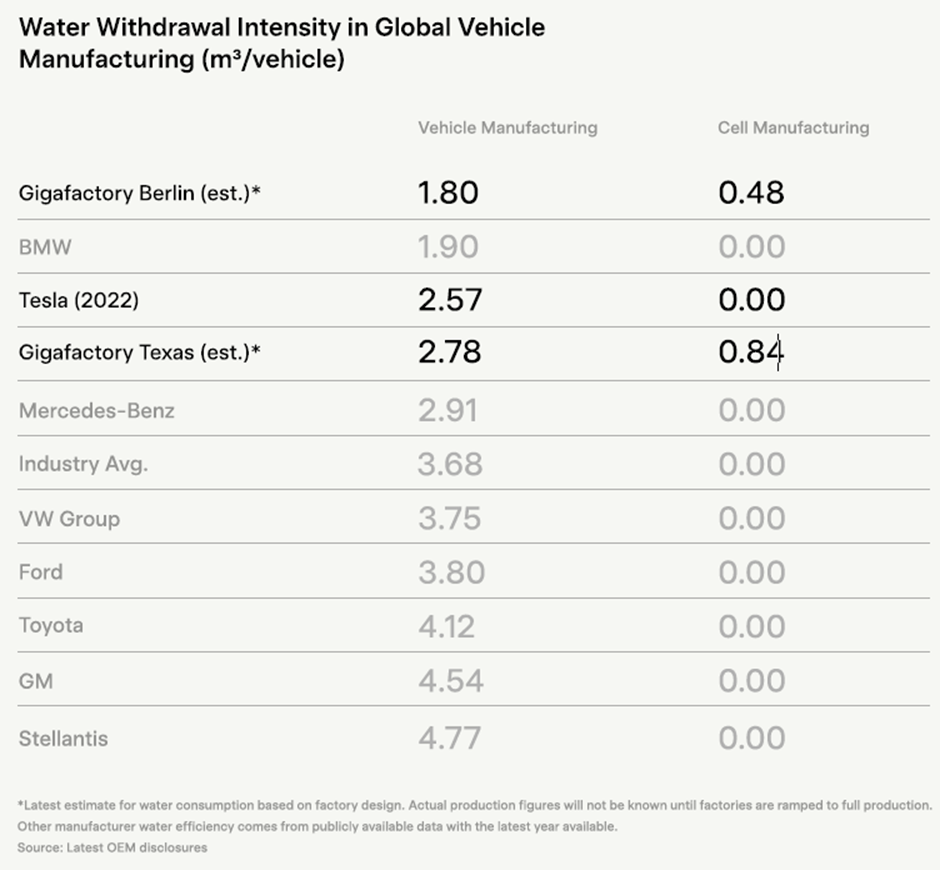
Tesla … uses a lot of water … surprisingly but its usage is low compared to the industry
I am just surprised to find out the amount of water being used in the production of cars. Currently, Tesla uses about 2.57 cubic meters of freshwater per vehicle or 2,570 litres of water. For context, a normal human being consumes about 3.2 litres of water per day.
That consumption has declined by 15% from 3.10 cubic meters per vehicle in 2020 and is relatively lower when compared to the industry’s average of 3.68. However, there is a caveat here. This is only true if we look at the manufacturing of vehicles. Tesla also uses water for the manufacturing of their battery cells which other traditional car companies don’t.
In its gigafactories in Berlin and Texas, Tesla uses water to cool the manufacturing processes in the production of batteries. The Texas factory uses 2.78 for the car manufacturing process, and 0.84 for the battery cell manufacturing, which comes up to 3.62, which is quite in line with the industry’s average.
3 main strategies to reduce its manufacturing carbon emissions
There are essentially three thrusts to Tesla’s reduction in manufacturing carbon emissions. Firstly, it is looking to build more sustainable factories from the ground up. They want to use less energy through the installation and design of green factories. For example, insulated, low-emissivity windows to reduce heating and cooling demand.
Secondly, it plans to cover all the roofs of its buildings with solar panels. Its supercharger stations have already been retrofitted with solar panels, and Tesla is planning to do the same for its factories and buildings too.
Thirdly, like all tech companies, it wants to use AI to make energy use more efficient. There is a lot of demand for heating and cooling in its factories and the AI will automate that.
Employee headcount and diversity – higher headcount and 67% underrepresented communities
Total global employee headcount increased sharply to 127,855 in 2022 from 99,290 in 2021, with half of them in manufacturing roles. Maybe the biggest point here is that its employees have the option to receive Tesla shares as pay and has attracted 3.6 million job applications in 2022.
In terms of diversity, the 67% underrepresented communities were computed just by subtracting the 33% white employees. To be honest, it’s hard to measure the impact of diversity quantitatively. All I have to say is that as long as they don’t hire solely based on filling a quota of ‘diversity’, there shouldn’t be much of a problem.
Conclusion
If you have been wondering about the ESG for Tesla, these points will be a good start for you. In the short-term, Tesla’s car emits more carbon emissions than a regular car due to its upstream supply chains of mining for rare earth minerals. However, in the long term, Tesla cars emit fewer carbon emissions in total.
 Slice of P.I.E