
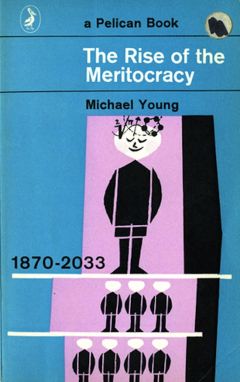
I am currently reading this book titled ‘The Rise of the Meritocracy’ by Michael Young, published in 1958.
Now, some background on the book. This book is a satire and is intended to criticise the state of education in the United Kingdom and the politics surrounding it in the 1950s.
Where is chapter 1? You wonder.
Well, I read the first chapter, then forgot about the book for 3 months, and here I am back reading it again.
So, I am just jumping straight to Chapter 2 – Threat of Comprehensive Schools
Comprehensive schools are public schools that accept anyone regardless of academic ability. And Michael Young paints the picture of how it will jeopardise the nation’s education system if the ‘smart’ and ‘dumb’ students are allowed together in the school without selecting and filtering in a satirical way.
Here are my thoughts and what I think I have learned from the Chapter.
This is an ongoing series where I will try to explore what I am learning from the books I am reading, and in turn, a reflection of my thoughts on them.
This is an ongoing series where I will try to explore what I am learning from the books I am reading, and in turn, a reflection of my thoughts on them. If you are interested in this content, subscribe to my channel!
Selection of ‘gifted’ and ‘talented’ students
What really stood out to me in Chapter 2 is the degree of severity of the selection of the ‘gifted’ and ‘talented’ students from a very young age. He writes about separating the smart from the dumb, the talented from the talentless, and the gifted from the ungifted as young as seven or eleven – barely of age.
Britain’s system is too hierarchical to allow a comprehensive school system that mixes the smart and dumb students. The dumb will feel even dumber, and the smart will get dragged down even further.
It’s best to select students based on their intelligence and talent from an early age so that they are put in the best situation possible. The best resources are deployed to them, so that they are ‘educated’ the best possible way, and in turn, they are pushed to the top of the social hierarchy.
The ‘mediocre’ and ‘talentless’ should be given basic education and minimal resources and funnelled into basic jobs, so that they can serve as cogs in the machine to serve the people higher up in the rungs of society.
Of course, this is satire, and Young is just pointing out the absurdity of such a situation when brought to an extreme. But essentially, that’s how the elites of English society viewed students in the education system.
He is touching on an important aspect of an education system built on ‘meritocracy’.
Students as factors of production, Labour
From my viewpoint, Young is criticising the prevalence of pure economics in dictating returns on education. He asks,
Which countries have the highest productivity? … Is not the moral obvious, that the battle for production will be won on he playing fields of the common school?
When you apply economics so rigorously to education, you tend to allocate resources into the most efficient ‘factors of production’. In this case, students are treated as ‘labour’, and the meritocratic education system invests in students who will produce ‘the highest rate of returns on investment’.
Hence, you treat children as ‘resources’ to exploit in the meritocratic economic system, awarding the best resources to ‘smart’ students.
Who’s smart and who’s dumb?
Therein lies the problem.
You are filtering students based on a narrow set of criteria that is determined arbitrarily by people in the ‘old’ system. Mind you, this book was written in the 1950s, when the aristocracy was slowly shifting to a new form of ‘elite’. In this case, these criteria were set by ‘old people’ who were once aristocrats and had the wealth and power in government.
Who is smart? It is such a vague question to ask. Mathematical and reasoning skills, and other science-based criteria, were put on a pedestal that required solid educational backgrounds and resources to achieve.
Young slyly said that these were all in the rich private and grammar schools, which essentially ‘detest’ the egalitarian comprehensive schools. In a nutshell, students who were placed in these schools were ‘smart’.
And how did they get there? My, of course, it was due to their ‘merit’ and smarts, that their parents’ and families’ power and wealth had nothing to do with.
The relevance to the modern world.
If you think this problem has gone away, think again.
This is where I think about the Malaysian education school system, and to a more extreme degree, the Chinese school systems.
We all know, from young, this ‘selection’ of who’s smart and who’s dumb was widespread in the Malaysian school system. We were selected into classes based on how well we did on our exams and test scores. From a young age, we were taught that doing well in exams guarantees our spots in the classroom rankings and hierarchy.
Comparison is rife. We are compared to every Tom, Dick and Harry (or in the Malaysian case, every Ali, Ah Hock and Mutu) how ‘smart’ we are. Being in the best classes guarantees the best teachers and resources, and in the ‘dumb’ classes, the school provides ‘basic’ and minimum attention.
Because why waste time and resources teaching kids who are not as ‘bright’? Those are low returns on investments.
The Malaysian Chinese school system took this to the extreme
To me, the Chinese school system took this philosophy to the extreme. I am not from a Chinese school (let me be clear), but my wife was. And she said some really important points about the system.
Shame is a core part of how they teach and keep everyone in line and focused on being ‘smart’. Arts (except for calligraphy and brass bands) are considered ‘low-return’ activities and hence, not emphasised.
She joked that the system took these children in and used shame to strip out all the ‘useless’ attributes and personalities from them, conforming them to the ‘ideals’ of an obedient school kid, and spitting them out to society as ‘identical’, traumatised adults that see merit as the highest of achievements and the only path in life.
They may or may not adapt to society.
You know what the worst thing is? We praise the Chinese school system for producing such kids who are ‘smarter’ and more hardworking than anyone else. The amount of time that I have heard people (especially Chinese people) talk about the ‘superiority’ of the Chinese school system, really makes me wonder what kind of state society is in right now.
And I am Chinese.
To me, the Malaysian school system is based entirely on selecting the ‘smart’ and filtering out the ‘dumb’ ones. Young, in his satire, accurately brings to light that this will surely not produce generations that are traumatised and only view achievement and merit as the only goals in life.
Surely not, right?
 Slice of P.I.E