

“Got oil?”
That has been the word on the street, last week. America and Israel going to war with Iran, has rattled the oil and gas markets.
This week, I am keen to talk about them.
Like what you are reading? Give us a follow and subscription for more content on investment, economics and personal development/philosophy.
The Fallout from the Iran Conflict on the United States and China
In just a week, the WTI crude oil prices have hit the US$100 mark. And this means trouble for the global economy and stock markets.
I like to keep things simple and straightforward, but not to a point that it loses context and nuances. Iran’s oil production makes up 12% of the world’s supply. Even though it’s sanctioned by the United States, it still finds its way around the world, especially to China at discounted prices.
So, the first country that I am looking at right now is China. While officially, China does not publish any data on this since 2022, Kpler estimates that it makes up 12% of China’s imports of oil. Most importantly, 31% of China’s imports of oil come from the Middle East.
And the region is going through a tough spot. Iran saddles on the other side of the Straits of Hormuz, which facilitates about 20% of the world’s shipment of liquid oil. And the conflict has shut the shipping lane down.
Understandably, the Shanghai Composite Index sunk by 1.9% to as low as 4,082 in the mid-week, before recovering to 4,124 by the end of the week.
However, the risks remain. China is a net energy importer. This means it consumes more energy than it produces. In economics, a cutoff in oil supply would mean that China would have to pay more for less. And it needs them to run the second-biggest economy in the world.
Meanwhile, the United States has the same situation. Just less severe. With the discovery of shale oil, the U.S. has significantly improved its oil & gas stockpile. It has stocked up on plenty of natural gas, and has record production in the past year.
However, this assumes that the conflict only lasts until the end of the month. China will definitely need to look for alternative sources of oil, which I think Russia will be in a position to export more.
The United States are already thinking of easing off some of the Russia sanctions, further complicating the conflict in Russia and Ukraine. Russia, after all, depends heavily on oil proceeds to fund the war.
But generally, the U.S. stock markets have essentially declined following this news. The Dow Jones is down by 3.0% for the week. Many investors are worried about the direction of the conflict in Iran, and also how it will impact gas prices in the U.S. in the long-term.
The U.S. economy, while still alright, is suffering from a weak job market, and potentially higher prices from Trump’s new tariffs. And that is getting dicey for the U.S. economy.
Takeaway: The Iran conflict is projected to last till the end of the month. From the outset, China has a lot to lose from the conflict lasting longer. Meanwhile, the United States can weather it for a while, but if it prolongs, it could mean trouble.
The U.S. Job Market is Not Doing Too Well
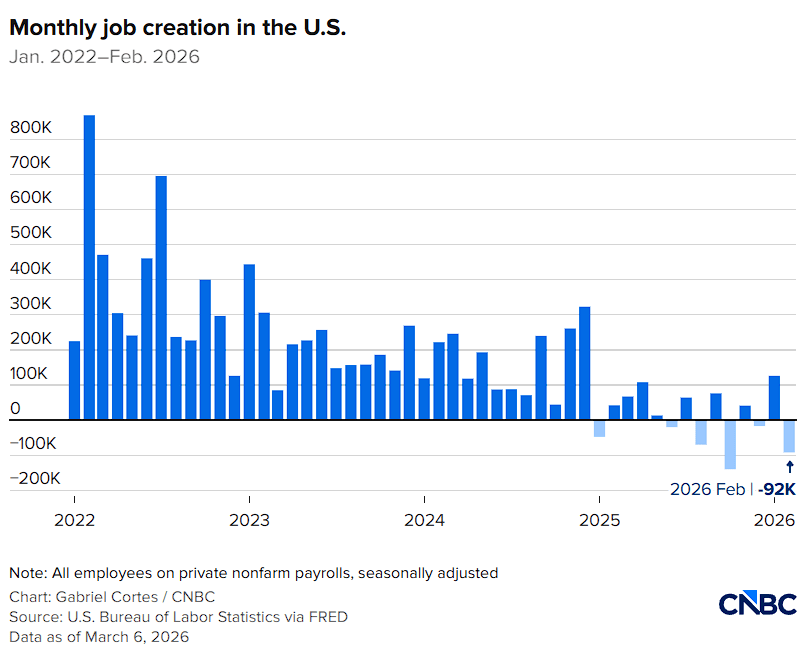
The United States job market lost 92,000 jobs in February 2026. And it was a reverse of the strong numbers in January 2026. As a result, the unemployment rate edged up to 4.4%.
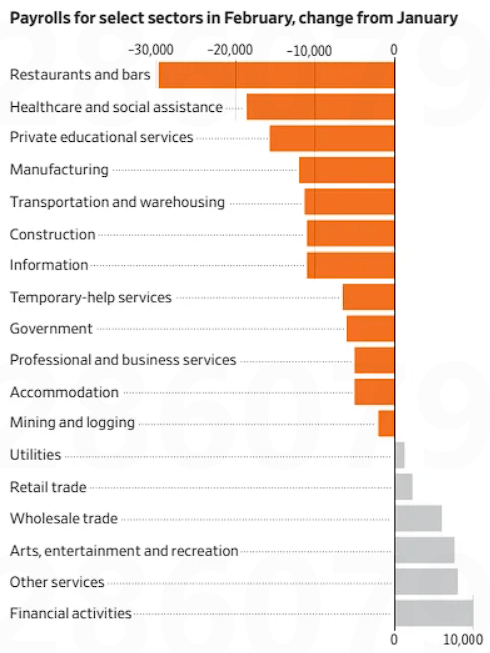
Looking deeper into the numbers, the restaurant & bar, healthcare, and educational sectors drove much of the decline in jobs. In the healthcare sector, the strike at Kaiser Permanente involved 31,000 workers, but has since been resolved.
All in all, the U.S. job market is becoming weaker. While it doesn’t mean that the economy is crashing, it means that it is heading there. I am reading this information with the current situation in Iran. Increase in oil prices is hard to handle, like the Russia-Ukraine situation in 2022. It increases the prices at the pump, which then feeds into everything as transportation and logistics get more expensive.
All eyes will now be on the non-farm payroll (jobs data) and inflation data coming out for March 2025. It will tell us the initial damage that the Iran conflict has had on the U.S. economy.
Takeaway: The U.S. job market losses came at a bad time. If we combine this information with the Iran conflict, the probability of a recession in the U.S. increases.
However, this actually presents opportunities in select sectors that could benefit …
The Global Oil & Gas and Defense Industry
Higher oil prices mean higher profit margins for oil & gas companies. At the start of the year, investors didn’t really rank the O&G sector that highly. Oil prices were stubbornly low.
But the situation has now changed. Whether this is for the short- or long-term remains the big question. If it is short-term, nothing much will change for the industry. However, if it’s long-term, O&G companies could reap higher profits.
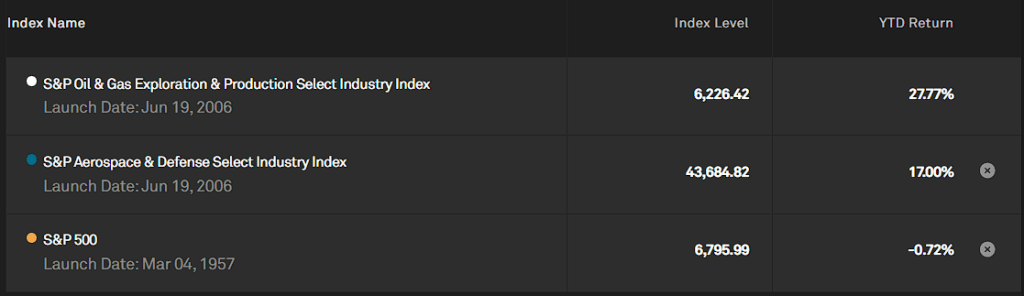
The S&P Oil & Gas Exploration & Production Select Industry Index has already gained by 5.2% for March 2026. And since the beginning of the year, the index is up by 28%.
Meanwhile, defense companies are once again coming in hot. The conflict will drive up demand for military equipment and supplies. The S&P Aerospace and Defense Index is up by 17% for the year.
With the rout in technology stocks, investors are now turning their eyes to everything else. And I can foresee that these two sectors will receive the bulk of the rotation out of tech. Both of them have already outperformed the S&P 500.
Takeaway: The oil & gas and defense industry could stand to benefit from the Iran conflict. Higher oil prices could drive up O&G companies’ profits, while higher demand for military equipment and supplies could drive defense companies higher too.
Coal and Renewable Energy Could Do Well
In China, almost 80% of its energy mix comes from coal. And with the possible cut-off in oil supply in the coming months, China could rely on coal and renewable energy even more.
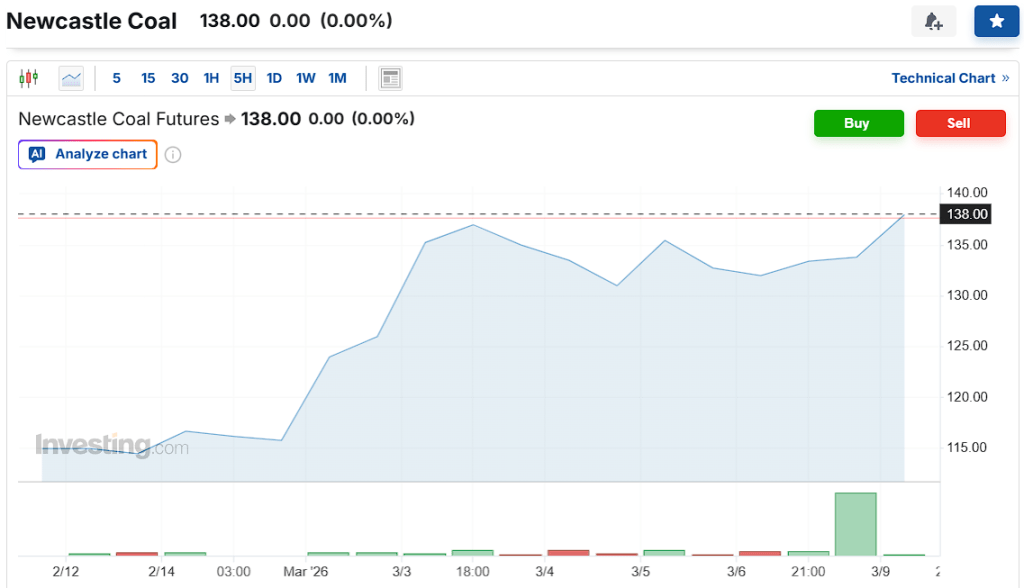
Newcastle coal prices have already risen by 16% last week, as the perceived oil supply disruption is pushing investors into the coal market.
Takeaway: Coal and renewable energy could be the next sectors to benefit if the Iran conflict stretches out.
Other News Headlines
Another disappointing earnings quarter for Target. [CNBC]
Morgan Stanley cuts 3% of its workforce [AP News]
Apple is keeping prices low to attack its competitors in the era of high memory chips prices [WSJ]
Ayer Labs, backed by Nvidia is raising US$500 million [Reuters]
Cigna is appointing a new CEO as the current CEO is retiring [CNBC]
Thank you for reading.
 Slice of P.I.E