
Hi all, it has been a while indeed since I last fully updated the analysis on Genting Malaysia Berhad. I have learned some lessons from my last analysis and have changed it accordingly in this version. This is quite a big revamp of the analysis since I got a lot of things wrong last time. Hope some of you can find this useful and you can find my past full analysis here.
(Post Image from Calvinayre.com)
Genting Malaysia Berhad (BUY, TP: RM5.76)
Summary
- BUY call with TP of RM5.76
- Genting Malaysia Berhad’s operational margins and growth have been lacklustre and are on a downward trend. However, there are room for improvements when Genting Malaysia Berhad embarks on rationalisation of its operations when several phases of the Genting Integrated Tourism Plan complete.
- The macro environment currently suggests little evidence of a bull trend in the gaming industry but there are some upside risks from the boom in Chinese tourism. Genting Malaysia Berhad is well positioned to capture this with extensive exposure in Malaysia, U.K and the U.S, where they are increasingly becoming hotspot destinations for Chinese tourists.
Background
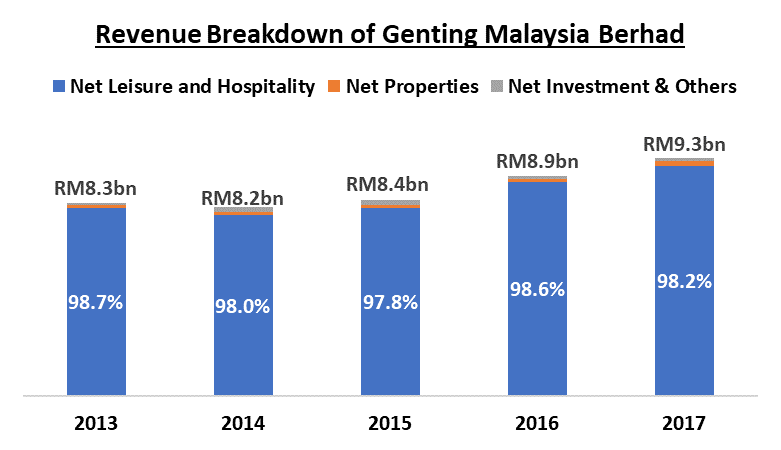
- Genting Malaysia Berhad is mainly involved in the business of leisure and hospitality (98% of revenue) and property development (1%). Leisure and hospitality business include the gaming, hotel and theme park sectors. This proportion has remained about the same from 2013 to 2017.
- In its leisure and hospitality segment, most of its revenue is derived from its Malaysian operations (63.8%) and increasingly from foreign countries also at 36.2% (2013: 30.8%)

Note: Foreign segment includes United States, United Kingdom, Egypt and Bahamas.
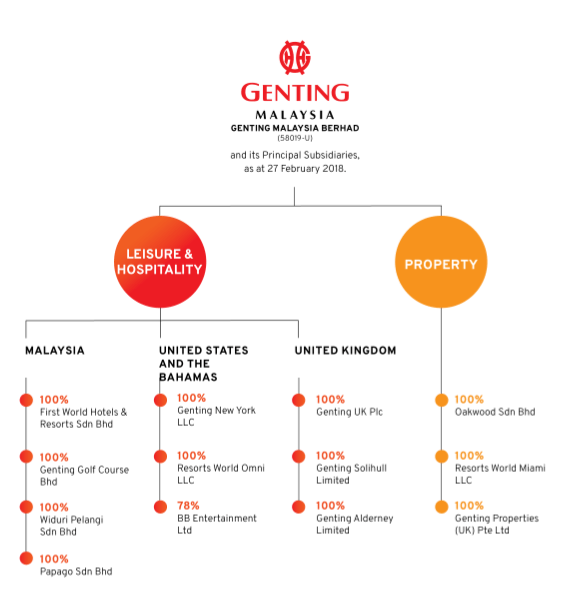
- Below is the Corporate Structure of Genting Malaysia Berhad (Source: Genting AR17). Most of its subsidiaries are wholly or majority owned.
Share Price Performance
- Things to take note, share price is trending above average recently and shows some evidence of good performance based purely on share price and historical average.
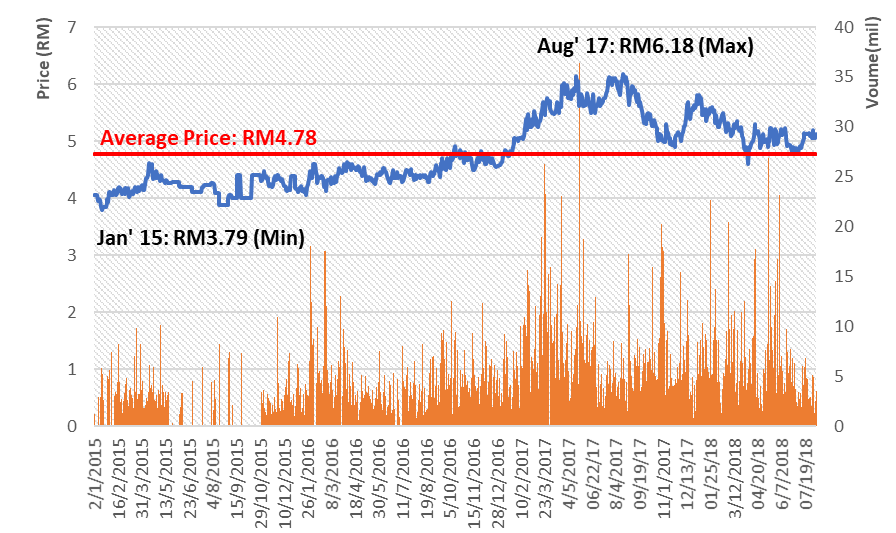
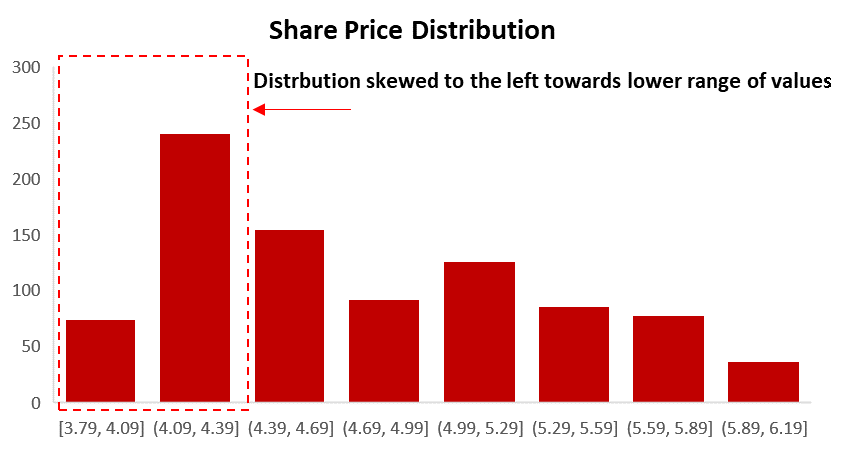
- From 2015 to 2018, Genting Malaysia Berhad’s share price averaged RM4.78 with a range of RM3.79 (Jan’ 15) to RM6.18 (Aug’ 17).
- Starting from 2017, share price has trended above average with the year 2017 registering an average of RM5.48, while 2018 registered an average of RM5.36.
 Source: WSJ
- The share price distribution is skewed towards the left, indicating that share prices trended mainly in the lower range of values.
- However, this should be read in the context that share prices have recently traded above historical averages in 2017 and 2018. This might present some selling opportunities for investors still holding this stock as historical evidence suggest that prices tend to be at the lower range.
 Source: WSJ
Financials
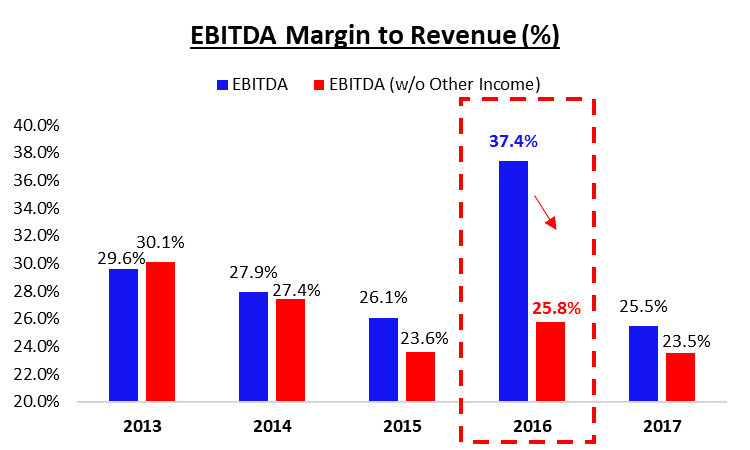
- There is a need to restate the income statement without the “Other Income” portion for Genting Malaysia Berhad so that we get a better view of its operations.
- GMB sold Resorts World Limited shares worth RM1.7bn to Golden Hope Limited in 2016, in which Tan Sri Lim Kok Thay and Lim Keong Hui (Tan Sri’s son) have deemed interest, which is included in the Other income portion.
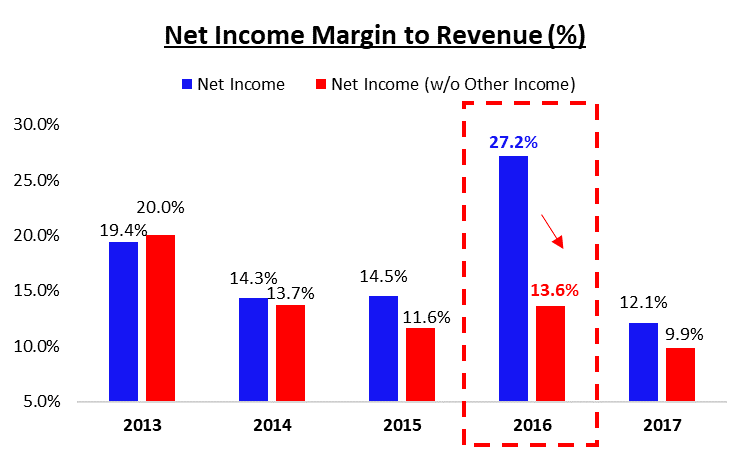
- The inclusion of the Other Income Portion greatly exaggerates the EBITDA and Net Income numbers especially for 2016. My view is that this transaction resembles an intercompany transaction and should be excluded.
- To illustrate my case, if we include the Other Income portion in 2016, EBITDA and Net Income margin are at 37.4% and 27.2% respectively. This is much higher than 25.8% and 13.6% if I stripped out the other income portion.
 Source: WSJ
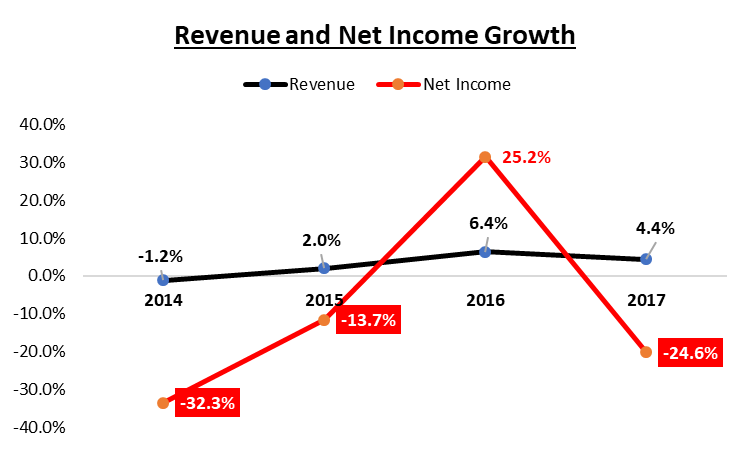
- With that out of the way, from 2013 to 2017, revenue growth for Genting Malaysia is on the low side but what is more worrying is that net income growth declined mostly throughout this period.
 Source: WSJ
- This is primarily due to operating cost growth outpacing revenue growth consistently throughout this period. Operating cost growth is driven mainly by increases in the Cost of Good Sold where it encompasses about 87% of total operating cost (Selling, General and Administrative expenses: 13%)
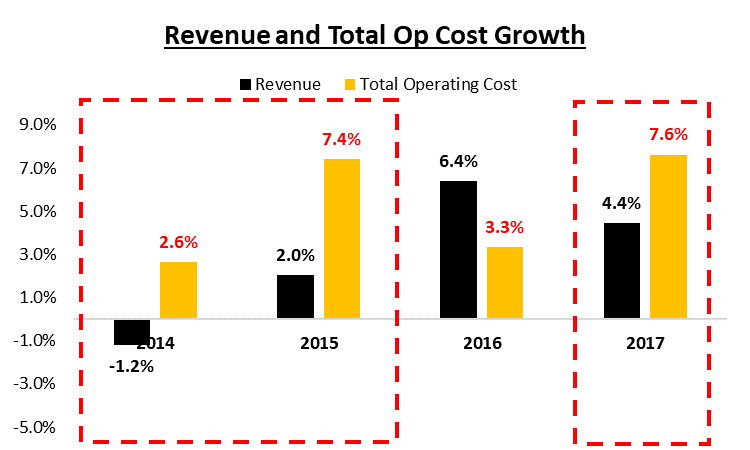
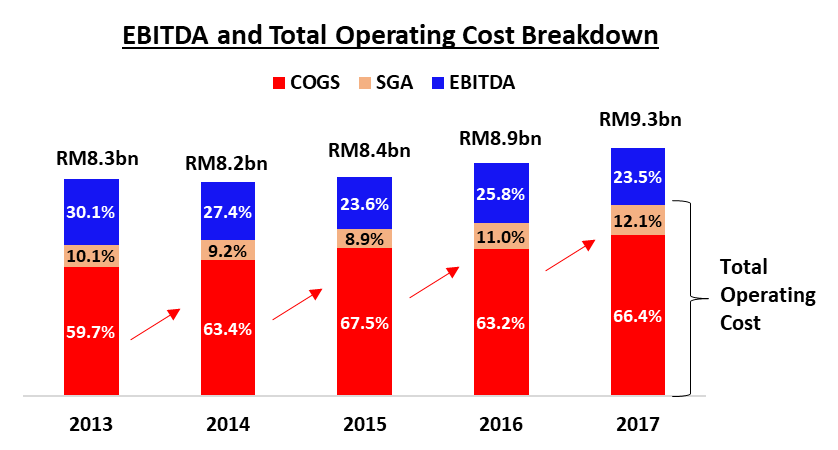 Source: WSJ
- In terms of operational margins, EBITDA and Net Income margins have been on a downward trend since 2013, sparking some concerns over Genting Malaysia Berhad’s ability to keep its cost growth in line with its revenue growth.
 Source: WSJ
- As a guide towards whether Genting Malaysia Berhad’s operational margins are high or low, Genting’s operational margin in 2017 is lower than its competitors leaving room for potential improvements. However, it should be noted that Genting’s GITP is still underway, and this could be the reason behind the low margins as some time is needed to realise cost efficiencies from its new revenue sources.
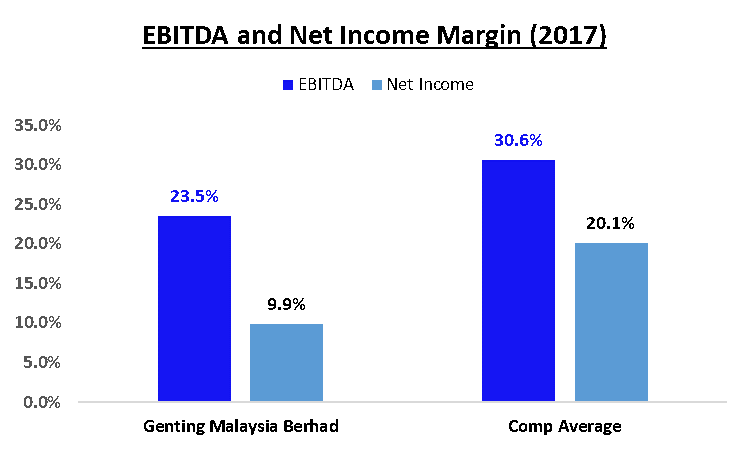 Note: The competitors I used are Las Vegas Sand Corp, Kangwon Land Inc, Bloomberry Resorts Corp, MGM Resorts International, and Galaxy Entertainment Group.
- Its debt structure looks intact with its leverage (Debt/ (Debt + Equity)) low at 26.3% compared to its peers at close to 50% but it should be noted that
- Its leverage has increased from 9.8% in 2013 to 26.3% in 2017, a 3-fold increase. Much of the increase in leverage came in 2017 with an addition of RM2.6bn to long term borrowing.
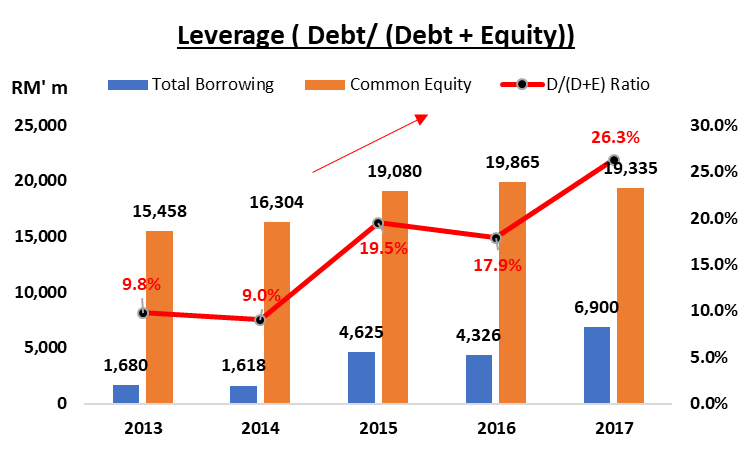 Source: WSJ
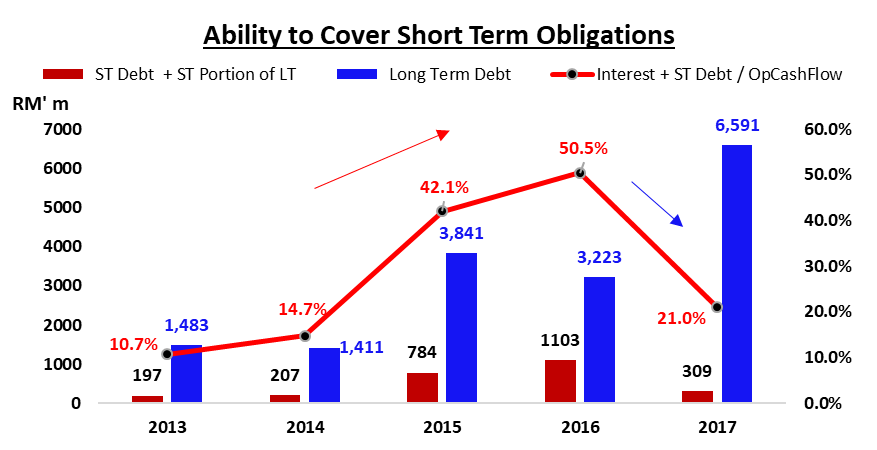
- Its ability to cover short term payments ( (Interest + ST Debt)/Net Op Cash Flow ) has deteriorated from 10.7% in 2013 to 50.5% in 2016 before improving to 21% currently. However, this improvement masks the increase in long term debt in 2017 as short-term debt decreased to RM309m (2016: RM1.1bn). I expect this figure to increase in the quarters of 2018 to possibly even higher levels since total borrowing is much higher now.
 Source: WSJ
- Probably a better metric to measure its ability to cover its interest is the interest coverage ratio (Interest Expense/ EBIT). It has steadily increased from 1.7% in 2013 to 9.2% in 2017. However, this figure has not increased to alarming levels now but warrants some monitoring and caution moving forward.
Main Macro Fundamental and Key Developments
- Based on Genting Malaysia’s core business of gaming (gambling) and theme parks, it is crucial to understand what drives these 2 industries.
- Gaming (Gambling)
How does a casino make money? A customer comes in and deposit RM100 for credit equivalent to gamble in the slot machines, blackjack, pokers and etc. At the end of the day, he is only left with RM40, meaning the casino is only obligated to return RM40, making RM60 in the meantime. More customers coming to gamble means more revenue for the casino. The richer a customer is, the more money he will gamble. From this, an analysis of the wealth of its customers will be important to determine the fundamentals of the gambling business. - Theme Park
Theme parks make money by charging a fixed fee on each visitor in exchange for entertainment in the form of rides and experience. The theme park industry is highly dependent on the customer’s disposable income growth, as it grows only when people’s income after paying for necessities grows. It is not something the customer needs, but rather would only buy if they have the extra cash for it. Therefore, the industry is highly vulnerable and exposed to any macro recessions and shocks to income. As most visitors and clients are one-time, it’s important to replenish the offerings the theme park has over time to generate renewed interest in the attractions.
- Gaming (Gambling)
- Genting Malaysia Berhad’s source of revenue comes mainly from Malaysia (64%), United Kingdom and Egypt (20%), and United States and Bahamas (15%). From the historical growth rates and projections of GDP from these countries, it does not appear that there is a bullish case for the gaming industry and I forecast the world economy to remain status quo without any bear or bull case.
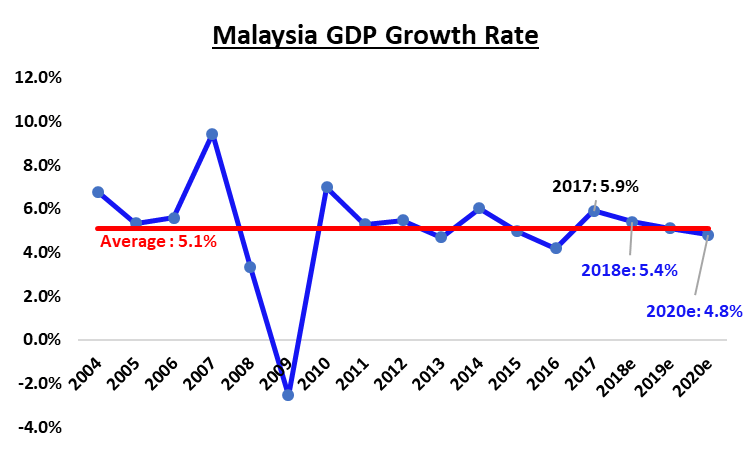
- Malaysia: While growth has been decent, forecast from World Bank does not indicate that Malaysia’s growth will exceed past growth rates. I for one, do not think there is a bull case for Malaysia too.
 Source: World Bank
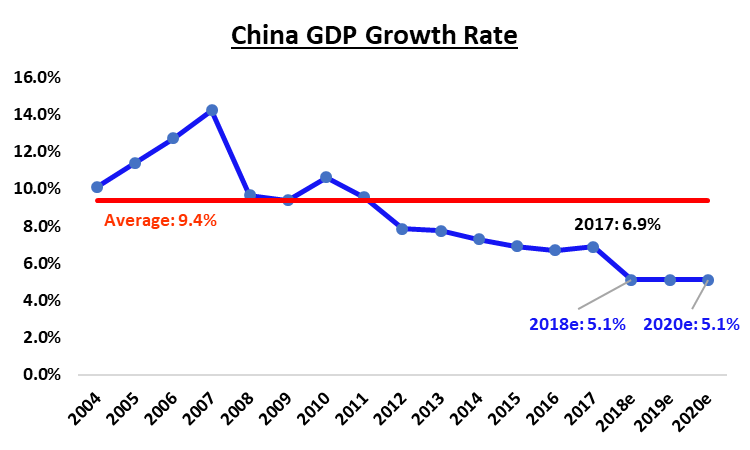
- China: As there is a strong case for Chinese tourism into Malaysia, it will be useful to examine China’s growth rates. China’s growth probably is the strongest among all the countries being examined at an average of 9.4%. However, World Bank forecasts are at 5.1% for 2018 to 2020, much lower than its average and 2017 growth rate (6.9%). As the trade war intensifies with the U.S and a shake up in the Chinese economy engineered by the Chinese political elites, there isn’t a bull case for China too in this respect.
 Source: World Bank
- United States: Nothing to really comment here except that the United States is still on a trade war with Trump at the helm. Growth is normalising (“recover”), however it doesn’t present much evidence for an upturn in economic activity.
 Source: World Bank
- Looking at the tourism industry specifically in Malaysia, tourist arrivals has not been impressive in 2017 at 25.9m, declining by 3.0% from 2016 (26.8m). However, it should be noted that tourist receipts per arrival have been growing at a healthy rate in 2016 (14.2%) and 2017 (3.2%). This can be partly attributed to the rise in Chinese tourist arrivals to Malaysia and their tendency to spend more. Chinese arrivals now encompass 8.8% of total arrivals (2005: 2.6%). This will have positive spill-over effects to the gaming industry.
 Source: Tourism Malaysia
- Goldman Sachs in its report “Chinese Tourist Boom”, projected that the number of Chinese residents who will travel overseas will increase from 120m in 2015 to 220m in 2025 and the amount they will spend on travel overseas will increase from $200bn to $450bn in 2025. There is a lot of potential in the Chinese tourist market as only 4% of Chinese nationals hold passport as opposed to the US at 35%. GS is projecting that this figure will increase to 12% in 2025. I predict that most of Genting’s revenue will increasingly be generated by the Chinese market, as its casino locations in Malaysia, UK and US are hotspots for Chinese tourism.
Financial Valuation (Please find my valuation in the tab called “Valuation”)
- I will be utilising a DCF valuation on Genting. How I will value this is to value Genting without the Genting Integrated Tourism Program (GITP) and then add the GITP committed CAPEX on top of it.
- Basically, my assumptions for my DCF are as follows:
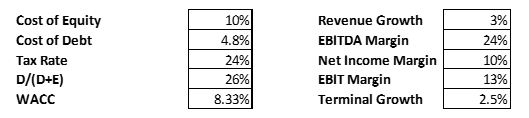
- I came up with a target price valuation of RM5.76 (Previous TP: RM6.38) as I think I overvalued the GITP program last time and as such I have applied a discount to it ( 20% ). It currently trades at RM5.25 with a market cap of RM29.7bn.
- The equity valuation came up to RM24.2bn, with the GITP program CAPEX at RM8.3bn (80% of RM10.4bn). This results in a total equity valuation of RM32.6bn.
- If benchmarked against analyst recommendations, my TP of RM5.76 is above analyst average TP of RM5.58, where I am a bit more bullish as I see potential room for Genting Malaysia Berhad to improve its operational margins when several phases of the GITP complete. My TP of RM5.76 is situated at the upper end of the valuation range between RM5.05 to RM6.00.
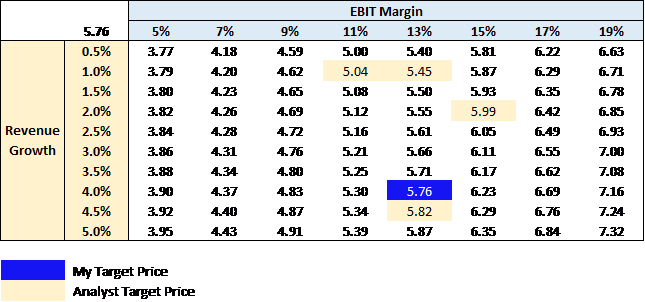
Note: Analysts include AmInvest, Public Bank, Kenanga, Hong Leong Bank, AMMB and Affin Hwang Capital
- This is a simple straightforward valuation in my opinion. Feel free to tinker around with the assumptions in the excel file Genting Malaysia Berhad Model v15
Verdict
My conclusion from Genting Malaysia Berhad is BUY with a target price of RM5.76. There are some growth prospects in the GITP with renewal of theme park attractions and I think Genting Malaysia Berhad is well positioned to take advantage of the potential bull trend in Chinese tourism with its casinos and entertainment outlets in Malaysia, UK and the US.
 Slice of P.I.E