Hi, guys. Sorry this took so long, there was a lot of reading up on the palm oil industry and the company itself as I wanted to do this properly. The analysis is quite long and I have prepared an executive summary for people who don’t want to read the whole thing. Please find my working excel Kuala Lumpur Kepong Model v11. I would like to bring your attention to this report by Chain Reaction Research back in 2015 which casts a negative light on KLK, and this counter report by KLK addressing the comments by Chain Reaction Research. I didn’t include many of the points raised here as the report did not really affect KLK’s share price and the opportunity for shorting is limited in the Malaysian market. There have been instances where a negative report by short investors like Muddy Waters, depressed share prices significantly but I don’t see it affecting KLK.
Executive Summary and Verdict for Kuala Lumpur Kepong ( SELL, TP: RM20.7 )
Kuala Lumpur Kepong is a plantation company primarily in the palm oil business with exposure in the upstream and midstream portion of the business. The Far East, Southeast Asia, and Europe are its main geographic exposure. It is currently trading at ~RM24-RM25 with a P/E of 20 times, which is higher than most of its peers at 10-13 times and I think the market and analysts has projected an aggressive upside to KLK’s business with high revenue growth and margins. KLK’s current margins are below its peers and its historical margins, and its cost structure growth has been higher than its revenue. Investors should evaluate carefully KLK’s commitd its operational cash flows have been weak so far. I have valued KLK at a target price of RM20.70, with a recommendation to SELL and this is counter intuitive to current market sentiments and valuations. I believe this is the time to take some profit off the table when market valuations are high and the palm oil industry prospects remain subdued until the end of the year.
Background
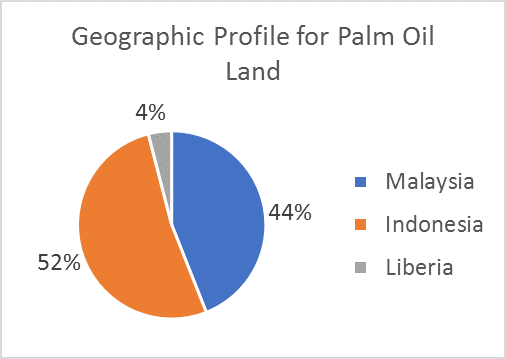
Palm oil company involved in the trading and manufacturing of palm oil and oleochemicals. (please see below for a brief description of oleochemicals) It has geographic exposures in Malaysia, Indonesia and Liberia with a total planted area of 225,243 ha. Out of the total planted area, about 94% of the land is for palm oil and 6% for rubber, while Malaysia, Indonesia and Liberia encompasses 44%, 52% and 4% of the total land for palm oil.
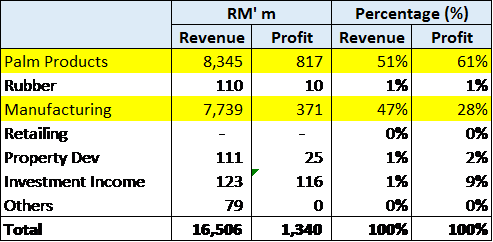
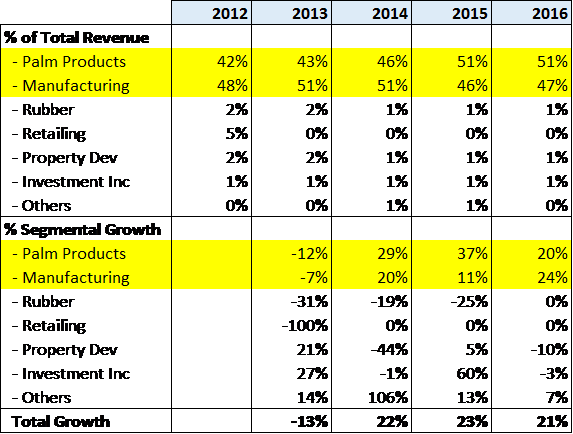
KLK currently has 3 business streams of Plantation, Oleochemicals and Property Development with the more detailed breakdown of the revenue segments below. Palm Products and Manufacturing makes up the bulk of KLK’s 2016 revenue with 51% and 47%, while contributing 61% and 28% to group profit.
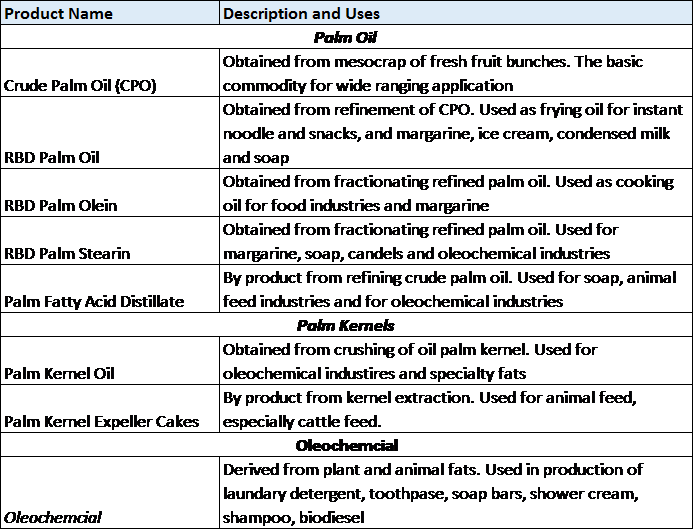
KLK primarily produces palm oil, palm kernel and oleochemical materials in the forms and uses described below.
KLK operates mainly in the upstream and midstream portion of the palm oil value chain, involved in producing, refining and selling palm oil produces and products to customers. Many of its products are intermediary inputs for its customers to produce final goods and bring them to the end market (consumers). KLK is not heavily involved in the selling and distribution (downstream business) of its palm oil products. Please refer to this dissertation here by Siti Rahyla Rahmat page 58-59 for a flow chart of the Malaysian Palm Oil value chain.
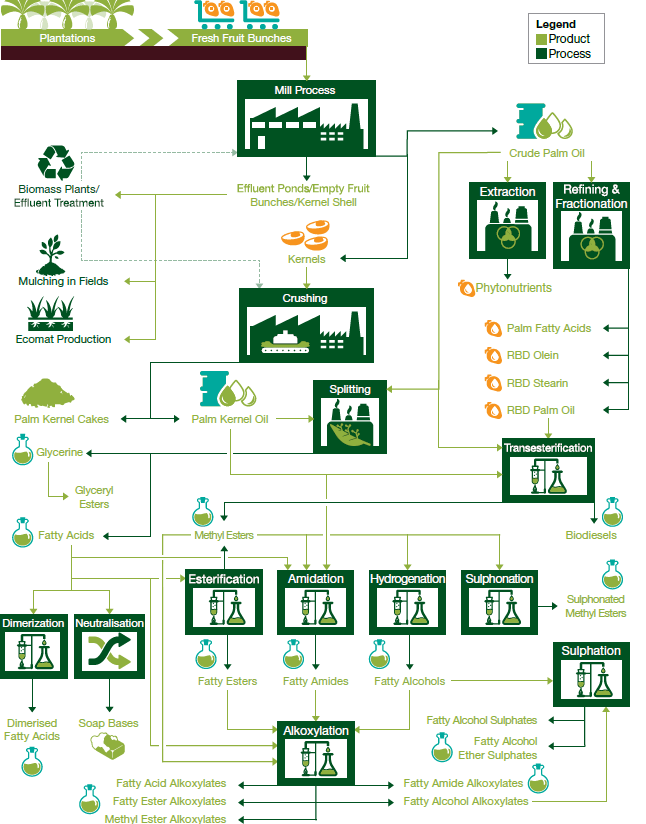
Source: Annual Report 2016
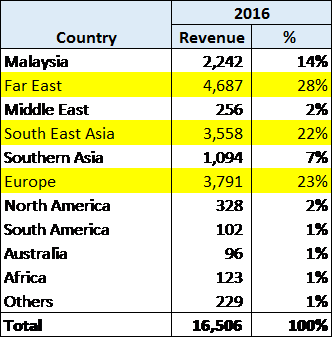
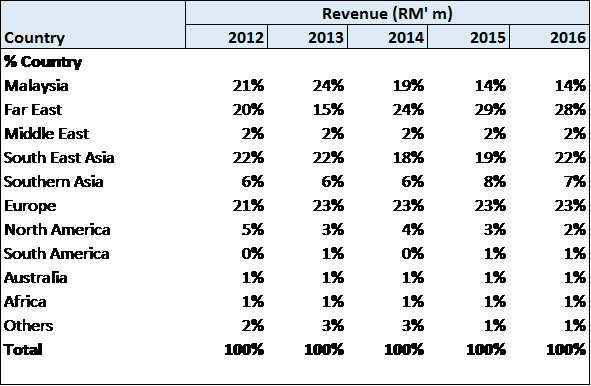
Most of KLK’s revenue from customers comes from the countries of Far East (28%), Europe (23%) and South East Asia (22%), with only 14% of revenue coming from Malaysia.
Market Valuation and Share Price Performance
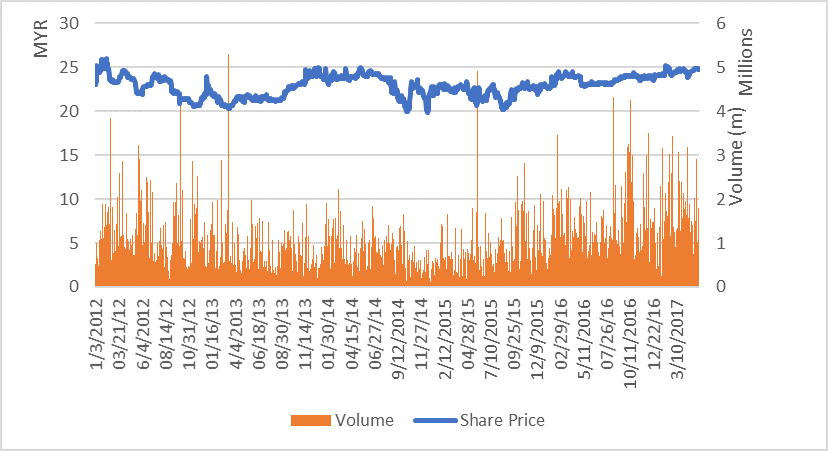
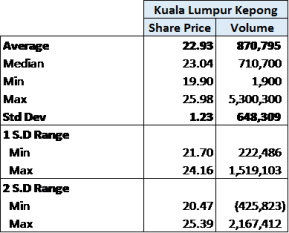
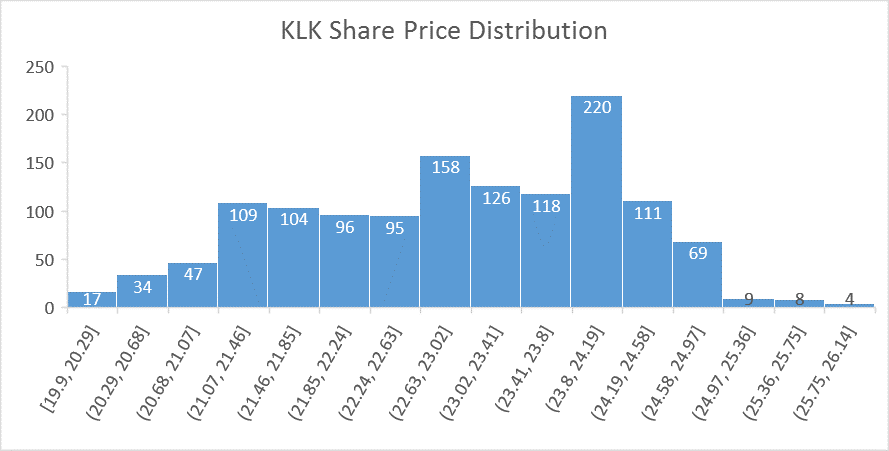
KLK has consistently traded at the range of RM20 – RM25 for the last 5 years, with an average price of RM22.93 and low volatility of RM1.23. The histogram indicates that the distribution is more skewed towards the values of > RM23.0 (right side of the distribution) indicating the share price has traded more often at the price range of RM23.0 – RM24.5.
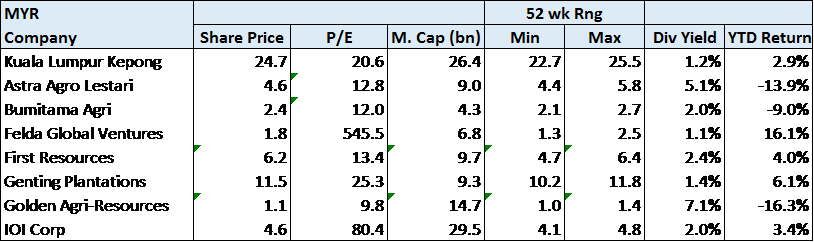
In a comparison of KLK’s share price, P/E and market cap to its competitors indicate that KLK is one of the biggest company with a market cap of RM26.4bn, dwarfing most of its competitors. Its P/E ratio of 20.6 is one of the highest out of its competitors (if we exclude FGV and IOI which trades at an incredibly high P/E), indicating that investors are quite bullish of KLK’s prospects. But its dividend yield and YTD price return of 1.2% and 2.9% are unspectacular, and are on the low side when compared to its competitors of First Resources (1.1% and 16.1%), Genting Plantations (1.4% and 6.1%) and IOI Corp (2.0% and 3.4%). First glance at the table below will yield the question of does KLK deserves a P/E valuation of 20.6? Most of its competitors (excluding Felda and IOI) trades at about P/E of 10 – 13.
Financials and Operations
KLK’s revenue has been growing at a high annual rate of ~20% from 2014 to 2016, with revenue largely fuelled by its Palm Product segment (43-51% of revenue) and Manufacturing segment (46-51% of revenue). From 2014 – 2016, the Palm Product segment recorded a very high 20% – 37% annual rate of growth while the Manufacturing recorded a 11% – 24% annual growth rate.
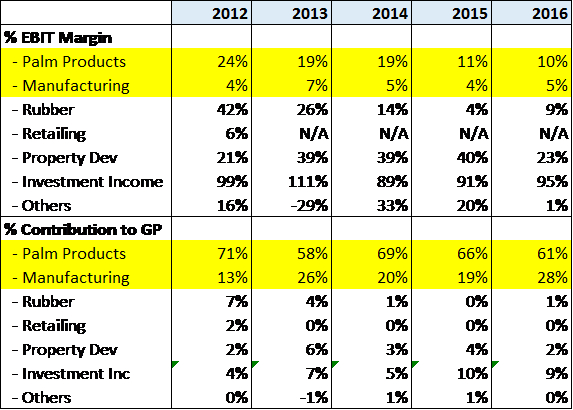
However, in terms of group profit/EBIT margin (Annual statement did not make it clear what group profit margin means, but I am of the opinion it’s the EBIT margin), property development has the highest margin at 21% – 40% but only contributes about 2% – 6% to group profit. The key takeaway is that the Palm Product segment is the main core business driving KLK with 58% – 71& contribution to group profit with a 10% – 24% margin, while its 2nd biggest segment of Manufacturing is a low margin business at 4% – 7% contributing 13% – 28% to group profit. The Manufacturing segment has contributed an increasing share to group profit from 13% in 2012 to 28% in 2016, and the Palm Products segment’s contribution has declined from 71% in 2012 to 61% in 2016. I view this as a positive development as KLK is moving down the value chain, to be more than just a primary commodity producer.
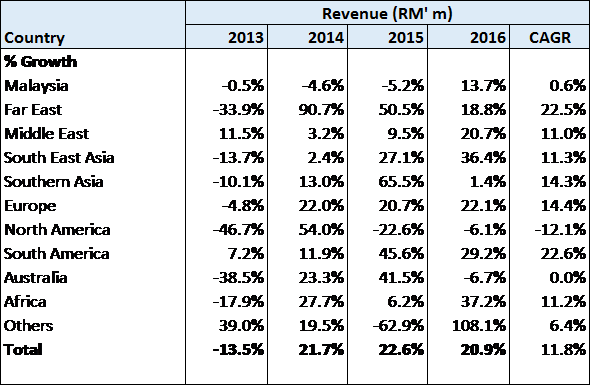
In terms of geographic exposure, the Far East, Southeast Asia and Europe remains as the main contributor to revenue at 28%, 22% and 23%. Far East’s contribution to revenue has increased from 20% in 2012 to 28% in 2016, while Malaysia’s contribution has decreased from 21% in 2012 to 14% in 2016. In terms of growth, Far East and South America has the highest CAGR at 22% (2012 – 2016) while North America has the lowest CAGR at -12.1%. KLK’s Malaysian market however has been flat at 0.6% CAGR. This means KLK’s revenue is highly dependent on foreign demand and caution needs to be exercised on the multiple exchange rate risk. KLK seems decently diversified in terms of geographic exposure with no one region being the dominant revenue driver.
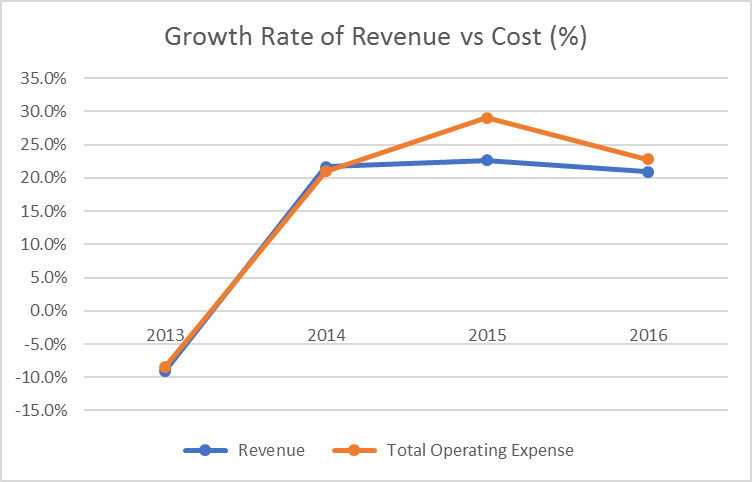
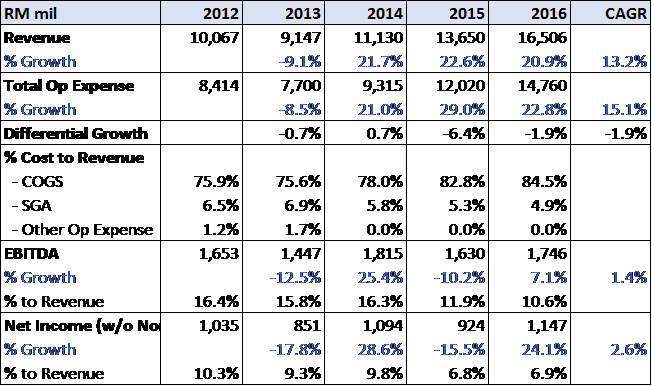
In terms of cost structure, investors need to be aware that although revenue growth has been high, its cost growth is even higher, resulting in lower margins. Cost (Total Op Expense) growth outpaced revenue growth by about 0.6% – 6.4%, resulting in a reduction of net income margin (without Non-Op Expense/Income) from 10.3% in 2012 to 6.9% in 2016. Its EBITDA margin has also declined from 16.4% in 2012 to 10.6% in 2016. Much of this is due to the Cost of Goods Sold, with an increase in COGS to revenue percentage of 75.9% in 2012 to 84.5% in 2016. My opinion is that KLK is more focused in expanding its revenue base than cost optimization now. Net income CAGR (2012 – 2016) is still positive at 2.6%, while revenue CAGR is at 13.2%. It is tough to estimate how much more revenue can grow before cost optimization measures kick in to consolidate its earnings, but my advice is that as long as net income growth don’t fall below 2% (my yardstick for inflation), it should be fine.
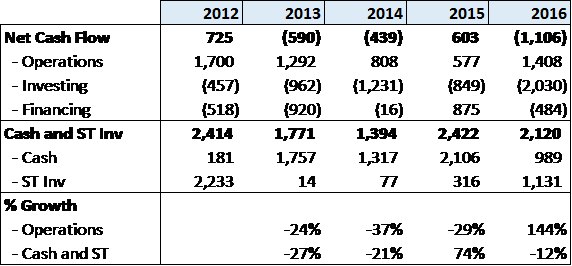
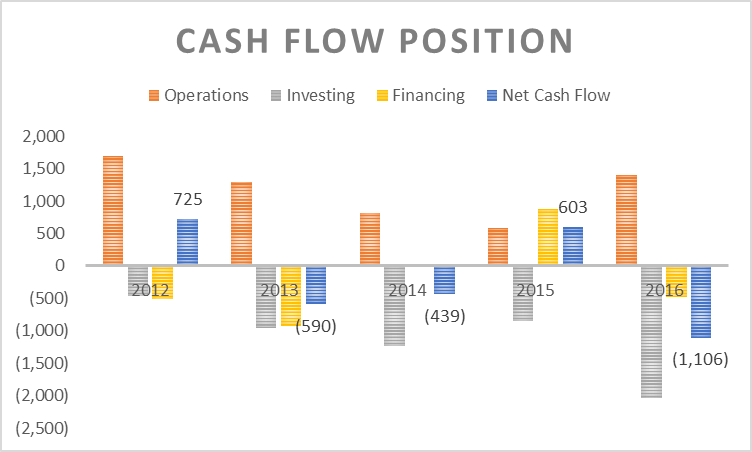
Its cashflows however has much to desire. KLK’s operational cash flows haven’t been able to effectively cover KLK’s investing and financing requirements, with the years 2013, 2014 and 2016 registering negative net cash flows. Although its revenue has been registering double digit growths every year, its operational cash flows growth has been in the negative territory from 2013 to 2015, while 2016 registered a big recovery. Investors need to be careful of companies with fluctuating operational cash flows and KLK in this case has to demonstrate in the next 2-3 years that its high CAPEX investments and leveraged capital structure can be sustained by its operational cash flows.
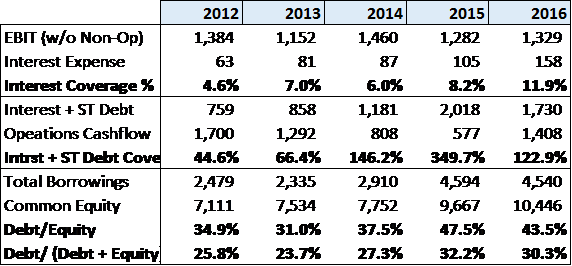
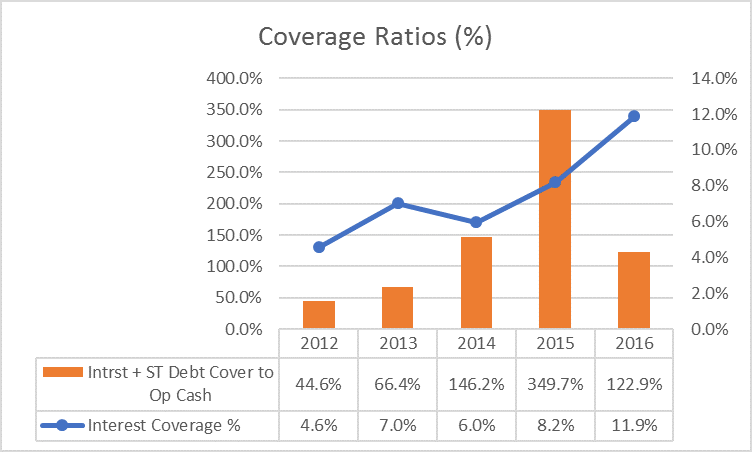
In terms of KLK debt analysis, its interest coverage ratio has tripled from 4.3% in 2012 to 11.9% in 2016, with interest expense nearly tripling from RM63m in 2012 to RM158m in 2016 while EBIT has remained flat at ~RM1.3bn. Its interest + ST debt coverage by operational cash flows has also tripled from 44.6% in 2012 to 122.9% in 2016, indicating that its interest and ST repayment load has increased significantly. KLK’s capital structure has also become increasingly leveraged with Debt/Equity increasing from 34.9% to 43.5% and Debt/(Debt + Equity) ratio increasing from 25.8% to 30.3%. All in all, investors need to be wary about their prospects about KLK in the future, as KLK needs to service its increasing financing obligations. Can KLK churn out adequate operational cash flows to cover its financing obligations in the future? That is the big question.
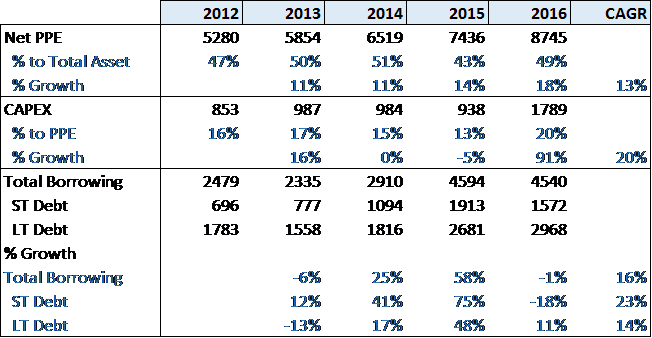
KLK remains a plantation company heavy on its PPE components with about 43%-51% contribution to KLK’s total asset and CAPEX heavy with 13%-21% of PPE. KLK’s PPE currently stands at RM8.7bn with a CAGR of 13% from 2012 to 2016. Total borrowings have grown at a CAGR of 16% from RM2.5bn in 2012 to RM4.5bn in 2016, driven mainly by ST debt at CAGR of 23%, while LT debt CAGR at 14%.
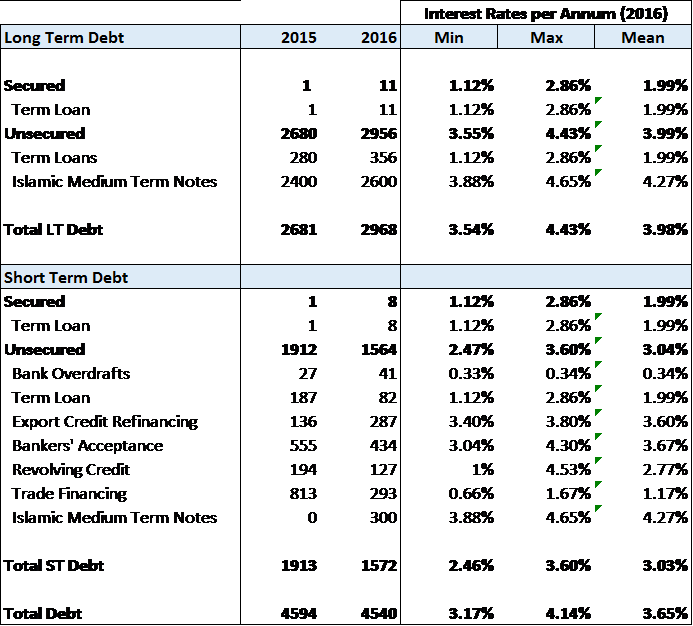
A look at KLK’s debt profile reveals that its Islamic Medium-Term Notes worth RM2.9bn features prominently in its RM4.5bn total borrowings. It has an interest rate per annum range of 3.9% to 4.7%, being the debt class that accrues the highest interest expense among all else. KLK’s weighted and effective interest rate stands at 3.7% and 3.5%, which in my opinion are on the low side. Despite this, I have some concerns about the serviceability of its debt and interest since its interest rates are already low. Operational cash flows from 2012-2016 has not been impressive and it’s quite uncertain when or if KLK would actually generate the adequate operational cash flows in the future.
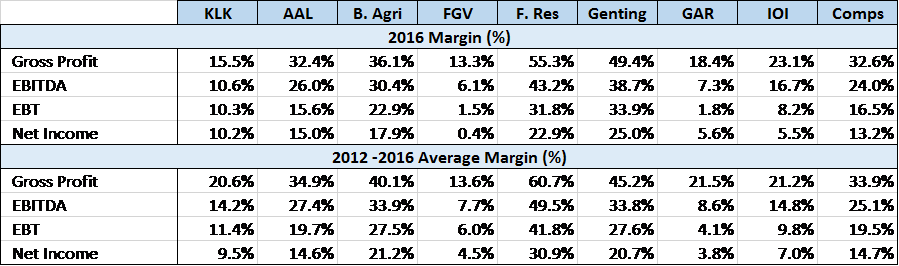
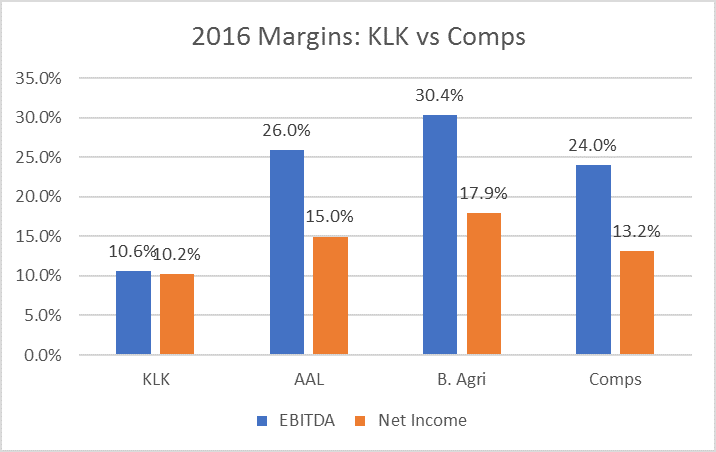
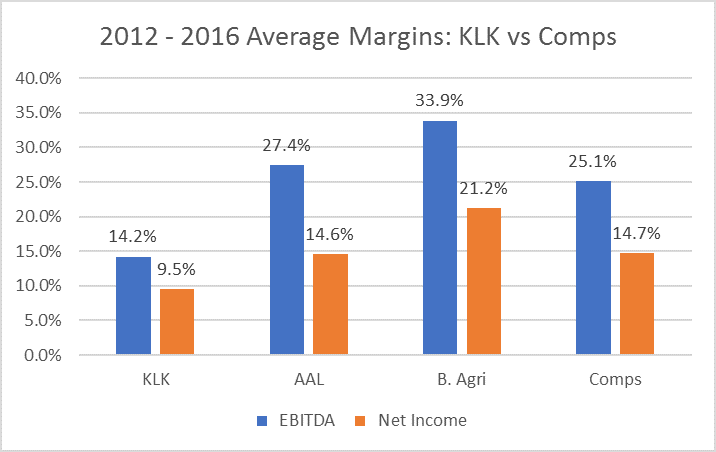
In comparison to its peers, KLK’s margins have not been impressive and are on the low side. Its 2016 EBITDA and Net Income margins are at 10.6% and 10.2%, while its peers’ margins are 24.0% and 13.2%. Even on an average basis from 2012-2016, KLK’s margins still lack behind at 14.2% and 9.5% compared to its peers at 25.1% and 14.7%. Most of KLK’s peers have lower COGS as a % to revenue, evident by its higher gross profit margin. KLK’s GP margins is something that KLK needs to improve on or at least recover, because its GP margin was at 24% in 2012 compared to 15.5% in 2016. But to be fair, most of its peers have also experienced decreasing GP margins due to weaknesses in CPO prices.
Macro Environment and Trends
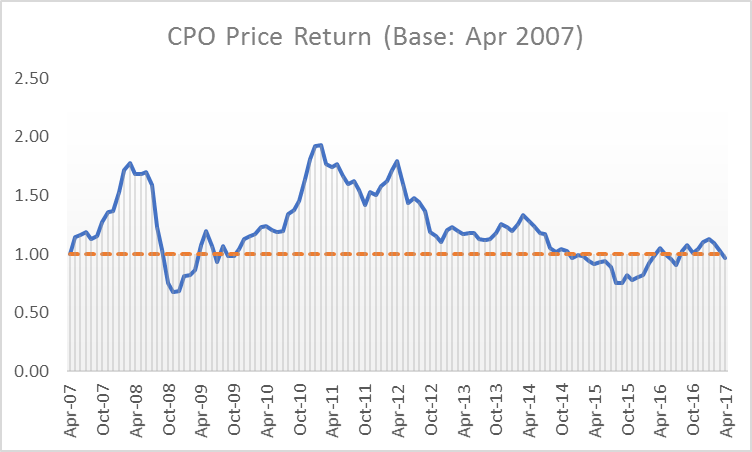
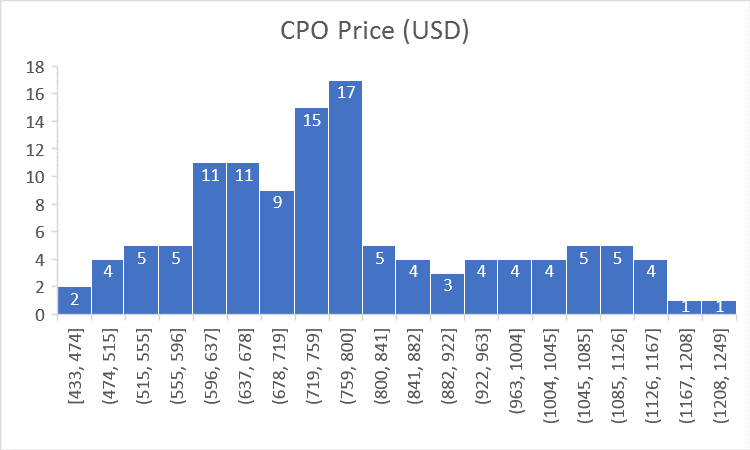
CPO prices have been depressed the last 3 years due to the El Nino effect. Calculating CPO price return (Base : Apr 2007 ), palm oil returned the highest return at 1.20 to 1.93 during the periods of 2009 -2013 while returns significantly dip below 1.00 from 2015 to 2017. The boom period of 2009-2013 saw high demand for palm oil by big players like China, US, India and Europe, while the bear period after that saw concerns of low GDP growth from China and India and the increasing competitiveness of soy bean and rapeseeds. CPO returns averaged 1.22 with a 95% CI of 1.16-1.27 while the price of CPO averaged USD784 with a 95% of 750-819 from 2007 to 2017. Its distribution shows a skewedness to its left side, meaning the lower end of returns and prices, which means historical returns and prices are more concentrated at values below the average. Investor should be wary about this skewedness in distribution when forecasting for future crude palm oil prices, and adjust their valuation accordingly to the lower end of prices (below USD784) to be conservative.
Thomas Mielke in his presentation at the Price Outlook Conference in KL on 8 Mar 2017 made the following points on Palm Oil trends.
- Past 25 years, world production of 17 oils & fats increased by more than 150%, with palm oil accounting for 30% of world production now.
- World will need additional 25 Mn T of palm oil per year in 10 years from now. World production has to be around 85Mn T yearly to satisfy prospective demand
- World palm oil to recover sizeably in 2017. Palm oil supplies to remain tight in Apr/June and will only start increasing from July/Sept onwards.
- Oil Palm have recovered from severe El Nino-caused draught, but production is still subdued. Recovery will also be driven by expansion in mature area by 0.5 Mn ha in Indonesia and 0.14 Mn ha in Malaysia.
- Major concern of labour shortage at many plantations. Difficult to get permits for foreign labour from Bangladesh and other countries.
- Expect palm oil prices to trade higher because of tight supplies and prospective recovery of world imports. Price pressure from June onward, and likely to accelerate from July to the end of the year.
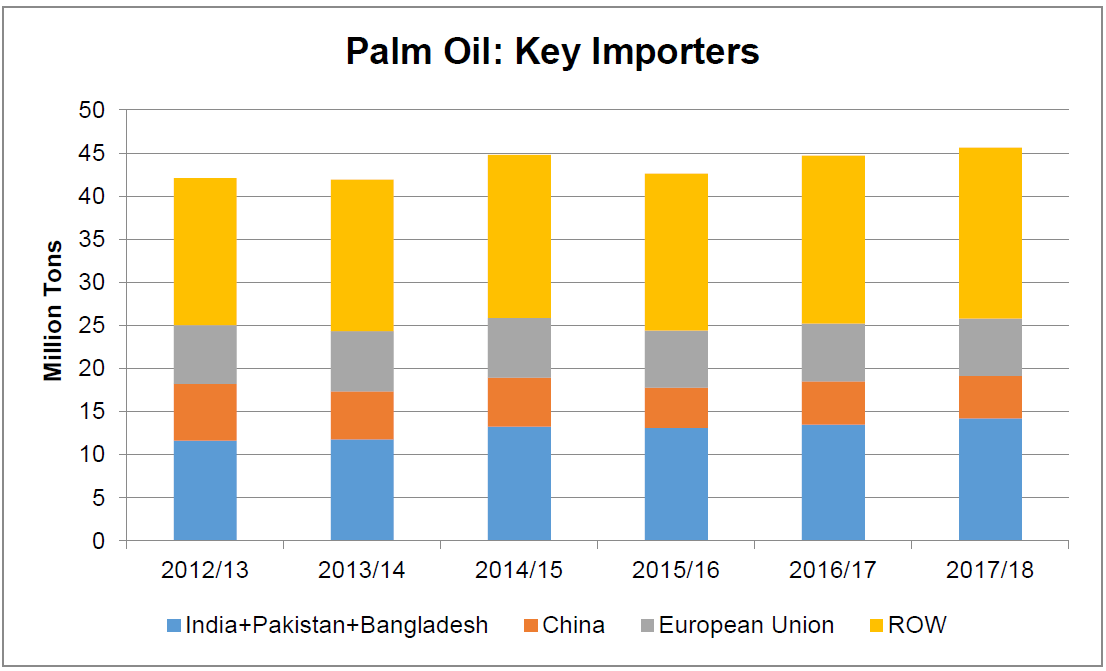
Based on the United States Department of Agriculture report on Oilseeds in May 2017, global palm oil production is expected to grow at a healthy pace for 2017/2018 but will come under increasing competition from soybean oil. India, China, Pakistan, Bangladesh and the EU will continue to be the key importers of palm oil reflecting continuing demand from the 2 biggest country by population in India and China.
Source: United States Department of Agriculture
Financial Valuation
Key Assumptions for DCF:
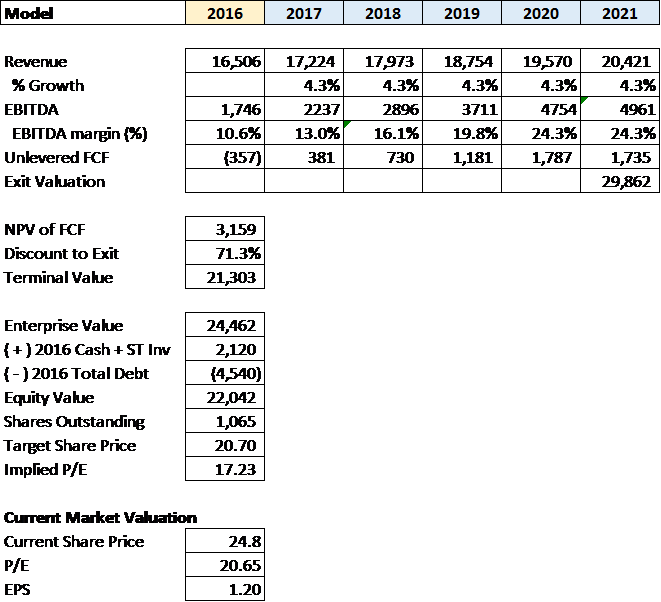
| Revenue Growth | 4.3% |
| EBITDA Margin | 24.0% |
| Cost of Equity | 11.27% | Tax Rate | 24% | Terminal Growth | 3% | |||
| MGS 10-year | 3.87% | D/D+E | 30% | |||||
| ERP (Damodaran) | 7.40% | |||||||
| Cost of Debt | 4.14% | WACC | 8.8% | |||||
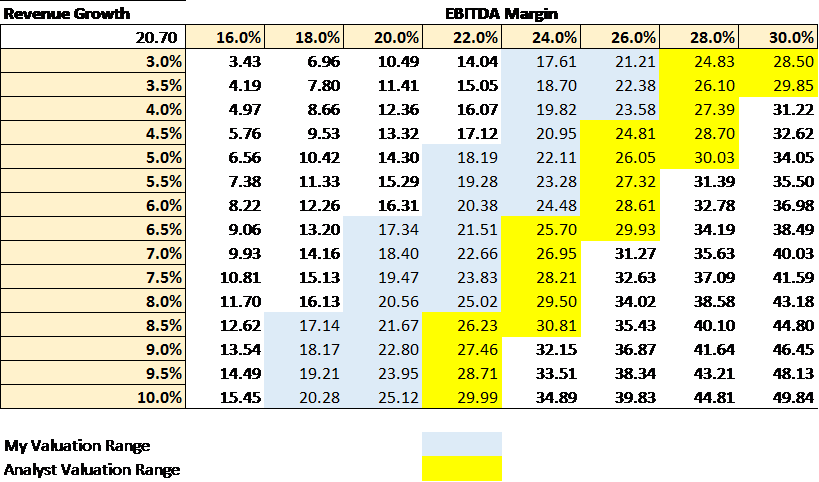
My DCF valuation yielded Equity Valuation of RM22.0bn with an implied P/E of 17.23. This is lower than KLK’s current Market Cap of RM26.1bn and P/E of 20.65. Investors seem to be pricing in a more aggressive upside for KLK while I was more conservative in projecting its revenue growth. I do want to point out that KLK’s current EBITDA margin is 10.6% and I have assumed that it will match its peers at 24% in 4 years time which is already quite aggressive in my opinion. I have earlier pointed out that KLK’s P/E is more on the high end of its peers ( Peers P/E at 10-13 ).
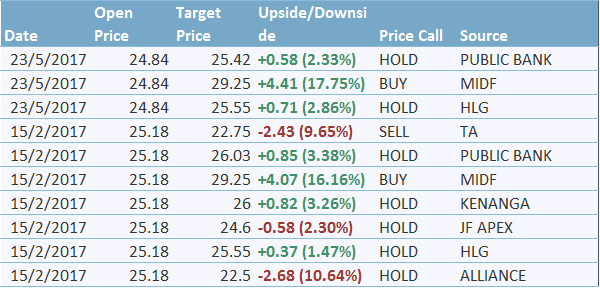
Analysts also seems to be quite bullish in its target prices with TPs exceeding RM25 for almost every analyst. The highest is by MIDF at RM29.25 and the lowest is by TA at RM22.75.
In order to get the target prices of RM25 above which is in line with market sentiment and analyst recommendations, the region highlighted yellow below needs to be obtained according to my model. What is assumed seems to be quite aggressive in terms of revenue growth and margin and I have decided to stick with my more conservative valuation.