

It seems the U.S.-Iran negotiations are over. Both sides are exchanging strikes again, as the Straits of Hormuz is probably going to be closed again. 20% of the world’s supply in oil and natural gas are going to be shut off, and oil-importing countries are going to be hit hard again.
In just the span of a week, Brent crude oil prices are up by 16% to US$88 per barrel (as of 17 July 2026). It seems like the short-term war that Trump has promised when the conflict started is turning into a long one. As a result, markets responded how they would be.
- S&P 500: -1.6%
- Nasdaq: -2.9%
- Shanghai Composite Index: -5.8%
- Hang Seng China Enterprise Index: +1.2%
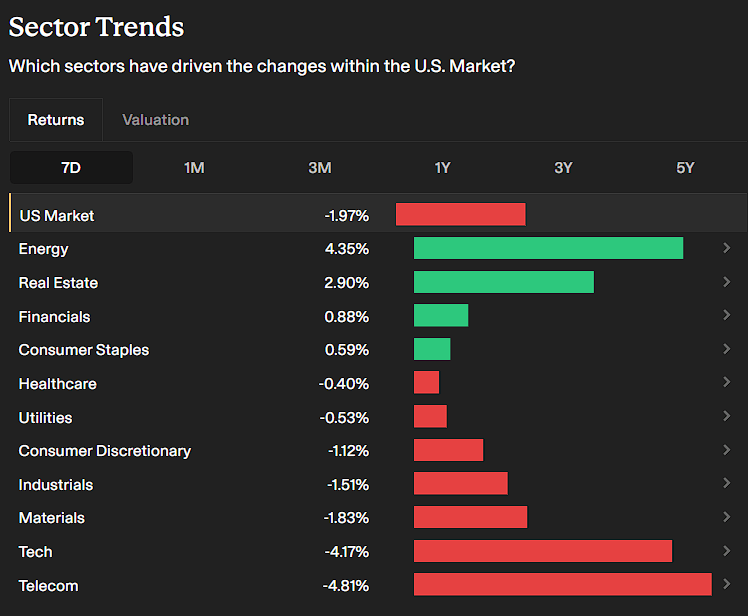
In the U.S., oil & gas counters were up naturally with data from SimplyWallSt showing that the energy sector was up by 4.4% for the week. The likes of Marathon Petroleum (+5.3%) and Valero Energy (+4.7%) were up as investors view them as ‘the high oil price’ play.
Why the U.S. Real Estate Sector also Gained
What I am looking closely now is actually the REAL ESTATE sector, which gained by 2.9% in the United States. And this has something to do with inflation. Many were expecting that high oil and natural gas price could bring inflation higher due to the conflict. However, recent data on inflation indicate otherwise.
- Inflation rate actually eased to 3.5% in June 2026 from 4.2% in May 2026.
- The decline was mostly led by lower energy prices. From May to June 2026, energy prices declined by 5.7% as oil prices cooled when the U.S. and Iran came to the negotiating table.
This actually gave the Federal Reserve the ammunition it needed to NOT do anything to interest rates in the latest Fed meeting. With interest rates keeping steady in Kevin Warsh’s first meeting, I think investors had a longer-term view on the real estate market.
- Generally, when interest rates are ‘low’, cost of borrowing is cheap. People who want to buy houses are encouraged to buy one.
- With inflation possibly trending downwards, there is no rush for the Fed to increase interest rates.
But with the U.S. and Iran conflict flaring up again, this thinking could prove to be too little too late. Brent crude oil prices are up to US$90 per barrel again (as of 19 July 2026).
I am now watching for inflation dynamics in July to play out to see whether the higher oil and natural gas prices could seep back in. However, these are the fundamental dynamics of the real estate sector that I am looking at so far.
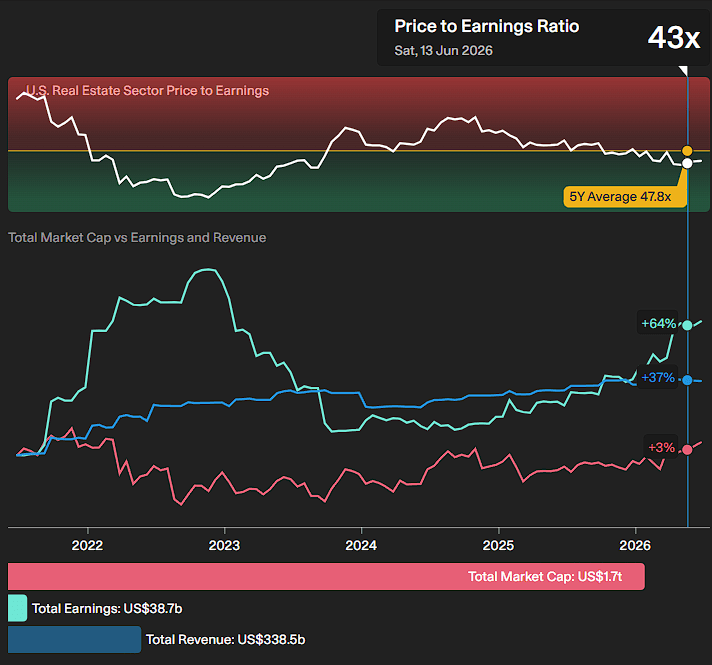
- Valuation: The U.S. real estate sector is trading at a price-to-earnings ratio of 43.9 times, slightly lower than the 5-year average of 47.8 times. It is trending back up to its average again.
- Earnings: Profits have also trended upwards since the beginning of 2025, signaling a broad-based recovery in the sector.
U.S. Tech Decimated by DeepSeek 2.0
They call it DeepSeek 2.0.
And rightly so. Moonshot AI has just released its Kimi K3, which has performance that is on par with Claude Opus 4.8 and ChatGPT 5.5.
The U.S. market erupted … the other way. AI companies sank on last Friday. The PHLX Semiconductor Index, which tracks AI heavyweights such as Nvidia, Broadcom, and Micron, sank 10% last week. Broadly, the Nasdaq, which is heavily tech-focused, dropped by 2.9%.
Some investors are taking this opportunity to take profit off the table, as many big tech companies are set to report on their earnings. They expect strong financial numbers but are wary that big tech is still investing heavily in AI. Hence, they are keeping a close eye on committed AI capital expenditure projections. The higher it is, the more sceptical investors will get.
Most importantly, Kimi K3 is open-source, unlike many of its U.S. competitors.
And there are signs that the industry is moving towards that. Thinking Machines and DeepReinforce are two examples of this.
Despite this optimism for Moonshot, things weren’t actually that rosy in the broader Chinese market last week …
Shanghai Markets Craters
The Chinese markets are not spared the global sell-off in AI stocks.
The Shanghai Composite Index (SCI) declined by 5.8% for the week, with most of the decline occurring on Friday (-3.0%). AI-heavy stocks in Korea, in particular SK Hynix declined. In Taiwan and Japan, the same thing happened also.
AI stocks in China are facing the same problems. Concerns about overvaluation is top of the list, but many of the big AI investments are coming into question now. Can they generate the required return on investment to justify such big investments?
That question is also posed to Chinese AI companies. SMIC is often regarded as the proxy for the semiconductor sector in China, and it declined by 9.8% last week. The technology sector in China declined by a whopping 17% last week.
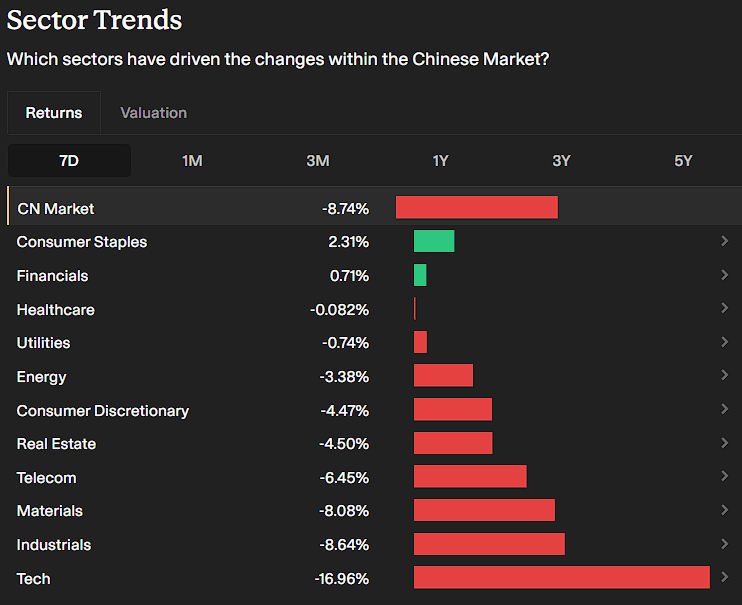
But this huge decline masks some big gains from China’s big boys. Here are the performances of major tech companies on the Hang Seng China Enterprise Index.
- Xiaomi: +7.1%
- Alibaba: +7.1%
- Tencent: +3.7%
- JD: 5.0%
- Meituan: +10.8%
And it looks like electric vehicle companies are back on the menu for many investors …
China EV Players Gain
They have Trump and Iran to thank.
With crude oil and natural gas prices spiking back up again, investors are piling back into electric vehicle players in the market. They are expecting demand for EV to remain strong at least for the next few months.
Reportedly, about two-thirds of car sales in China now are EVs. Here are the top EV gainers in China last week.
- BYD: +7.7%
- Xpeng: +5.8%
- Li Auto: +5.3%
- Geely: +2.9%
EV players in China have found the conflict to be their best friend, as Chinese consumers flock to EVs amid high oil prices. Petrol cars are having bad months at the market.
However, overall car sales in China are not doing too well. In the first half of 2026, sales were down by 20% as the industry is coming off a record year in 2025, while subsidies for EVs are decreasing.
Projections are now: -14% decline in overall car sales.
So, while EV players are gaining on renewed demand for EVs due to high oil prices, 2026 is still projected to be a bad year for the auto industry.
I am looking at Chinese EVs that will survive the year. But ultimately, I think valuations are still high and expensive, and their earnings forecast for the year are not so great.
2027’s projections will be crucial here.
That’s it, folks on my thoughts on markets for the week. If you want to know more, subscribe to my website for more updates like this.
 Slice of P.I.E