The global AI industry is booming and faltering at the same time. Last month’s (October 2026) sell-off got so bad that banks started to tighten their credit requirements. Before this, they were quite trigger-happy in lending to them.
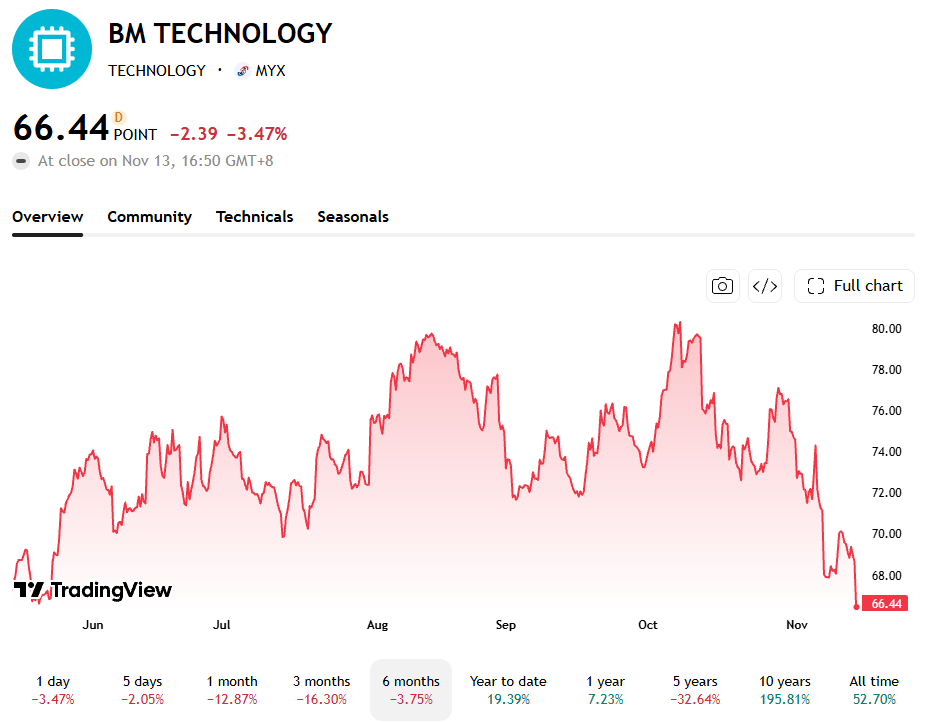
In the Malaysian scene, a similar thing unfolded. The Bursa Malaysia Technology Index declined from a peak of 80.32 on 7 October to a low of 66.44 as of 13 November. The AI trade for Malaysia has continued to unravel despite some recovery in the U.S. AI trade in the recent week.
I am going to take a good, objective look at Pantech Group Holdings’ outlook and prospects for the rest of the year and for 2027, and analyse where its catalysts and risks could come from.
The company has recently gained attention due to its involvement in the AI data centre infrastructure, as it provides critical cooling and piping solutions. However, it also has deep linkages to the Malaysian and global oil & gas industries and a still strong outlook for the oil & gas sector could be the catalyst the company needs.
Disclaimer: This is not financial or investment advice, and is only meant for educational purposes. I take no responsibility for anyone’s decision.
Business Model in Detail
You can think of Pantech Group as a one-stop solutions and products provider to companies that require fluid and gas transmission services. It services clients in the oil & gas, petrochemicals, palm oil, oleochemical, electrical and electronics, and most recently, data centres.
Its services stretch across almost the entire value chain (with the exception of raw materials extraction). Firstly, it takes in raw materials such as iron ore and nickel to make pipes, fittings, flanges, hot induction bend, valves, and steel products. Then, it either sells in-house to its trading division, which sells and distributes to clients, or sells to other wholesalers.
Pantech is broadly divided into two segments:
- Manufacturing (65% of revenue for 1H 2027): Produces fluid and gas transmission components through precision engineering that includes welded pipes and butt-welded fittings.
- Trading (35% of revenue): Sources and stocks inventory from certified vendors, including in-house products, and sells them to customers.
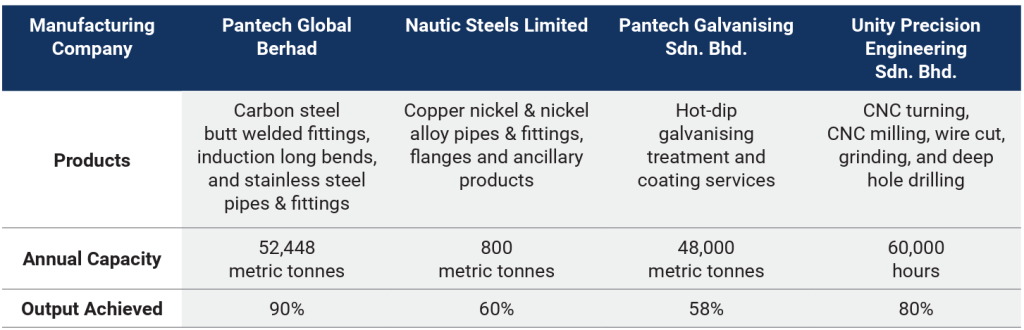
Source: Pantech Group Annual Report 2026
Most of its revenue is derived from its Malaysian operations, generating 97% of its overall revenue. The remaining 3% is generated by overseas operations.
Financial Performance
The fortunes of Pantech Group are tied to the outlook for the oil & gas and palm oil sectors. Unfortunately, it’s unclear how much of Pantech’s revenue is attributed to each individual sector.
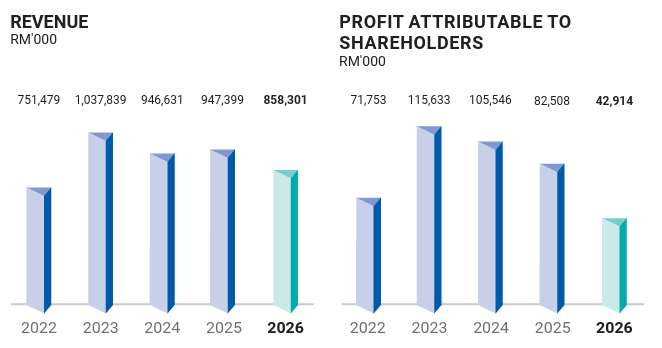
In the past five years, revenue and profits have actually declined continuously from 2023 onwards, reaching a low in 2026.
Source: Pantech Group Annual Report 2026
By our analysis, it seems that Pantech Group’s fortunes are more closely tied, firstly, to the manufacturing of refined petroleum industries’ GDP in Malaysia and then to the overall mining sector (most of it is crude oil and natural gas).
| Year | Refined Petroleum GDP Growth (%) | Mining GDP Growth (%) | Pantech Revenue Growth (%) |
| 2022 (end February 2022) | 16.2 | 1.8 | 54.5 |
| 2023 | 6.2 | 4.8 | 38.1 |
| 2024 | -3.4 | 0.8 | -8.8 |
| 2025 | 1.8 | -0.5 | 0.1 |
| 2026 | -1.8 | 0.9 | -9.4 |
Source: TradingView, DOSM
2026 (from February 2025 to February 2026) has been its weakest year so far, which was in line with the weak performance of the Malaysian mining and refined petroleum sectors.
However, 1H 2027 (February 2026 to August 2026) tells a story of recovering financials that is driven by higher oil & gas and data centre activities.
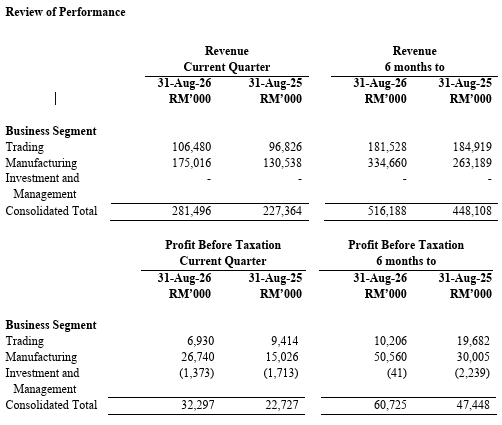
Revenue was up by 15.2%, driven mainly by higher revenue from its manufacturing division (+27.2%), while its trading division slightly declined. Meanwhile, on the profit side, manufacturing (+68.5%) once again drove much of the increase in net profits (+27.8%). The uptrend was driven by higher sales volume and average selling prices, while deliveries to the oil & gas sector increased.
Meanwhile, from TA Research, it cited that demand from the data segment, particularly in the U.S. has strengthened. Gross margins for stainless steel fittings have improved to 60% from 47% previously. Meanwhile, it was able to increase average selling prices by 10% to 15% despite lower raw material costs, which means that the company’s ‘spread’ is now wider. Manufacturing capacity has also increased to 80% for carbon steel fittings and 90% for stainless-steel fittings and pipes. Most importantly, its customers for carbon steel are 70% committed through July 2027.
From the Philips Capital side, it has cited generally the same reasoning but added that there is a robust export demand while its tender book expanded by 80% yoy.
Catalyst and Outlook
For Pantech, there are two catalysts that could be driving the company forward.
- Oil & gas industry strength in 2026 and 2027
- Continued boom in AI data centres
For the first one, I have highlighted in my piece here on Malaysia’s oil & gas sector that the outlook remains favourable due to still-high oil prices. To note, Pantech’s revenue sources and streams could be anchored by
- The Pengerang Integrated Complex turnaround project, which is scheduled to commence by March 2027
- Sarawak Gas Roadmap, which has earmarked RM1.1 billion in critical pipeline transmission networks and trunkline expansion projects. Main involvement of Pantech is through a 49% stake in Avel (Sarawak) Sdn Bhd.
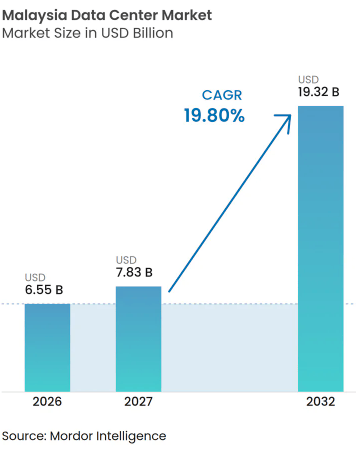
Meanwhile, from the data centre side, Malaysia has attracted about RM95.8 billion in approved data centre and cloud computing investments, which represent 44% of all approved investments during 1H 2026. Based on projections from Mordor Intelligence, the Malaysian data centre market is expected to grow from an estimated US$7.4 billion in 2027 to US$19.3 billion by 2032, at a CAGR of 19.8%.
Finally, Pantech’s 2Q 2027 results state that “global oil & gas capital spending is expected to remain resilient over the long term, supported by sustained energy demand” while “Sustained industrial activity in Malaysia and robust export demand present medium- to long-term opportunities for Group’s diversified product offerings in sectors such as petrochemical, palm oil and refinery, power generation, shipbuilding, water treatment, semiconductor, infrastructure and data centre.”
Risks
Pantech’s financial performance has shown some recovery in its latest quarters in 2027 (Feb 2026 to August 2026), and this was mainly driven by higher oil & gas deliveries and average selling prices. Furthermore, AI spending has also provided a lot of heavy lifting to Pantech’s revenue sources.
The situation regarding the oil & gas outlook is still very volatile, as the conflict in the Middle East is ever-changing. The situation in 2027 could be vastly different from what the market is projecting now. Case in point, in Pantech’s 2026 annual report, it projected that the oil & gas market would remain challenging in 2026 due to low oil prices, just before the Middle East conflict started.
Meanwhile, in the data centre portion, U.S. mid-term elections won by the Democrats meant that data centres might be undergoing tougher regulatory standards and scrutiny. U.S. communities are already starting to turn on data centres being built in their backyards, and draining their energy and water.
The global AI sell-off or slowdown in investments could dramatically push Pantech’s prospects from positive to negative in an instant.
Valuation
Pantech is currently trading at a price-to-earnings ratio of 10.7 times, which is in line with its 2-year historical average of 9.7 times.
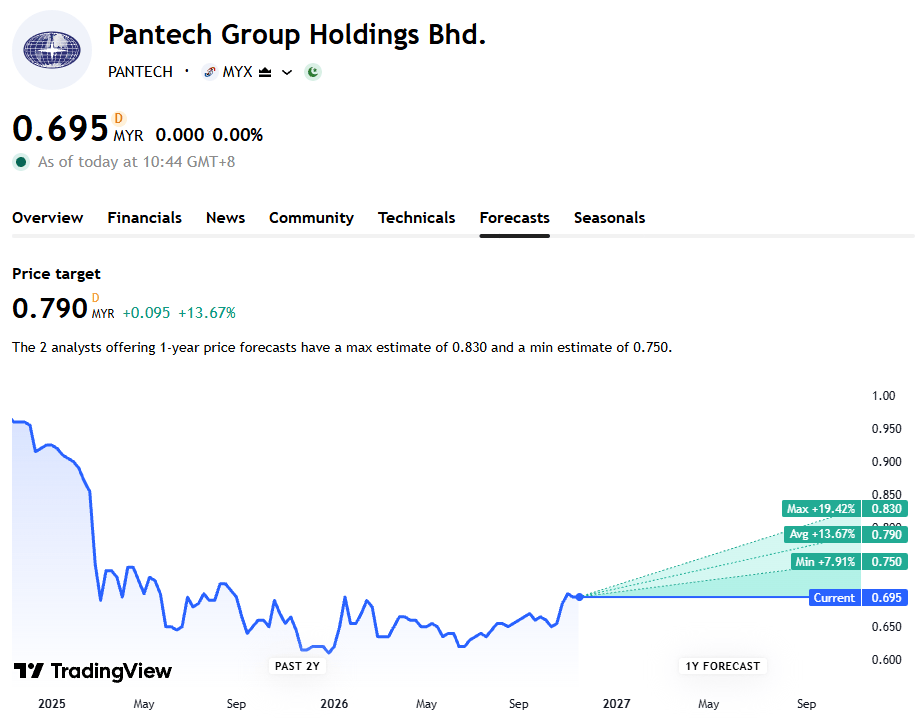
Right now, there are 2 analysts that are covering Pantech, both with BUY calls, according to the current share price of RM0.695 (as of 13 November 2026)
- TA Research: Target price of RM0.75.
- Philips Capital: Target price of RM0.83.
Here are their summary calls:
TA Research: We remain constructive on Pantech Group Holdings Bhd’s (PANTECH) outlook, supported by key catalysts of: (i) strong data centre demand to underpin order visibility; (ii) pricing discipline and automation to underpin margin resilience; (iii) disciplined capex to drive operational efficiency. We raise our earnings forecasts by 7.0%/8.3%/9.9% for FY27F–FY29F, respectively, following higher stainless steel utilisation assumptions. Maintain Buy with a higher TP of RM0.75/share based on 8.0x FY28F EPS and incorporating a 3% ESG premium.
Philips Capital: We remain positive on FY27E earnings outlook, underpinned by manufacturing margin expansion and a broader trading project pipeline. ASPs for stainless steel and carbon steel products have increased by 15-25%, and have remained firm into 2HFY27 amid robust export demand, despite nickel and iron ore prices easing by 18-19%, from their May26 peaks. This favourable pricing spread, coupled with automation gains from new laser-cutting machines, has reduced consumable costs by 80% and is expected to drive core net margin expansion to 8% in FY27E (FY26: 5.8%). On the trading front, 80% YoY growth in the tender book, alongside opportunities from the domestic DC supply chain, the Pengerang turnaround project and the Sarawak Gas Roadmap, should provide further earnings upside. Overall, we forecast FY27E core net profit to rebound 51% YoY to RM78m, reinforcing our positive outlook on Pantech‘s earnings recovery.
Based on the current share price of RM0.695, this implies an average target price of RM0.79 and an implied upside of about +13.7%.