With the year almost gone and dusted, Malaysia’s energy sector seems to have benefited the most.
The Bursa Malaysia Energy Index was up by 7.8% for the year, as it benefited from high oil prices that lifted its financial prospects. The U.S. and Iran are once again trying to strike a deal in November 2026, but analysts are projecting that a deal would probably be unlikely given that Trump is still committed to its war with Iran.
Brent crude oil prices remain very high at US$117.64 as of 30 October 2026, but declined to US$104 per barrel on news of talks between the U.S. and Iran in early November.
I am looking at this situation with interest as I am researching the prospects for Malaysian energy stocks in 2027. The conflict will probably continue past the end of the year in various forms, and I am seeing that Brent and WTI crude oil prices could remain high, suggesting a sustainable trend in revenue and earnings.
Disclaimer: This is not financial or investment advice, and is only meant for educational purposes. I take no responsibility for anyone’s decision.
Macro Picture
Let’s keep the macro picture simple to read. There is currently no breakthrough in any negotiations between the U.S. and Iran. And the mid-term election loss for Trump has now turned him into a ‘lame duck’ with both the Senate and the House lost to the Democrats. But it does mean that Trump has nothing to lose now, and he could be continuing the war in Iran more vigorously. From a supply shortage standpoint, I do see this situation continuing towards at least 1H 2027, before other supplies in the Middle East recover by the end of 2027. This viewpoint was based on what I have read from the EIA report in November 2026.
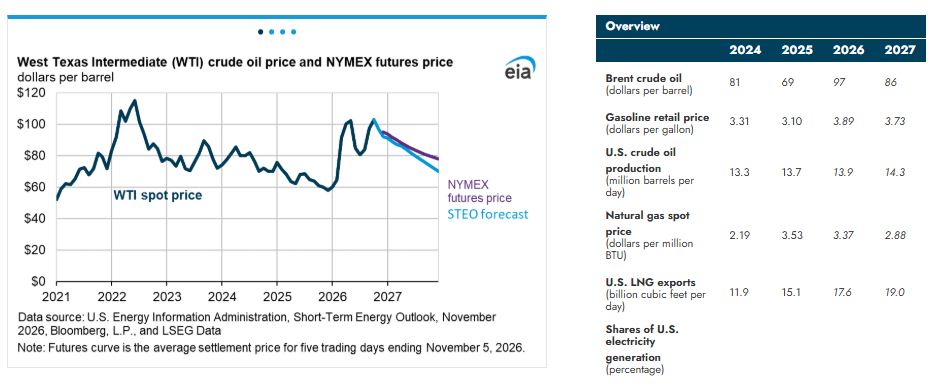
Price projections for 2027 indicate that investors and forecasters are pricing in still-high crude oil prices at US$86 per barrel, down from an average of US$97 per barrel in 2026. I view this as favourable for oil companies, considering that their average production cost per barrel is between US$10 and US$15 per barrel in Saudi Arabia and US$30 to US$70 per barrel in North America.
So, I do see a sustained outlook for Malaysia’s oil & gas companies for 2027 in terms of pricing and sales opportunity. However, that outlook could be affected by the volatile geopolitical developments in the Middle East region.
MISC
MISC operates a fleet of vessels and offshore vehicles that services energy companies (oil & gas primarily) in maritime and transportation. The company’s operations can be divided into 4 units, namely
- Petroleum & product shipping (49% of revenue): Provides petroleum and chemical tanker services.
- Marine & Heavy Engineering (20%): Marine repair, conversion, engineering and construction works.
- Offshore (19%): Own, lease, operate and maintain offshore, floating, production and offloading terminals.
- Gas assets and solutions (11%): Provide LNG carrier services and gas asset solutions.
We all know the story from MISC. It is not a direct crude oil and natural gas player, but rather a service company to the big boys that are transporting their commodities halfway around the world. In 2025, the Americas made up about 56% of its revenue, with Malaysia at 40%. The remainder went to Asia.
To me, there are two important elements to take note of for MISC.
Firstly, MISC’s petroleum and product shipping has performed mightily well in 1H 2026 due to higher freight rates. Revenue for the segment was up by 74.1% to RM2.2 billion in 2Q 2026, amid the geopolitical conflict in the Middle East. According to its 2Q 2026 report, the company thinks that crude tanker rates and tonne-mile demand would be supported by potential inventory rebuilding following drawdowns earlier this year and robust long-haul crude exports from the Atlantic basin.
So, I did a check on these prospects. Crude tanker rates indeed have risen sharply in 1H 2026, with VLCC, Suezmax and Aframax rates more than doubling from the end of 2025.
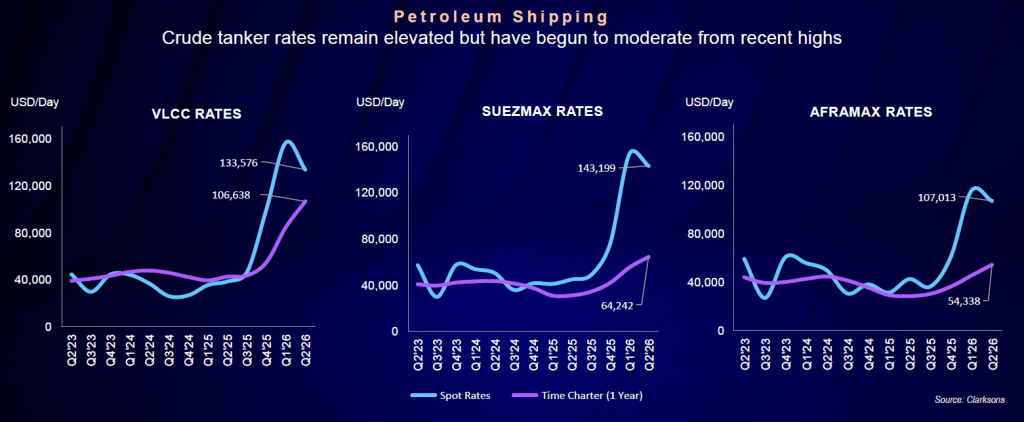
According to market forecasts, Evercore has doubled 2027 VLCC earnings forecasts from US$57,500 a day to US$115,000 a day for 2027. In 2026 itself, that projection is US$215,000 per day. This means that rates will start retreating in 2027. Other outlets, such as Jefferies, are forecasting US$65,000 a day for VLCC rates in 2027, due to an ageing fleet and the potential for substantial inventory restocking.
Meanwhile, high freight rates are incentivising Asian refiners to source shorter-haul Middle Eastern crude rather than Atlantic barrels, which could potentially present a risk to MISC’s American operations. From the supply side of things, Evercore is forecasting that tanker newbuilding deliveries could rise to an unprecedented 62.8 dwt in 2028, with an additional 54.9 dwt scheduled for 2029. This means that net underlying tanker growth could be 5.3% in 2026 and 5.5% in 2027, which indicates more ships entering the market.
How am I making sense of this?
To me, MISC could be facing lower crude tanker rates in 2027, but not that much lower. The supply situation could present more competition to MISC, while Asian refineries could be importing less from the Atlantic basin. However, I don’t think the impact is big, considering that the situation in the Middle East remains volatile and it is still difficult to source crude oil from the Middle East. MISC’s clients would still see substantial business from the global crude oil refinery markets.
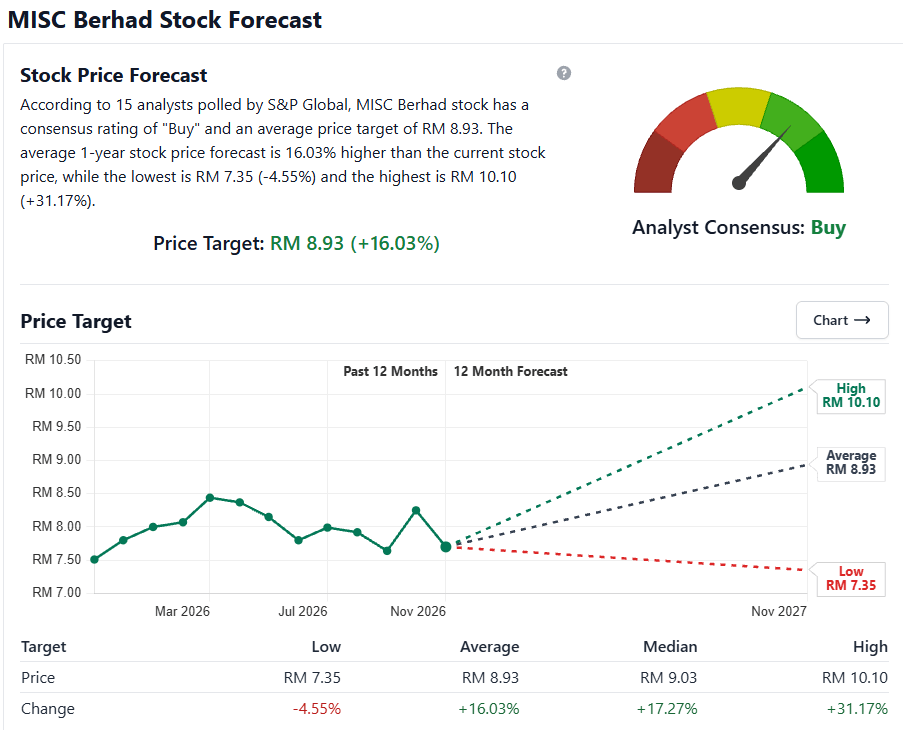
Valuation-wise, MISC is currently trading at a price-to-earnings ratio of 14.7 times compared to its historical average of about 20 times. From the market point of view, MISC’s target price is at RM8.93 with an implied upside of about +16%.
Dialog
Dialog Group is an integrated oil & gas player that has operations in the upstream, midstream and downstream portions of the market, and also has businesses in the renewable side of things. Most of its operations are centred in Malaysia, with Malaysian clients contributing 65% of revenue, while its international clients make up the rest.
Dialog can be considered a vertically integrated player with its hands in almost all of the oil & gas supply chain. A period of high elevated crude oil prices would boost its upstream and midstream portion of the business. Unfortunately, they don’t provide a breakdown of its segments, so it’s hard to tell how exposed the company is to the current market conditions.
However, there is one development that could be beneficial for the company. The U.S.-Iran conflict has actually increased demand for storage services all around the world. Countries are more worried about energy security and being cut off from the global crude oil and natural gas markets. More of them are investing in storage facilities and procuring services from petrochemical storage companies to safeguard oil barrels for a rainy day.
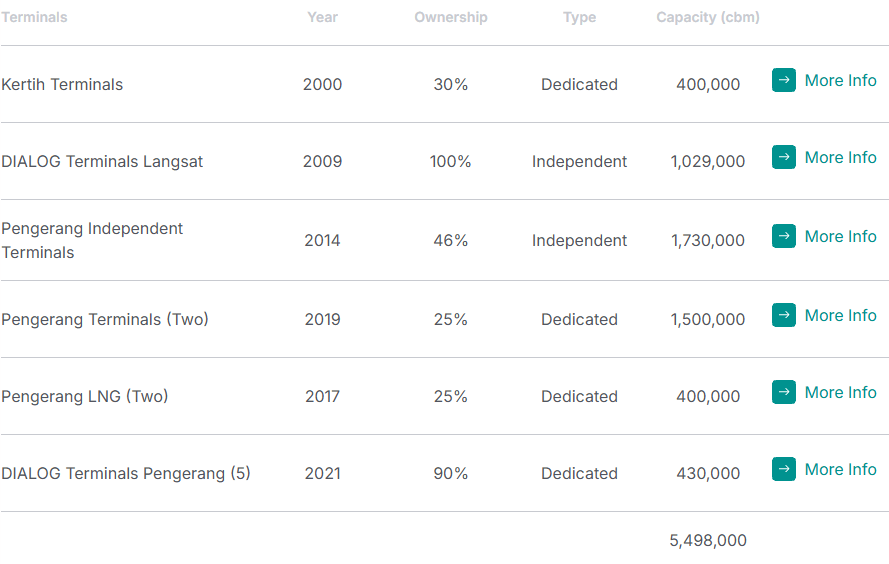
Dialog’s midstream segment services precisely this. Currently, it has a capacity of about 5.5 million cubic metres, with most of its terminals at the Pengerang sites. Most importantly, it has secured a major customer in BP Singapore for its Phase 3 expansion, which will add an additional 614k cubic metres by mid-2028.
Recently, Saudi Aramco’s move to store more oil in Singapore’s deep caverns could also be a catalyst for more storage options by major oil players moving forward. This is an indication of a shift in energy security policies due to the conflict in the Middle East. To mitigate supply disruptions, countries want to store oil off-site to secure oil supplies.
I do see the case for sustained long-term demand for Dialog’s storage facilities and solutions, with the current geopolitical conflict reminding countries that energy security remains an important policy.
In its latest quarterly results, Dialog did see a surge in revenue. It was up by 27.3% to RM775 million in 2Q 2026, while profits are up by 10.4% to RM168 million. For the full year, revenue is up by 15.3%, while net profit more than doubled to RM625 million.
However, its 2Q results yield some interesting points that we need to consider for its prospects in 2027.
- Its upstream business did benefit from higher average selling prices for oil, but it cited that its total contribution to revenue was lower due to reduced production.
- Midstream business did well as it is supported by healthy tank storage capacity.
- Downstream performance improved, driven by higher EPCC projects.
From here, I think that Dialog’s prospects would not benefit much from high oil prices, and could benefit more from its midstream and downstream businesses, considering that energy security is a bigger issue now for countries.
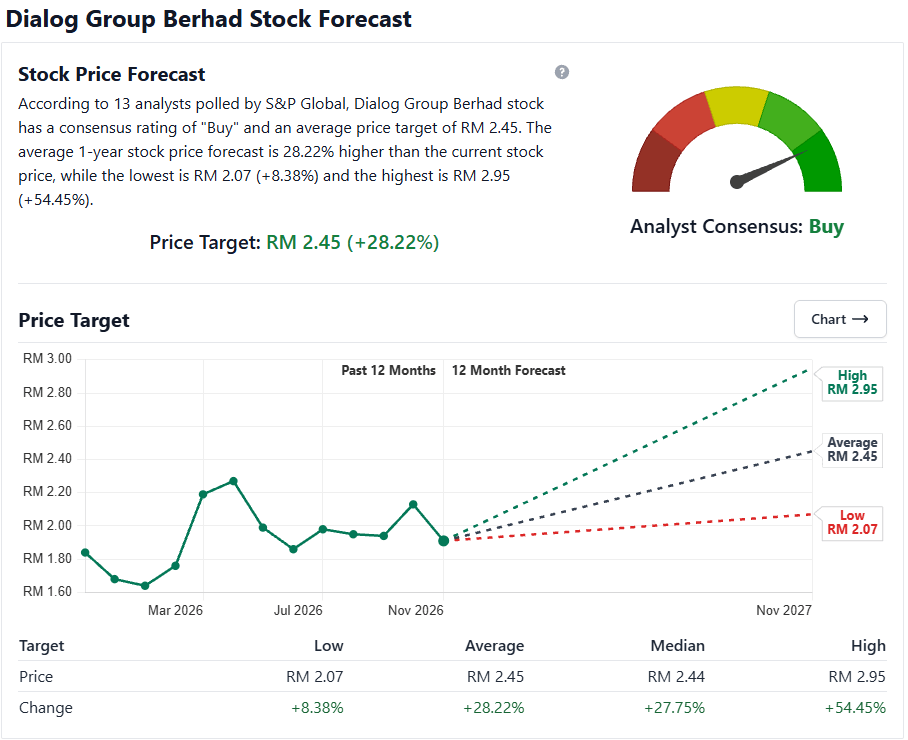
Dialog is currently trading at a price-to-earnings ratio of 18 times compared to its historical average of 24 times. This presents an attractive undervaluation opportunity for the company. Meanwhile, from the market perspective, analysts are setting an average target price of RM2.45 with an implied upside of +28.2%.
Petronas Chemicals
Petronas Chemicals is an integrated chemicals producer in Southeast Asia that produces speciality chemicals for sale that are produced from crude oil and natural gas. Products include
- Olefins: 38% of revenue
- Fertilisers and Methanol: 42%
- Specialties chemicals: 20%
First of, Petronas Chemicals is not entirely plugged into the oil & gas cycles. It uses crude oil and natural gas as raw materials to produce the products and chemicals for other uses. Hence, you can view Petronas Chemicals as dependent on the pricing of these raw materials.
In general terms, I would view higher raw material prices as detrimental to such a company, but its 2Q 2026 results suggest that Petronas Chemicals has pricing power and benefits more from higher feedstock prices.
In its Fertiliser and Methanol segment, it reported that its average product prices rose by more than 50% quarter-on-quarter, with segment revenue rising by 38% to RM3.7 billion. This meant that volume did decrease, but its higher prices more than offset the volume decrease. The report also highlighted that there were stronger product spreads, which I take to mean that its margins improved.
It was the same story in its olefins and derivatives segment, where its average product price increased by 37%.
All in all, 2Q 2026 delivered a 12.6% growth from 1Q 2026 in revenue, driven mainly by higher average product prices. I interpreted that the company’s volume sold actually decreased.
Furthermore, the company undertook extensive planned turnaround activities at several facilities in Bintulu and Kertih that effectively reduced its plant capacity rates from 97% in 1Q 2026 to 73% in 2Q 2026. If they were open, this could have meant that Petronas Chemicals could have had better financial performance.
That means that 3Q and 4Q 2026 results could be stronger than expected, depending on the plant capacity rates. Higher capacity combined with higher average product prices could mean that Petronas Chemicals could have a potent catalyst in its hands.
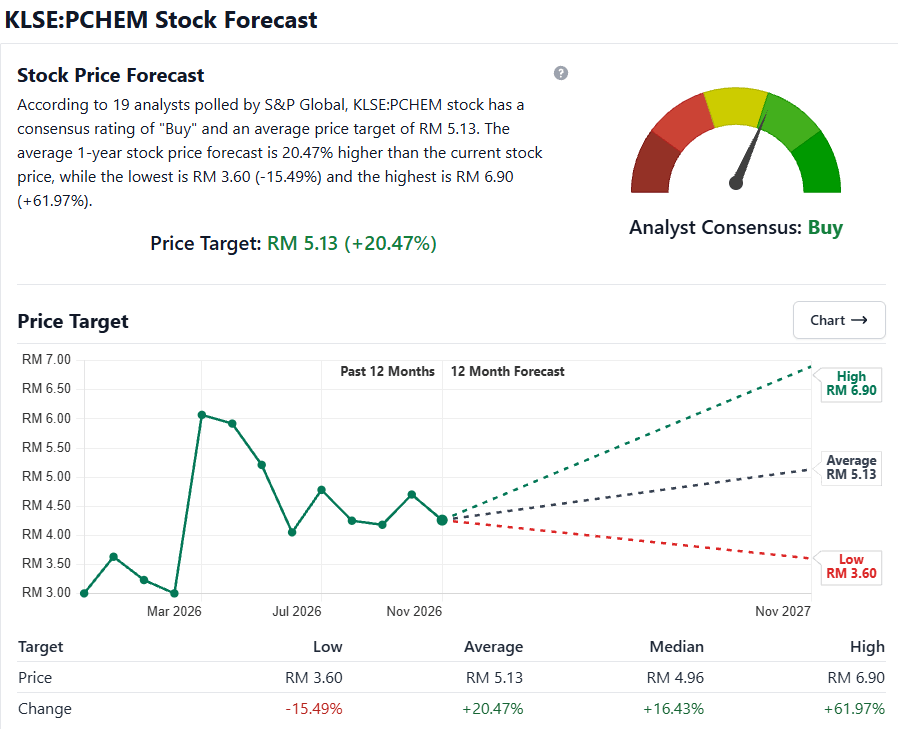
In the market, analysts are setting an average target price of RM5.13 with an implied upside of +20.5%.