

“Buy when everyone else is selling”. We have all seen this mantra by investors who follow closely what Warren Buffett always practices. And this week, we take a good look at what this means for the global markets.
1. The Markets View
The United States Markets Tanked
This week marks one of the deepest sell-offs in recent memory, with the S&P 500 declining by 8.6%. There were only 34 winners with Tyson Foods surprisingly being the biggest winner at a gain of +10.7%, followed by other food players such as Hormel Foods (+6.6%), Campbell’s (+4.5%) and Domino’s Pizza (+2.0%). ‘
Of course, the big story is Nvidia and its related AI companies that have plunged. Even though Nvidia posted a strong 3Q results, investors remain unconvinced about the company’s ability to weather the current crisis in its ex-CEO, Jensen Huang and the appointment of a competent new CEO to lead the company.
Many have called for the reappointment of Huang as the CEO, with figures such as Bill Ackman and Elon Musk supporting the move. After all, there are now 205k signatures on the standwithjensen movement that supports bringing him back. 10,299 of current people working in Nvidia also signed, with 1,836 former Nvidia workers signing also.
Nvidia board has come out to say that bringing him back is “out of the question” and has reportedly approached current Arm Holdings CEO Rene Haas to lead the company. He has worked for Nvidia before. But market sentiment seems to be very bearish now, with Nvidia dropping by 22.9% and many of the AI counters on the S&P 500 also following suit.
- Micron: -23.6%
- AMD: -20.5%
- Super Micro Computer: -19.4%
- Dell: -19.3%
- Oracle: -19.3%
- Lam Research: -18.9%
- Intuit: -20.9%
- ON Semiconductor: -14.3%
- Palantir Tech: -14.6%
- Intel: -14.1%
The bearish sentiment is understandable. Nobody wants to be caught on the wrong side of the sell-off. So, as more and more people sell, this creates a vicious cycle for the sell-off that perpetuates itself. The big question is how low can it get? And can this be considered the ‘bursting of the bubble’ like what Michael Burry predicted in September 2026?
Sell-Off Spreads to Global Markets, especially China
The world followed suit, with the MSCI World Index declining by 8.1% for the week. The AI sell-off affects China’s AI industry directly also, and this shows in both its Hang Seng China Enterprise Index (-4.8%) and Shanghai Composite Index (-2.8%). From the HSCEI side, it’s obvious the AI names declined sharply.
- Alibaba: -8.0%
- Horizon Robotics: -16.8%
- Tencent: -11.0%
- Lenovo: -7.2%
- Baidu: -13.7%
But it becomes much more brutal when you consider Hong Kong’s Artificial Intelligence Themed Index.
- MiniMax: -32.8%
- Zhongke WengeAI: -33.0%
- WeRide: -22%
- PonyAI: -21.2%
- Victory Giant: -13.5%
- GigaDevice Semiconductor: -18.8%
- Z.AI: -18.2%
However, despite the brutal sell-off, three AI names actually caught my eyes here for the week as they gained instead – SMIC (+1.2%), Hua Hong Grace (+3.9%), Shanghai Xizhi Tech (+4.5%).
Less Intense Sell-Off in Malaysia
The Malaysian FBMKLCI market was down by 1.6% for the week, and I think the sell-off was less intense due to the limited linkages of the Malaysian market to the global AI sector. However, the Bursa Malaysia Technology Index decline was much more at 6.5%. AI-related names led the decline, such as
- SkyeChip: -13.3%
- Unisem: -9.0%
- Frontken: -8.7%
- ViTrox: -8.2%
- Stratus Global: -18.5%
- Globetronics: -5.6%
- Pentamaster: -6.7%
Sentiments could have been better as Malaysia released its gross domestic product (GDP) results for 3Q 2026 that showed the economy growing by 5.5%, better than the 5.3% advance estimated provided previously. With one more quarter to go, sentiments are high that the country can deliver a better-than-expected growth compared to its projections last year that range from 4.0% to 4.5%, as 9M 2026 growth is already at 5.6%.
2. How are Valuations Shaping Up to Be?
The S&P 500’s price-to-earnings ratio declined to 23.6 times as of 20 November 2026 from 2026’s average of 25.8 times. This is lower than the 5-year historical average of 25.7 times.
Overall market valuations show about 10% undervaluation compared to the historical average, but of course, when you investigate deeper, things are changing rapidly, especially for tech stocks.
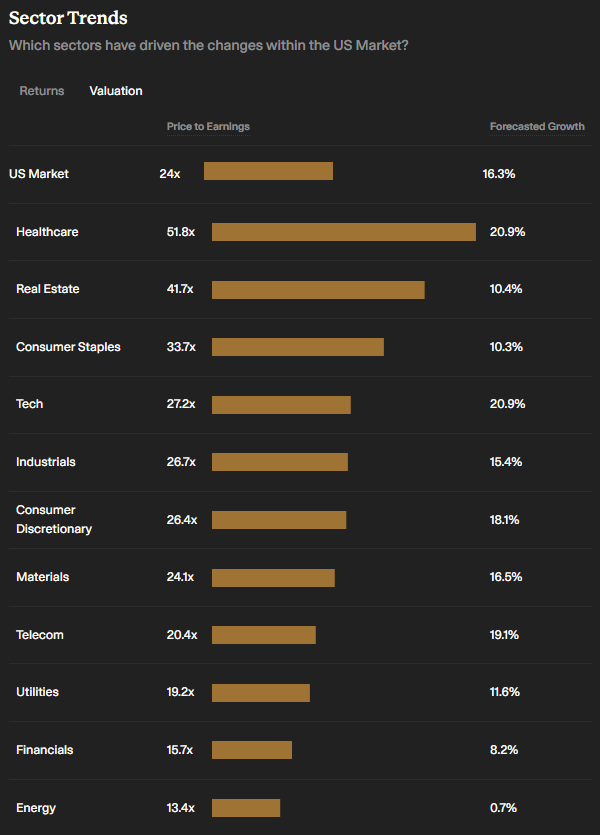
Source: SimplyWallSt
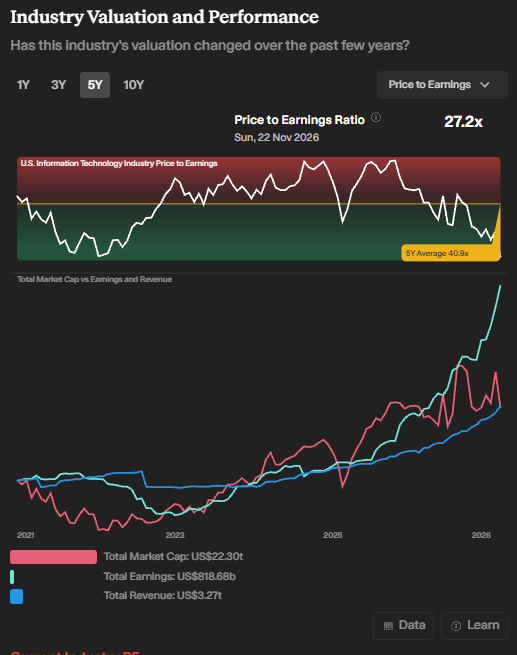
The technology sector, which used to be the darling of the U.S. markets, is now trading at 27.2 times. This is a pretty underwhelming valuation considering that its forecasted earnings are among the highest at 20.9%. That means its PEG ratio is now at 1.3 which is a pretty fair deal. Over the past few months, the technology sector PER has declined sharply from its 5-year historical average of 40.9 times and is now at a 5-year low.
If we take a look at Factset’s weekly earnings insight, there seems to be an opportunity now for the whole market as its price has dropped below its forward 12-months PER in recent months. The only times that have happened in the past few years were during 1) the early 2025 sell-off in tech stocks, and also the Russia-Ukraine war that triggered massive rate hikes by the Federal Reserve from 2022 to 2023.
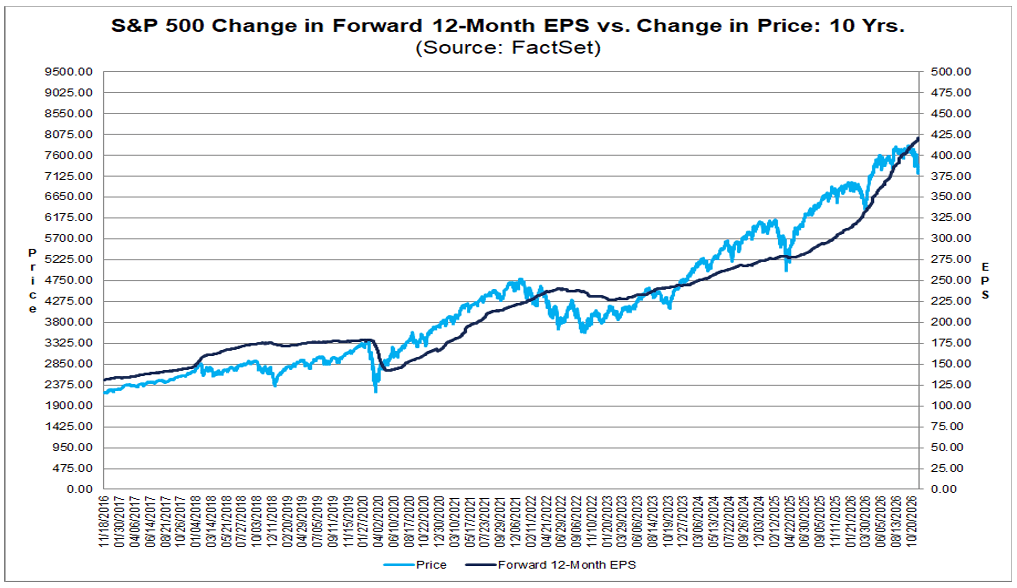
My read here is that it depends on how long this bear market will last. Your guess is as good as mine. But this indicator does show that it’s relatively cheap now to buy into the market’s projected earnings for the next year. So, I am potentially looking at an overall exchange-traded fund market play here.
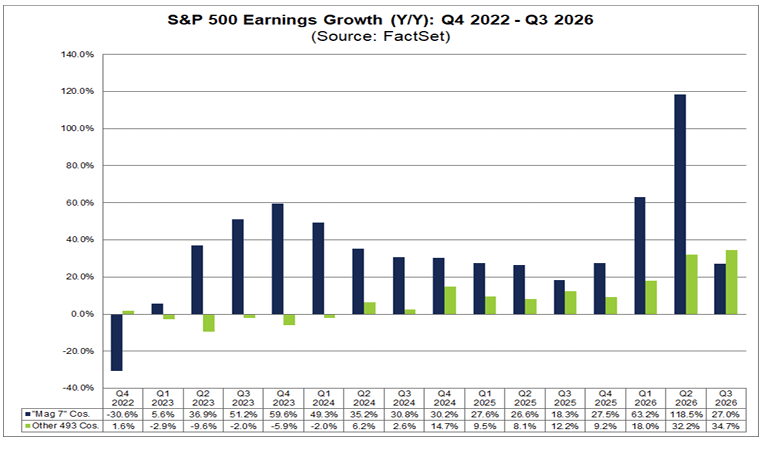
However, I need to be more objective about the prospects of the AI industry now. The Magnificent 7 companies, which comprise Nvidia, Meta, Alphabet, Amazon, Microsoft, Tesla, and Apple, actually reported weaker-than-expected earnings results for 3Q 2026. According to Factset, markets expected earnings to grow by 33.6% for the quarter, but the actual growth was 27%. And what’s more surprising is that the other 493 S&P 500 companies reported stronger earnings growth of 34.7%, and this represents the first time that the Mag 7 has lagged behind the overall market. Of course, some context is needed here, Mag 7’s growth has been very strong in 1Q and 2Q 2026 that investors were worried about whether their earnings growth was sustainable.
Here are the breakdown for the Mag 7 companies with their trailing and forward PE also their upsides from MarketBeat. Nvidia (+110%) of course, has the highest potential upside here, as its share price has declined sharply from the Jensen Huang spy scandal fallout. Its trailing and forward PER is so cheap now that it looks like a joke. I still remember the days when it was trading at 140 times at its peak and of about 30 to 40 times after that. But the risks are huge. We are not sure who will lead Nvidia in the future, and whether its market position will be secure moving forward. Alphabet (+55%), Meta (+48%) and Microsoft (+26%) are in the same boat, as they have been sold down also following the Nvidia fallout.
| Company | Ticker | Share price (US$) | Trailing P/E | Forward P/E | Avg. target price (US$) | Upside / (Downside) |
|---|---|---|---|---|---|---|
| Apple | AAPL | 342.91 | 38.23 | 32.94 | 347.11 | +1.23% |
| Microsoft | MSFT | 484.50 | 25.29 | 20.35 | 612.48 | +26.42% |
| Nvidia | NVDA | 125.56 | 13.49 | 7.70 | 263.66 | +109.98% |
| Alphabet | GOOGL | 265.40 | 13.85 | 17.79 | 412.51 | +55.43% |
| Amazon | AMZN | 247.13 | 19.98 | 22.92 | 320.73 | +29.78% |
| Meta Platforms | META | 561.15 | 19.13 | 16.54 | 831.61 | +48.20% |
| Tesla | TSLA | 346.04 | 380.27 | 326.45 | 420.82 | +21.61% |
Currently, to me, Nvidia, Alphabet, Amazon and Meta do have attractive PERs that are worth investigating more on. Their risk-to-reward ratio looks attractive now if we take into account their 52-week lows as the base for how much they could decline, and compare them to their potential upsides.
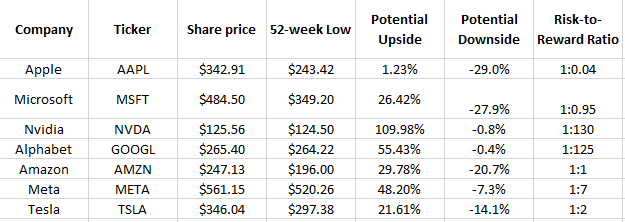
Nvidia, Alphabet and Meta seem to have the highest risk-to-reward ratio based on this and I could be looking more into these companies this week. Stay tuned for an in-depth article investigating these companies!
Disclaimer: This is not investment or financial advice, and is meant for educational purposes. I take no responsibility for anyone’s decision regarding this.
Want to get more analysis like this?

