

No, I did not expect Jensen Huang to be reinstated as CEO of Nvidia that quickly. In yesterday’s newsletter, I talked about which Mag 7 companies have the best risk-to-reward ratio now, and three names appear: Nvidia, Meta and Alphabet. I was going to do a follow-up analysis on these companies the next day.
And then I went to sleep with the U.S. markets in the background and I woke up to the news that Nvidia reinstated its CEO and Nvidia’s share price is up by 31.5% for the day, rising from $125 to US$165. No one could have predicted this, and some might convince you that this was already coming with the petition signed by so many people. But no one could have predicted the timing.
Here I am left holding this analysis article in my hands, and wondering should I still do it. The overall S&P 500 market was up by 4.7%, but of course, this was not enough to reverse the losses from the last week. Here are the performances of the other two companies I was looking at.
- Alphabet: +5.9%
- Meta: +6.7%
Regardless, I still think the risk-reward ratio is worth taking a good look. I have recomputed them and of course, Nvidia’s risk-to-reward ratio have fallen dramatically fgrom 1:130 yesterday to 1:2.4 now. Meanwhile, Alphabet’s ratio has also fallen sharply from 1:125 yesterday to 1:8.7 now. Meta’s decline was much more flat, from 1:7 to 1:3 now.
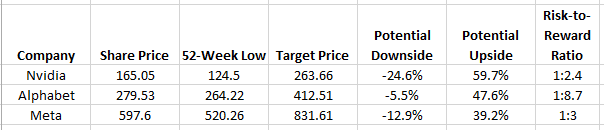
Here’s where the hard work will come in. I will attempt to look at them more deeply to investigate their catalysts, uspides and risks moving forward to form a coherent big picture views of these companies.
Disclaimer: This is not investment or financial advice, and is meant for educational purposes. I take no responsibility for anyone’s decision regarding this.
Nvidia
At this stage, I think Nvidia has become more like a penny stock in terms of volatility but has the reputation of the biggest company in the world. For investors, I think it’s prudent to analyse Nvidia from a market sentiment perspective also, which is hard to do, but this makes its fundamental analysis even more important to hold on to.
If you didn’t know, Nvidia ($4.0 trillion) has lost its first position in the market to Apple ($5.1 trillion) but it’s only a matter of time again before it reaches $5.0 trillion mark again. The question is when, and how volatile will the ride be.
Let’s first take a good look at Nvidia’s 3Q 2027 results.
- Revenue was up by 20% from 2Q 2027, and doubled from a year ago. The story is still the same. Its data centre segment drove much of the overall growth, growing by 110% from a year ago.
- It has retain its high gross profit margins at about 75% for 3Q, which yielded a net income margin of 56.3%.
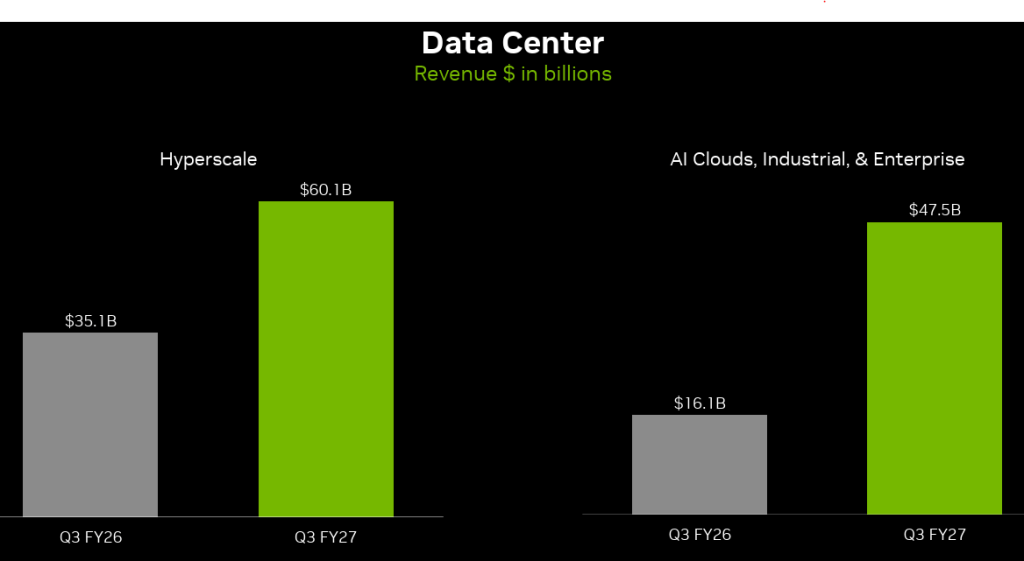
Source: Nvidia 3Q 2027 Resulte Presentation.
From its earnings transcript, the company has cited that its Vera Rubin rollout has been very strong as it has generated nearly $20 billion in revenue in its first quarter. This was its fastest product ramp up in its history.
Furthermore, it has also raised its guidance for full-year 2028 forecast, where it is now expecting revenue to grow by 75% (previous: 70%). It is leaning on the fact that the cloud industry backlog is at $2.5 trillion currently, which is higher than the $2 trillion last quarter.
However, there seems to be some concern on Nvidia’s capital allocation and financing for its vendors in some of the questions being raised by analysts in the call. The interim CEO went to great lengths to explain that the availablility of land, power, shell are critical parts of the whole structure in building data centres and that they see this as the area that Nvidia could provide assistance. Nvidia provides some form of guarantee but if the cosntruction is delayed, that guarantee no longer applies.
To be honest, my read here is that Nvidia is providing these financial ‘assistance’ and guarantees to its vendors and customers for the reason of resolving funding and cash shortfalls that might impact the timing of them buying Nvidia compute chips. Chips produced need to be sent in a timely manner, and Nvidia is trying to provide guarantees to keep the data centre construction timelines on schedule.
I don’t know how I feel about this yet, as I am not too privy on the working relationships between Nvidia and its vendors and clients, but it feels circular to me for sure.
Putting that aside, Nvidia’s outlook is certainly strong for its 2028 financial year but here is where I see some potential undervaluation in the short-term (which has been eroded away from Jensen Huang’s reinstatement as CEO).
Nvidia is still trading at a cheap price-to-earnings ratio of 13.5 times, compared to its peers’ average of about 28.2 times. Based on my own discounted cash flow valuation (a rough one), I obtained a price of $207 per share for Nvidia compared to current share price of $165, which is more conservative compared to the average target price of $264.
Alphabet
Well, Alphabet is quite different from Nvidia in terms of its core operating business and its stake in the AI business. We need to always remember that Alphabet’s Google and YouTube businesses are still its main businesses where it sells advertisements and companies pay them for it.
However, here’s the thing. Alphabet does have quite a solid AI semiconductor chip business in its tensor processing units, and have its AI model, Gemini. Last year, its Gemini model made headlines when it became on-par with the best models in the market. Currently, its Gemini 4 model is also on par in terms of intelligence.
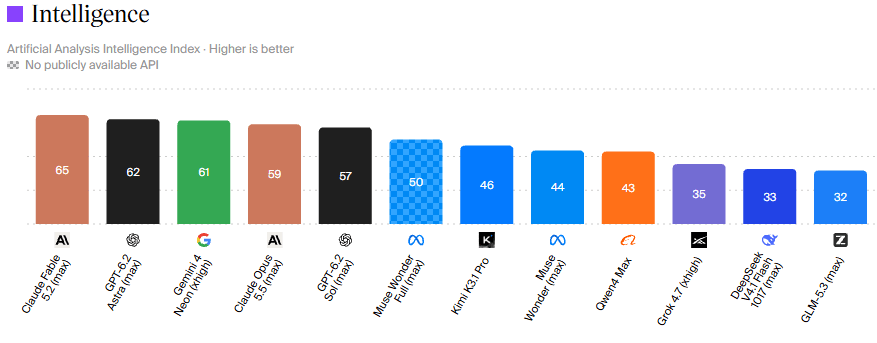
It 3Q 2026 results were strong and encouraging but it comes with caveats that might impact how we see Alphabet’s core operating businesses.
- Revenue is up by 25%, driven by its Google Cloud segment which doubled from a year ago. This is where its TPU systems are being demanded by its customers. Operating margin improved to 36.2% as of 3Q 2026 as the company achieves higher economies of scale.
- However, its Google Service segment revenue’s growth has slowed to 11% in 3Q 2026 from 14% in 3Q 2025, with slowdown coming from Google Network and YouTube Ads. On the bright side, its operating margin has improved to 40.7% from 38.5% over the same period.
Positively, the company is seeing still strong growth rates in its subscriptions business, where YouTube Premium has passed 150 million subscribers and outpaced advertising business growth. And the company is rolling out its AI features for its advertisements that have yielded some results.
Let’s go over its AI division. Its customers who used Gemini Enterprise has basically quadrupled its spending from a year ago, and it cites that 90% of the Fortune 100 companies uses Gemini. The company still depends on Nvidia chips, but I see its TPUs units as a good hedge against Nvidia’s risks. The company generally expects a strong outlook for its AI division which is consistent with many other players in the market, and expects TPUs to scale in 2027.
But what is getting me worried about is its pace of capital expenditure spending. 3Q 2026 is the second consecutive quarter where it has a negative cash flow. Its capital expenditures have basically doubled from a year ago. It has committed to a capital expenditure of $205 billion for 2026, and based on this, Alphabet will probably spend about $70 billion in 4Q 2026.
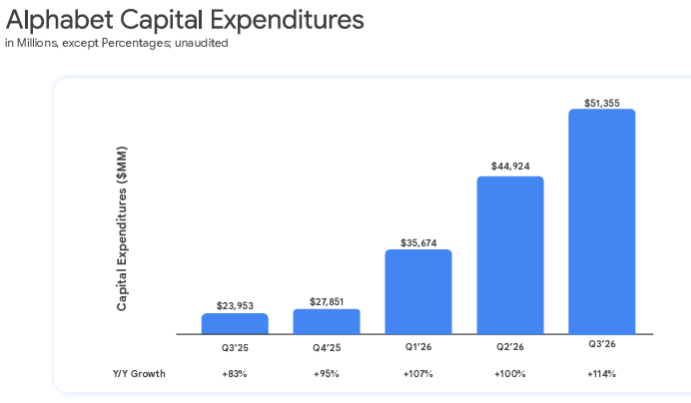
Source: Alphabet 3Q 2026 Results Presentation
Alphabet will mainly be using debt to fund this, as its long-term debt position has tripled from $47 billion in 3Q 2025 to $125 billion in 3Q 2026. Here is where I get slightly concerned. Its debt to equity ratio basically doubled from 0.09 in 2024 to 0.22 currently. While this leverage is still relatively low, there are big questions on the return on invested capital here for the company in its AI division.
Valuation-wise, the company is quite cheap now with a PER of 13.4 times compared to its historical average of 24 times (2021 to 2025). Average target price is set set $412.51 with an implied upside of about +47.6%.
Meta
Oh, Meta. Analysing this company is like throwing a dice sometimes.
I still remember the disastrous metaverse that is still bleeding cash. And now, it is pivoting towards AI to catch up with other players in the market. Meta has released its Muse Wonder in October 2026, and the model has performed relatively well compared to other peers in the market.
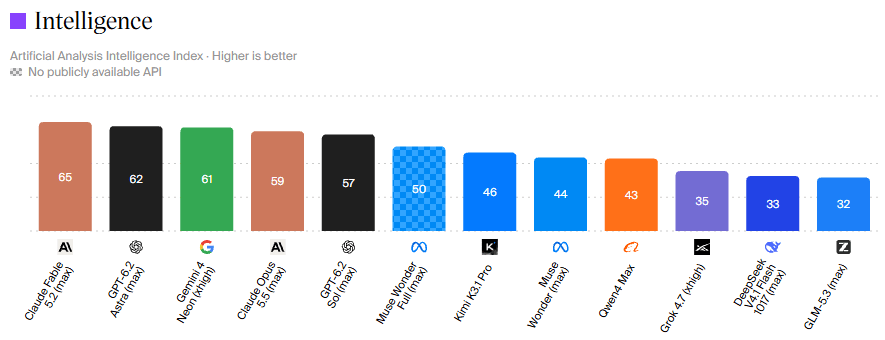
But Meta has a lot of catching up to do in terms of its AI progress. In its 3Q 2026 results, some things stood out, while others are quite bad to see.
Firstly, advertising revenue is still strong at 25.7% growth and that drove Meta’s entire topline. However, Meta was hit by a litigation fee that costs up to $19 billion. The company paid about $9.9 billion of that this quarter, and said that income from opeartions would have been at $22.9 billion. However, this still meant that income would have declined without the litigation fee.
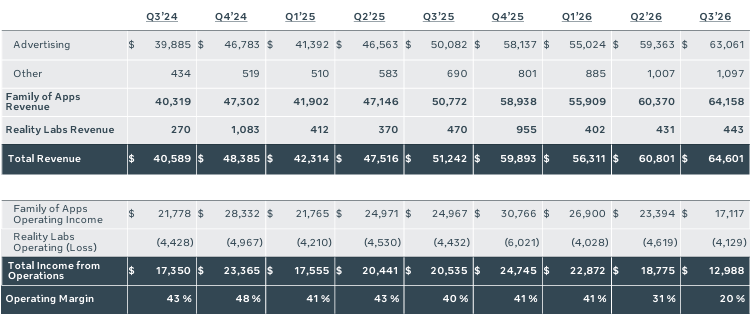
Reality Labs continue to bleed money, incurring a loss of $4.1 billion, continuing its streak of billions in losses. It has now reached $100 billion in losses with nothing to show for it. This is Mark Zuckerberg plunging even more money in a division that everyone know would not yield anything.
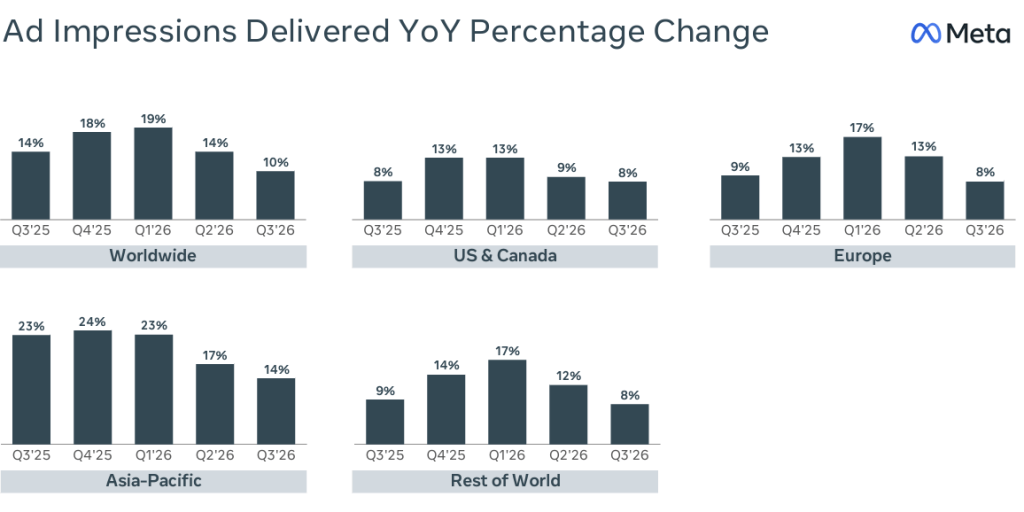
What’s more worrying is its pace of capital expenditures for the quarter. It has almost doubled that to $35 billion in 3Q 2026, and has incurred $85 billion now. I wonder how much more its advertising segment can support this type of investments. Worryingly, its operational metrics show that ad impressions growth are slowing.
And yes, 3Q 2026 free cash flow is negative at $2.1 billion. But if we take out the fine, that would have been about $7 billion, which is still lower than 3Q 2025’s $10.6 billion.
Valuation is of course, relatively cheap now at 19 times PER, but its core business is trending downwards in terms of growth which is worrying. Analysts are targetting a price of $831.61 which has an implied upside of +39.2%.

